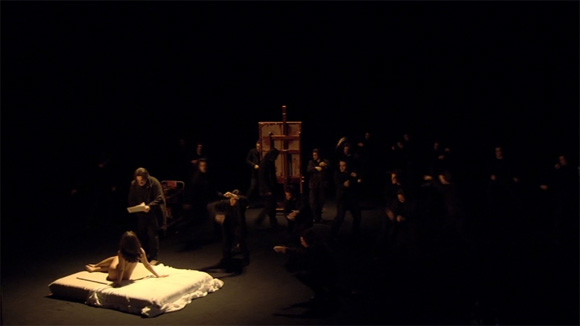
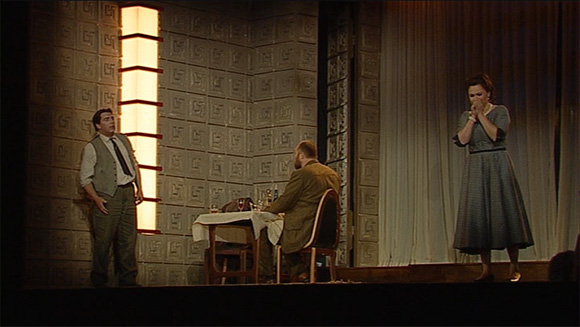
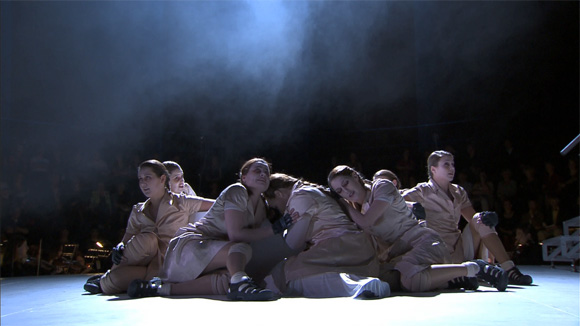
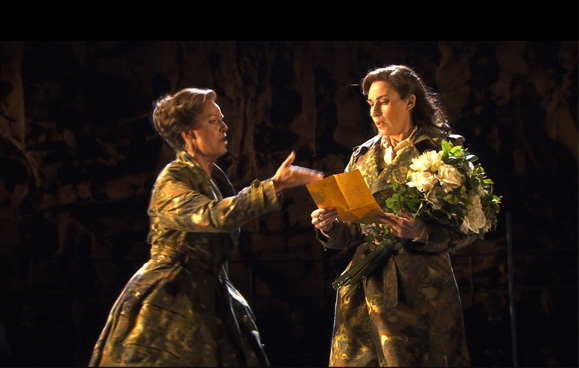
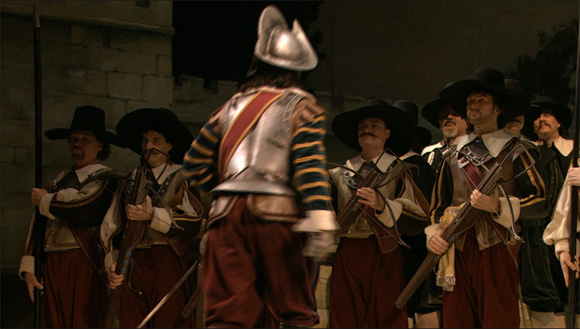
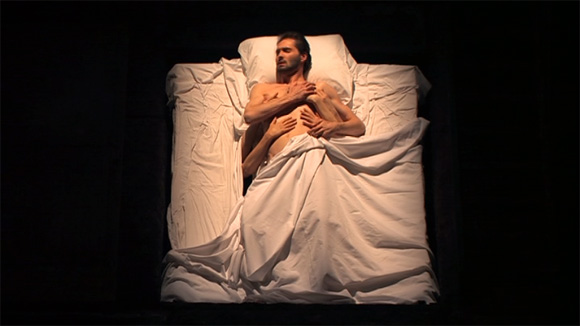
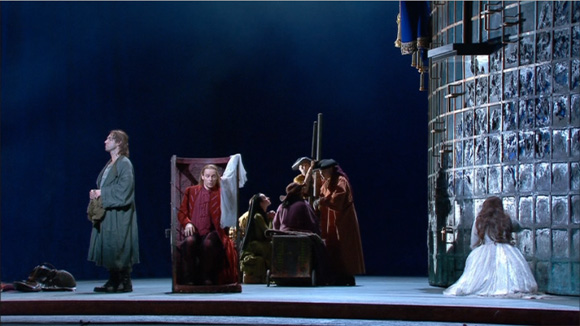
Gluck’s Iphigénie en Aulide is finally available on Blu-ray and DVD. It was staged and recorded as a double bill with Iphigénie en Tauride at De Nederlandse Opera in September 2011 in productions by Pierre Audi. It’s excellent in just about every respect. The cast is to die for, the production is interesting and so is the staging in the rather challenging space of The Amsterdam Music Theatre, which also poses problems for the video director. Backed up, on Blu-ray, by a 1080i picture and DTS-HD-MA sound it’s a pretty compelling package.
Category Archives: DVD review
Gentle Death, I embrace you
It’s 1990 and Dame Joan Sutherland is retiring. Australian Opera decide to stage Meyerbeer’s Les Huguenots as a farewell gala. In some ways it’s an odd choice as the Sutherland character, Marguerite de Valois, only appears in two of the five acts of an opera that’s rather long despite cuts. Still, as a vehicle for an ageing coloratura it’s not a bad choice. The production is by Lotfi Mansouri so there is nothing to get in the way of the plot and, by the same token, nothing much to think about. It’s also, equally characteristically, quite dark in places. Everything then rests on the performances. Continue reading
The Copenhagen Ring – Das Rheingold
This 2006 Copenhagen production of Wagner’s Ring has been written about a lot. It’s been dubbed “the feminist Ring” and a lot has been made of the frequent camera cuts and odd angles. Actually what struck me most about it was the comparative goriness. The video direction (by Uffe Borgwandt) didn’t strike me as particularly unusual. I’d say it was better edited than a typical Halvorson Met broadcast but not so terribly different in spirit. The main difference is that this is very much presented as a film rather than a documentary record of a live performance. Oddly it begins very much in live performance mode with footage of the Queen of Denmark taking her seat and of the conductor (Michael Schønwandt) complete with miniatures of his decorations on his tail coat going to the pit. From then on though we get anything but what the audience in the house saw.
1649 And All That
Bellini’s I Puritani is one of those 19th century operas that dishes out a version of 16th or 17th century English history that’s all but unrecognisable to anyone with any actual knowledge of the subject. In this case we are in Cromwell’s Commonwealth and the nasty Puritans want to off anyone with a Stuart connection including the widowed queen Henrietta. Various implausibly named Puritan colonels (everyone in the New Model apparently holds that rank) feature as well as a Royalist earl who is, of course, in love with the Roundhead commander’s daughter. Immediately prior to marrying her though he decides to save Henrietta from execution and escapes with her thus triggering the obligatory mad scene, which is probably the main reason for watching this thing at all. Finally Arturo (the earl) returns, is captured and, inevitably, sentenced to death. As he is being led to the block Cromwell’s messenger arrives with the second most improbable reprieve in all of opera. The Stuarts have been defeated and everyone is pardoned. A happy ending with fortissimo soprano high notes ensues.
A baroque rarity
Cavalli’s Il Giasone isn’t a work one sees performed often. It’s a peculiar beast. It’s about Jason and Medea and the Golden Fleece but has few of the elements of the version of the story that everone knows and everybody from Charpentier to Reimann has made into an opera. In Cavalli’s version Giasone has got Isifile, a princess of Lemnos, pregnant with twins and then gone off after the Golden Fleece. In Colchis he spends his time in bed with a mysterious local beauty, much to the disgust of Ercole who thinks he’s gone soft. Eventually Giasone works out that his squeeze is Medea and with her help defeats some monsters and grabs the fleece.
Love is stronger than death
Peter Sellar’s production of Handel’s Theodora has long been one of my favourite video recordings of opera. It’s brilliant in so many ways and I don’t think I’ve ever made it through the whole thing without tearing up. It’s now been remastered from the original tape and reissued on Blu-ray. The video and sound quality are distinctly better than previous DVD releases though not, inevitably, in the same class as the best modern recordings. It’s also still a depressingly bare bones release with no extras and minimal documentation but don’t let that put you off.
My original review is here. I thought about rewriting it but for the most part I stand by my original comments. The only judgement I’d change is that, on greater experience, I do think this is one of Handel’s best works.
Catholic kitsch
Don Giovanni is one of the most fascinating operas in part because it can be reinterpreted in so many different ways. There’s also the tension between a story with elements of murder, rape, revenge and damnation and broad humour. It’s tricky to find a balance. There’s also a decision to be made between a concept based production and a more laissez faire approach. Francesca Zambello’s production for the Royal Opera House, recorded in 2008 doesn’t really have a concept and sort of goes with the flow mixing very broad humour with lots of Catholic kitsch and some flamboyant stage effects. As a production I find it distinctly underwhelming.
Campy Clemenza
Besides the production of La Clemenza di Tito still in repertory at the Met, Jean-Pierre Ponelle also made a film of the piece. It was shot among the ruins of ancient Rome in 1980 and is one of those lip synched opera films popular in that era. The forces involved are eclectic. James Levine conducts the Wiener Philharmoniker and the Konzertvereinigung Wiener Staatsopernchor with mainly American soloists. Continue reading
Carsen’s Hoffmann riffs off Don Giovanni
Robert Carsen’s production of Offenbach’s Les Contes d’Hoffmann does a very decent job of presenting this rather muddled and overly long piece. He sets it in and around a production of Don Giovanni in which Hoffmann’s current infatuation, Stella, is singing Donna Anna. There are several quite clever DG references scattered around. By and large it works and is one of the better “theatre in theatre” treatments that I’ve seen.
Slapstick stick slapping
If you have ever wondered why a slapstick comedy is so called then look no further than Gilbert Deflo’s production of Prokofiev’s L’Amour des trois oranges recorded by L’Opéra de Paris in 2005. There’s a great deal of smacking with sticks; most of it by Barry Banks who gleefully whacks just about any bottom, male or female, that comes within range. The production is also slapstick in the generally understood sense of broad physical comedy. There are elements of commedia del arte and lots of circus; jugglers, clowns, fire swallowers, all wrapped up in a sort of 20s vamp aesthetic. It’s wildly chaotic in a rather fun way though it’s all a bit overwhelming and probably worked better in the theatre than on DVD.