Lauren Pelly’s weird, dour Tales of Hoffmann

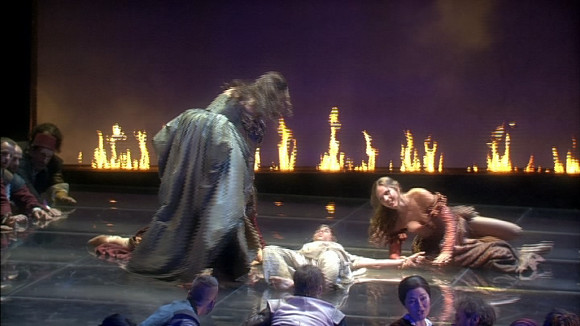
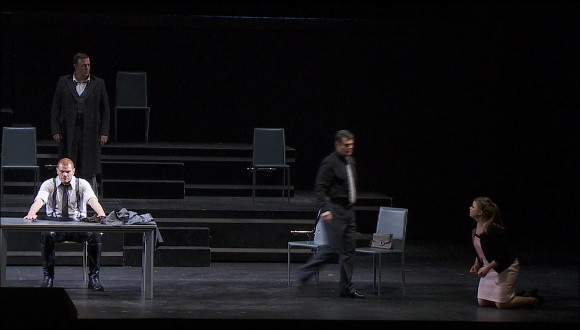
Laurent Pelly’s 2013 production of Offenbach’s Les Contes d’Hoffmann at the Liceu is one of those productions that’s a bit hard to take in at first go.  Part of it is the performing edition used (Michael Kay and Jean-Christophe Keck) which seems to have added a lot of dialogue compared to any version I’ve seen before and includes Hoffmann killing Giulietta in Act 3.  This produces a constant sense of “where they heck are we in the piece”.  It doesn’t help that the DVD package contains no explanatory material at all.  There are no interviews on the disks and the documentation is sub-basic.

1.weird Continue reading

Grumpy Otello

Verdi loved Shakespeare and tried to reflect the psychological depth of his characters in the operas he based on the bard.  You really wouldn’t know that watching the 2008 Salzburg Festival production of Otello.  There’s a lot to like in both production and performance but the emotionally monochromatic performance of the title role by Aleksandrs Antonenko, who can do every mood from fairly grumpy to furious, and the moustache twirling Jago of Carlos Álvarez rather reduce the piece to pathologically jealous nutter with anger management problem kills wife.

1.orgy Continue reading

La Grand-Duchesse de Gérolstein

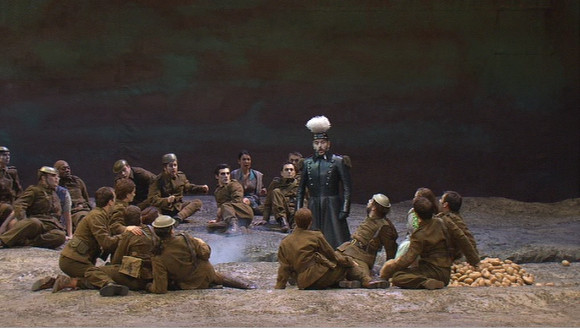
Despite a thin to non-existent plot and music that sounds like a remix of all the other Offenbach operettas, La Grande-Duchesse de Gérolstein, performed by largely French forces and recorded at the Théâtre du Châtelet in 2004 is a highly enjoyable romp.  The plot centres on the susceptibility of the Grand-Duchess to fall rather hard for younger men.  This makes it a perfect vehicle for Felicity Lott who rather seems to specialise in such roles; whether Strauss’ Marschallin or La Belle Hélène.  She’s brilliant.  She sings gorgeously except where she doesn’t want to and her comic timing is impeccable.  She’s well backed up by Yann Beuron as the young soldier Fritz who she promotes from private to général-en-chef without swaying his affections for his sweetheart Wanda sung by the irrepressible and cute Sandrine Piau.  The slapstick element is provided by François Le Roux, as Le Général Boum, Franck Leguérinet as Le Baron Puck and Eric Huchet as Le Prince Paul who are set on getting the Grand-Duchess to marry Paul even if it means murdering Fritz.  They get lots of up tempo numbers that sound as if they are singing a Korean restaurant menu.

1.boum
Continue reading

The Solti show

The recording of Richard Strauss’ Die Frau ohne Schatten made at the Salzburg Festival in 1992 is very much Sir Georg Solti’s show.  The conducting is superb and the Vienna Philharmonic, of course, respond for Solti.  From the opening, shattering cords through the various orchestral interludes to the final ensemble and chorus Solti is utterly convincing in his command of tempi and dynamics.

1.ammekaiserin Continue reading

Puzzling Genoveva from Zürich

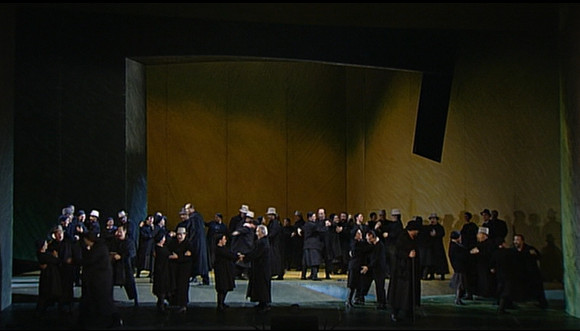
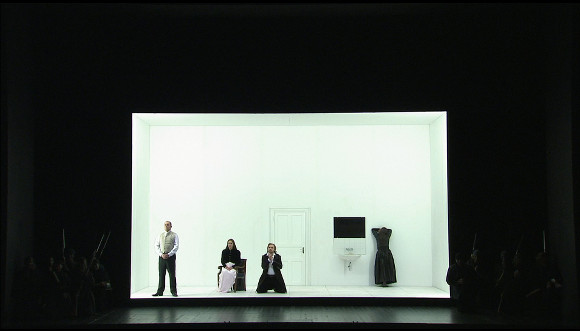
Schumann’s Genoveva is a rarity. It premiered in 1850 and quickly slipped into obscurity.  Recently it has been championed by Nikolaus Harnoncourt who has gone so far as to call it “the most significant opera of the second half of the 19th century”; a slightly eye popping claim.  So what’s it about?  On the face of it it’s a pretty typical German opera of the period, set during the wars against the Moors in Spain.  Siegfried (Graf in the libretto but mysteriously translated as Duke in the disk subtitles) is recently married but must lead his men off to the war leaving behind his young, beautiful, pious and virtuous bride Genoveva. He leaves Golo; a knight but a bastard so apparently not OK for active service, to guard his lands and wife.  Golo has the hots for Genoveva but when she rejects his advances he concocts, with the aid of a witch, a plot to make it appear that she’s having an affair with an elderly retainer.  She’s locked up by the servants and word is sent to Siegfried; returned from Spain but recovering from wounds in Strasbourg, of what has transpired.  He gives Golo his sword and ring and tells Golo to kill Genoveva.  Instead Golo tries to get her to run away with him but she refuses and he disappears.  The servants too are happy enough to humiliate Genoveva but pretty slow about killing her.  This gives time for Siegfried to arrive, having learnt of his wife’s innocence, and save the day.  All sing a hymn of praise to God.  Along the way there’s a magic mirror, a ghost, a magic potion and a whole lot of cloying sentimentality and piousness.
1.quartet Continue reading

A weirdly eclectic Fidelio

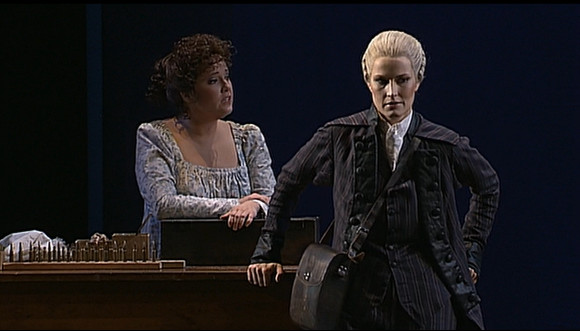
I’m really not sure what to make of Jürgen Flimm’s 2004 production of Fidelio for the Zürich Opera House.  It’s not offensive and it doesn’t really get in the way of the story but it seems quite devoid of originality beyond mixing styles in a way one might describe as anachronistic if one could figure out when synchronistic would be.  Rocco wears a sort of frock coat with, apparently, goatskin pants, Marzellina’s dress looks probably 20th century, bolt action magazine fed rifles are apparently muzzle loaded and metal cartridge cases filled by hand.  Then to cap it off when Don Fernando shows up he looks like he’s stepped straight out of a Zeffirelli production of Der Rosenkavalier.  So “nul points” for coherence.  For once one rather appreciates that so much of the action takes place in the dark.

1.marzfid Continue reading

Abstract Freischütz

Nikolaus Harnoncourt has long been one of my favourite conductors, particularly for pieces that require a strong sense of period.  The same goes for the wonderful Zürich Opera House Orchestra who, uniquely as far as I know, can change up their instruments to suit the piece.  For Weber’s Der Freischütz, recorded in 1999, they use valveless brass but, as best I can tell, modern woodwinds and it all sounds great especially in the many hunting scenes.

1.chorus Continue reading

Gounod’s Mireille

Gounod’s Mireille is a bit of a rarity and with good reason.  It’s got everything that modern audiences find hard to take in 19th century French opera.  It’s revoltingly wholesome with a bit of the supernatural, some patriarchal nastiness and a whole lot of Catholic schmaltz thrown in culminating in a final scene where the dying heroine (of course the heroine dies!) is carried off to heaven by angels while everybody else is suitably pious.  It also has some pretty good tunes and a fiendishly difficult soprano lead part.

1.cornfield Continue reading

Weint! Weint! Weint! Weint!

Aribert Reimann’s Lear is a pretty good example of how to create a thoroughly modern opera within a thoroughly traditional framework.  It’s a classic story of course.  Here librettist Claus Henneberg has taken the classic German translationof the Shakespeare play and condensed it in a highly intelligent fashion; retaining all the emotional drama while sacrificing some fairly peripheral narrative.  Reimann’s score is modern though not strictly twelve tone.  He creates a distinct musical voice for each character; speech/Sprechstimme for the Fool, weird coloratura for General etc. This is reinforced by many of the characters having a tone row that serves as a sort of leitmotiv.  Atonality and quarter tones are used for varying effects from the violence of the Blasted Heath scene; apparently inspired by the composer’s experience, as a nine year old, of the bombing of Potsdam, to the shimmering, ethereal quarter tones of Lear’s final monologue.  For anyone with even a vague tolerance for “modern” music it’s a fascinating listen.

1.learcordelia Continue reading

Eine Frau von Heute

I don’t usually associate Arnold Schoenberg with comedy but he did write a one act comic opera Von Heute auf Morgen which premiered in 1929.  It was an attempt to cash in on the vogue for satirical operas on modern themes characterised by Brecht and Weill and , if a bit slight and lacking Brechtian punch, it works well enough.  A bourgeios husband and wife have returned from an evening out where they have met an iold friend of the wife who has become something of a femme fatale.  There’s also a singer, inevitably a tenor, involved.  The husband is rabbiting on rather gormlessly about the charms of the “other woman” so his wife decides to teach him a lesson.  She apes the manners of a “modern woman”, neglects their child, plans assignations etc.  There’s a long phone conversation inwhich the “friend” and the singer invite them back to the bar.  By now the husband is beginning to realise what he stands to lose.  The wife realises she has won.  The other couple show up and there’s a “modern” vs. “traditional” quartet after which the “moderns” leave in disgust and the husband and wife revort to bourgeois domesticity.

1.couch Continue reading