All girls like honey wine

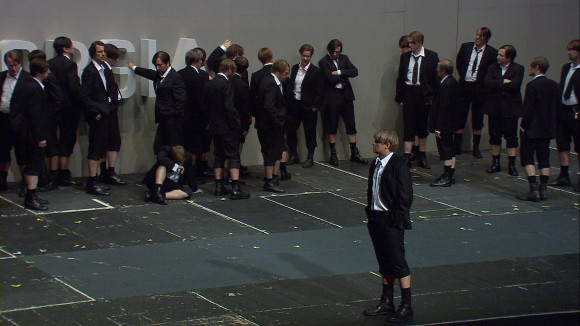
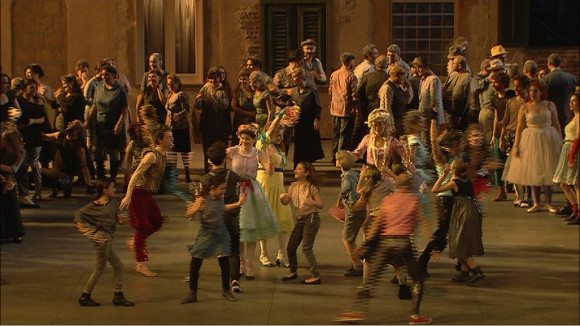
Richard Strauss operas do tend to have somewhat weird plots but perhaps none more so than his early and seldom performed piece Feuersnot.  We are in mediaeval Munich on St. John’s Eve when apparently large bonfires and, one suspects, other things, are traditional.  The children are gathering firewood and the magician Kunrad is stalking the mayor’s daughter Diemut.  To her, apparent at least, disgust and the scandal of the townspeople, he kisses her.  She gets her revenge by pretending she’s going to winch him up to her room but leaves him stranded halfway where he is mocked by the other girls.  He calls on the spirit of his mentor, an even greater magician, to help him extinguish all the lights and fires in the town.  This bit is very Wagnerian because who was mistreated by the people of Munich?  And who is his equally mistreated heir?  You’ve got it in one right?  Anyway, the townspeople rather whimsically persuade Diemut that it’s her maidenly duty to get the lights turned back on.  After all, people have sacrificed a lot more than a quick shag to the needs of the energy industry.  All it’s missing is a wordly crustacean really.
1.crowd

Continue reading

Wozzeck in Moscow

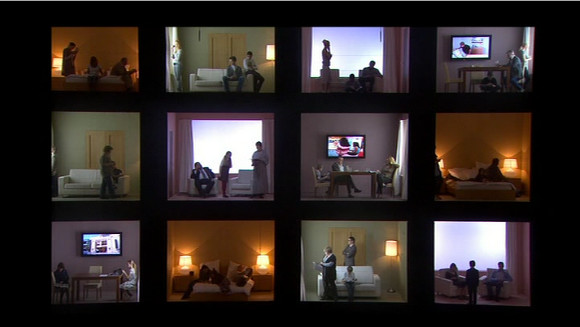
In 2010 Berg’s Wozzeck was produced in Russia for the first time since 1927.  The production, at the Bolshoi, was directed by Dmitri Tcherniakov.  Few people familiar with his work will be surprised to learn that Tcherniakov does not see Wozzeck as a  down trodden and impoverished soldier.  In fact he doesn’t see him as downtrodden and impoverished at all (unlike, say Calixto Bieito who transplants the action to a chemical plant but leaves the power relationships pretty much intact).  Rather, Wozzeck is a sort of 21st century salaryman leading a life of modest prosperity but crushing boredom with Marie and their son in a city inhabited entirely by other such families.  What’s missing is anything that resembles sensation or “life”.

1.calendar

Continue reading

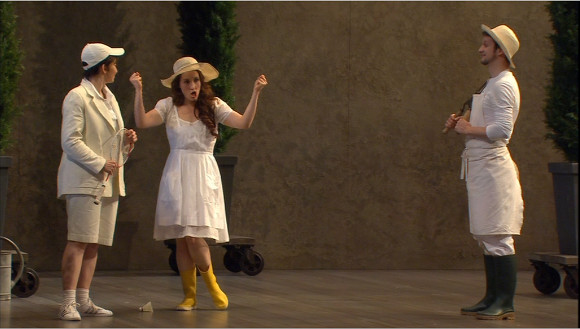
La finta giardiniera in glorious white and white

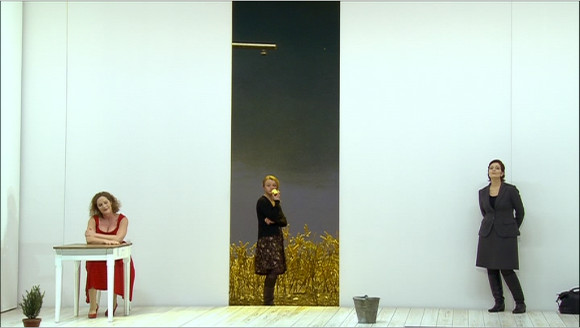
Mozart’s La finta giardiniera is pretty thin stuff.  The libretto is dreadful.  The fits of madness start before the opera gets going when Count Belfiore tries to murder his fiancée Marchioness Violante.  She runs off and becomes a gardener aided by her man-servant Roberto.  There’s another gardener, Sarpetta, who is being wooed by Roberto (alias Nardo) and Violante’s (now Sandrina) boss the mayor has a niece, Arminda, who now plans to marry Belfiore to the dismay of her former lover Ramiro.  And along the way the mayor, Don Anchise, gets the hots for Sandrina.  Throw in a whole lot of confusion about Sandrina/Violante’s identity (because she keeps claiming that she’s not Violante or is just pretending to be Violante depending who she is talking to) and it’s no wonder that everyone goes mad at least once.  Frankly the audience has every right to as well.  And there’s three hours of this.  The music is OK.  It’s Mozart at 18 and he’s writing to a formula most of the time.  So we get workmanlike but predictable arias and ensembles that only occasionally hint at what is to come in the later operas.

1.sandrina

Continue reading

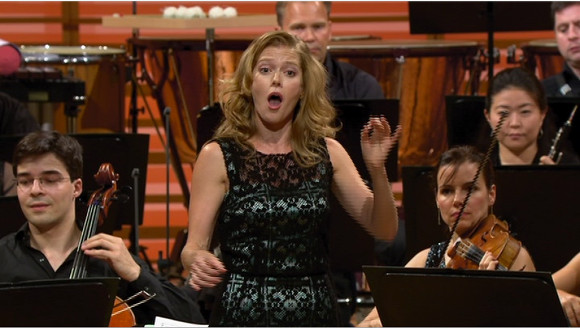
Barbara Hannigan – Concert Documentary

The Hannigan obsession continues.  This time I’ve been looking at a DVD, Barbara Hannigan – Concert Documentary.  It’s in two parts.  There’s a recording of Hannigan as soloist and conductor with the Mahler Chamber Orchestra at the 2014 Lucerne Festival and there’s a documentary, I’m a creative animal, looking at her life and work.

1.conducting

Continue reading

Making sense of La Sonnambula

I’m not a huge bel canto fan so it’s probably no surprise that I had, previous to this DVD, only seen Bellini’s La sonnambula once.  That was in Mary Zimmermann’s messy production at the Met which had left me with the impression that it was a rather feeble comedy with formulaic music and not much improved by Zimmermann’s attempts to sex it up.  I did wonder if it might be improved by the full on Regie treatment and so I was quite happy to have a chance to see the DVD of Jossi Wieler and Sergio Morabito’s 2013 Stuttgart production, especially as it had played to significant critical acclaim and won a bunch of awards.  I was surprised and impressed.  Far from being a cavalcade of extraneous elements (the usual charge levelled at Regie), this production probed the libretto and the source materials in a highly intelligent way to produce something really rather moving.  The music is still what it is; tuneful, well crafted but hardly deep, but there you go.

1.inn

Continue reading

The Devil it is

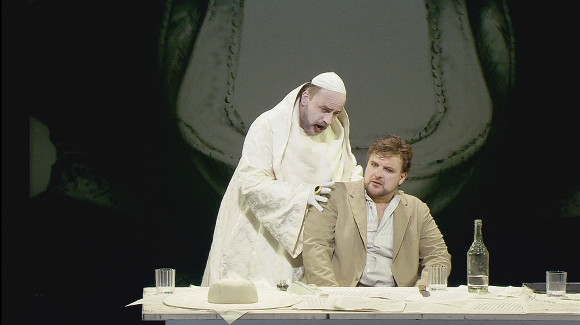
Boito’s Mefistofele is a rather odd work.  It’s truer to the original Goethe than other operatic versions of the Faust legend which means it’s very episodic and focuses on the Faust/Mefistofele relationship rather than on Margherita.  In fact she’s dead with an act and an epilogue still to go.  It’s hard to categorize musically too.  Some parts are rather bombastic, vulgar even, yet at other times we seem to be drifting into bel canto territory.  So it’s a bit uneven; listenable enough but not very memorable.

1.mefistofele

Continue reading

I Capuletti e I Montecchi

The story line for Bellini’s opera I Capuletti e I Montecchi will be familiar enough though it’s very condensed and based on the earlier source by Bandello rather than Shakespeare’s more elaborate reworking.  So, lots of feuding but no back story, no balcony scene, no friar’s cell.  But (spoiler alert) the ending is the same.  Vincent Broussard’s production, originally from Munich but filmed in San Francisco in 2012, sets the work around the time of its composition and seems at times to reference that it was composed for the Venice Carnivale.  It also veers around between being quite literal and trying to make the story something going on in Romeo’s head.  The production is quite influenced visually by the fact that the costumes were designed by Christian Lacroix and it’s unclear whether he’s trying to support the production concept or promote his brand.

1.saddles

Continue reading

We the sheeple

Calixto Bieito’s production of Mussorgsky’s Boris Godunov recorded at the Bayerische Staatsoper in 2013 is, unsurprisingly, strong stuff.  The central concept is that the political classes “don’t give a fig” for ordinary people and that’s as true , or truer, now than in early modern Russia.  In such a world, where the people are manipulated into acting as their “betters” demand, is it possible for a person like Boris, who has risen to supreme power through manipulation and violence, to have a conscience?

1.placards

Continue reading

Phantom of Lilith

Krzysztof Warlikowski’s production of Berg’s Lulu (it’s the three act version with the Cerha completion) recorded at Brussel’s La Monnaie in 2012 is so stuffed full of symbolism it’s really hard to fully unpack.  There’s a sense that Lulu represents Everywoman, for some rather twisted definition of “woman”.  She’s Lilith.  She’s Pandora.  She’s the Black Swan and the White Swan.  She’s lost or corrupted childhood and she’s love gone wrong.  Maybe she’s even the phantom of Berg’s estranged daughter.  All these symbols recur again and again in various combinations.  In fact, on DVD, it’s pretty much impossible to keep track of them.

1.point Continue reading

La Comtesse Cecilia

Rossini’s Le Comte Ory is extremely silly.  It’s a crazy, gender bending romp with no real substance but plenty of rather crude humour and good tunes.  I suspect it’s beyond the wit of any director than do more than make sure the mad cap elements are mad enough but one is, I suppose, bound to try.  For their 2012 production in Zürich, Moshe Leiser and Patrice Caurier chose to set the piece in immediately post war France.  It works well enough and allows for a few visual gags but it doesn’t really add much to the piece.  Nor, though, does it detract.

1.caravan Continue reading