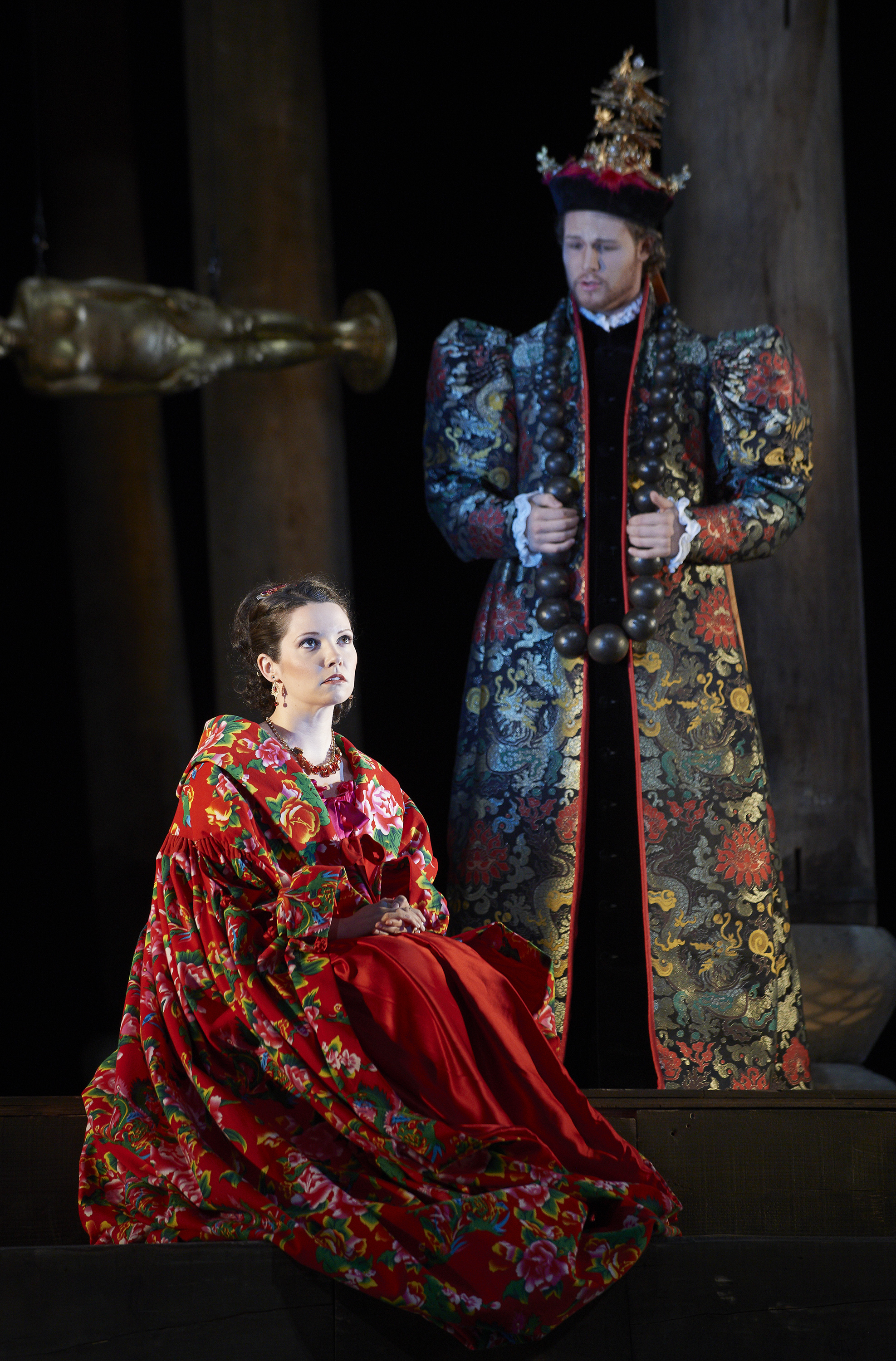
One of the early Metropolitan Opera Live in HD broadcasts was a 2007 showing of Robert Carsen’s 1997 production of Tchaikovsky’s Eugene Onegin with Dmitri Hvorostovsky and Renée Fleming. It was subsequently released on DVD and Blu-ray by Decca and remains one of the most successful disk releases spawned by the broadcasts.
Author Archives: operaramblings
Thoughts on the Metropolitan Opera Live in HD series 2012/13
The Metropolitan Opera has announced the HD broadcast line up for next season. Here it is with my entirely objective and unbiased comments.
Donizetti’s L’Elisir d’Amore New Production – October 13, 2012
Cond – Maurizio Benini, Dir – Bartlett Sher, Cast – Anna Netrebko, Matthew Polenzani, Mariusz Kwiecien, Ambrogio Maestri
Bartlett Sher? Again? Clearly Gelb’s “Broadway show of the year” (one of them, anyway). Probably worth seeing for the cast who are capable of being funny in the drabbest production.
Verdi’s Otello – October 27, 2012
Cond – Semyon Bychkov, Dir – Elijah Moshinsky, Cast – Johan Botha, Renée Fleming
Well we are not going to see much acting here. Probably one to stay home and listen to on the radio,
Adès’s The Tempest Met Premiere – November 10, 2012
Cond – Thomas Adès, Dir – Robert Lepage, Cast – Simon Keenlyside
Probably the highlight of the season. A must see.
Mozart’s La Clemenza di Tito – December 1, 2012
Cond – Harry Bicket, Dir – Jean-Pierre Ponnelle, Cast – Elīna Garanča, Giuseppe Filianoti, Barbara Frittoli
Is this production any good? I’ll probably go but I’m not as excited about this as I am about seeing Michael Schade in Christopher Alden’s production in February.
Verdi’s Un Ballo in Maschera New Production – December 8, 2012
Cond – Fabio Luisi, Dir – David Alden, Cast – Marcelo Álvarez, Karita Mattila, Dmitri Hvorostovsky, Kathleen Kim, Stephanie Blythe
This looks promising. On the list.
Verdi’s Aida – December 15, 2012
Cond – Fabio Luisi, Dir – Sonja Frisell, Cast – Liudmyla Monastyrska, Roberto Alagna, Olga Borodina
I’d quite like to see Monastyrka but I’d rather gouge my eyes out with a spork then watch this dreadful old production again. Thank you CBC Radio.
Berlioz’s Les Troyens – January 5, 2013
Cond – Fabio Luisi, Dir – Francesca Zambello, Cast – Deborah Voigt, Susan Graham, Marcello Giordani, Dwayne Croft
I have my doubts about Debbie as Cassandra but this is definitely worth a look.
Donizetti’s Maria Stuarda Met Premiere – January 19, 2013
Cond – Maurizio Benini, Dir – David McVicar, Cast – Joyce DiDonato, Elza van den Heever
Can McVicar raise his game to a higher level than his rather dismal Anna Bolena? Worth going to see probably.
Verdi’s Rigoletto New Production – February 16, 2013
Cond – Michele Mariotti, Dir – Michael Mayer, Cast – Piotr Beczala, Željko Lucic, Diana Damrau
Another of Gelb’s Broadway buddies takes a crack at opera. It’s been such a successful strategy after all. The bland leading the bland?
Wagner’s Parsifal New Production – March 2, 2013
Cond – Daniele Gatti, Dir – François Girard, Cast – Jonas Kaufmann, Katarina Dalayman, Peter Mattei, Evgeny Nikitin, René Pape
Fabulous cast! This is a co-pro with Opéra de Lyon and the COC so (a) the reviews from Lyon will be in before we have to decide and (b) I’ll eventually get to see it in Toronto. Still, that cast…
Zandonai’s Francesca da Rimini – March 16, 2013
Cond – Marco Armiliato, Dir – Piero Faggioni, Cast – Eva-Maria Westbroek, Marcello Giordani are the doomed lovers.
This is a new piece for me. Curiosity calls.
Handel’s Giulio Cesare New Production – April 27, 2013
Cond – Harry Bicket, Dir – David McVicar, Cast – David Daniels, Natalie Dessay
New production? This is the Glyndebourne production set in 19th century British occupied Egypt complete with red coats, kilts etc. It’s available on Blu-ray and DVD with a stronger cast (Connolly/de Niese) and period instruments. The Blu-ray has better production values than any MetHD broadcast I’ve ever seen so go buy that instead.
Bottom LIne
Yes: The Tempest, Un Ballo in Maschera, Les Troyens, Maria Stuarda, Parsifal, Francesca da Rimini
Maybe: L’Elisir d’Amore, La Clemenza di Tito
Not a chance: Otello, Aida, Rigoletto (is there a pattern here?), Giulio Cesare
L’Amour de Loin on DVD
I put off watching Saariaho’s L’Amour de Loin on DVD until after the run at the Canadian Opera Company because I didn’t want to prejudge the piece. Now, having seen it live twice and listened to Kent Nagano’s Berlin CD recording it seemed like time to look at the DVD. The DVD is of the original Salzburg production directed by Peter Sellars but it was recorded at Finnish National Opera in Helsinki. It features the original cast of Gerald Finley (Jaufré Rudel), Dawn Upshaw (Clémence) and Monica Groop (Pilgrim). Esa-Pekka Salonen conducts with the Orchestra and Chorus of Finnish National Opera. If you are unfamiliar with the piece you might want to check out my review of the COC production which gives a plot summary etc.
The production concept is simple enough. At each side of the stage is a spiral tower representing Jaufré’s castle in Blaye and the Citadel in Tripoli. The towers stand in a lake which the Pilgrim traverses in a sort of crystal boat. It’s simple and effective but much less spectacular than Daniele Finzi Pasca’s production seen at COC. Colour is used to symbolise the two sides and the journey; blues and greens for Blaye, reds and oranges for Tripoli and black and white for the journey. In typical Sellars style there is a fair amount of stylized and elaborate gesturing. It all seems to work pretty well.
The performances are excellent. All three singers have complete mastery of their parts and can act vocally as well as sing. Some of the acting is a bit overwrought but I think that’s Sellars. At key moments, and especially in the beautiful final scene, this very intense approach works much less well than the more understated approach taken in Toronto which seems more at one with what the music is doing. The Orchestra and, off-stage, chorus are just fine. Salonen has worked a lot with Saariaho and knows what’s required.
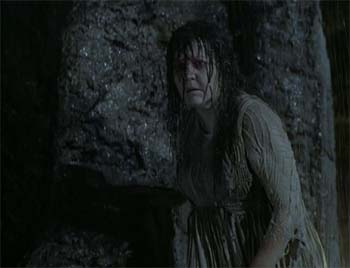
Where I have serious reservations with this recording is the video direction. Sellars directs this himself and like his Nixon in China Met HD broadcast it’s really quite bizarre. All video directors use close ups. Most use too many of them. Sellars takes this to extremes with bizarre partial face shots or body extremities filling the whole screen. Coupled with the exaggerated acting style, which might just be OK at a distance, this makes for a very overwrought effect that is at serious odds with the music. I’ve included four entirely typical screen caps at the end of the post to show what I mean.
Technically the disk is OK. The picture is European TV quality 16:9. One might have expected a little better for a 2004 disk. The sound is decent DTS 5.1 (Dolby 5.1 and PCM stereo alternatives). It’s quite vivid though I think the voices are balanced artificially forward. Documentation is pretty decent and the subtitle options are English, French, German and Spanish. There are very informative interviews with Sellars, Saariaho and Salonen that are all well worth watching. This is the only DVD of the piece and it’s pretty adequate. I wish someone would film Daniele Finzi Pasca’s production though.
OK, here are some screen caps of close ups. These are not cropped. This is the screen you see watching the DVD.
Zambello’s Carmen
Francesca Zambello’s Carmen for the Royal Opera House has more going for it than is immediately apparent. On the face of it it’s a very traditional, conservative production; period costumes, literal sets, hordes of kids in Acts 1 and 4, live animals, but a close look reveals rather more. Zambello reveals her intentions during the overture where we see a manacled, distraught Don José dragged to execution by a masked executioner. This is going to be Don José’s story rather than one that focuses almost exclusively on the title character. What we see here is a stark contrast between what Don José really wants; respectability, an obedient wife, conformity with the Church, honour and what key choices, accidents and conflicts drive him to; criminality, liminality, execution and, we may suppose, damnation. The staging subtly highlights each of the key moments in Don José’s descent; his arrest and demotion in Act1, the fight with Zuniga in Act 2 and the realisation, in Act 3, that Carmen will never be the women he really wants reinforced by Micaëla’s aria that ironically offers him the choice he can no longer make and does so unmistakeably in terms of Catholic eschatology. There is so much more going on here than a sexy woman and some pretty tunes.

Red beret?
It’s funny how one can see a work many times but miss what may or may not be an important detail. I just watched the first act of Carmen for the umpty-umpth time and heard something the significance of which had never struck me before. There’s an exchange between Zuniga and José quite early on that goes roughly as follows:
Zuniga: Vous êtes Navarrais?
José: Oui, et un bon Chrétien!
Are we being told that José is a Carlist; for what else could a Navarrese of respectable peasant stock who draws attention to his religion be in such an era? Is so, what are we to make of it? Is this an additional deliberate signifier of the gulf between respectable, pious, legitimist José and bohemian, pagan, anarchist Carmen?
Or am I just making a sierra out of a molehill or stating the blindingly obvious? Whatever I find it odd that I missed that detail on all previous watchings.
Die Fledermaus auf München
I didn’t really feel that the Mörbisch production of Die Fledermaus was giving me the reference point I needed. The Dalek BDSM ballet and Russian roulette certainly suggested that it was a production with ideas, albeit not terribly coherent ones and a baseline was what I was after. Fortunately the answer was at hand. Surely an Otto Schenk production could be virtually guaranteed to be free of ideas and his 1987 production for the Bayerischen Staatsoper was conveniently to hand. What’s more it’s conducted by Carlos Kleiber so I expected good things musically.
The production is typical Schenk. It’s very opulent; big on stuff, short on ideas. It would go down well at the Met. The only real interpolation is incorporating the Donner und Blitzen polka as a ballet number in Act 2 (which turns into something really a bit bizarre that looks like it might have happened at the Drones’ Club dinner dance) and the updating of a few of Frosch’s gags in Act 3. The transition from ballroom to dining room is carried out by means of a rotating stage, to the applause of a rather easily pleased audience. There’s really nothing much else to say about it.
Musically this performance is very high quality and much more operatic than the other production. The quality is apparent from the first few bars of the overture where Kleiber’s command of this material and his ability to inspire the orchestra is very clear. He’s backed up by a pretty heavy duty singing cast. Eberhard Wächter is Eisenstein, Benno Kusche is Frank and Pamela Coburn is Rosalinde which is pretty heavy duty casting and very effective. Even the roles which might get more operetta type voices are quite heavily cast. Adele, for instance, is sung by Janet Perry who seems to have a biggish voice for the role though she floats lightly enough through the coloratura passages. Similarly the Alfred of Josef Hopferweiser and the Falke of Wolfgang Brendel are full on operatic voices. Orlofsky is cast to a mezzo, Brigitte Fassbaender, and her voice suits the music much better than a counter-tenor’s does. So, solidly good singing across the piece and it’s backed up by good acting. Frosch, here is played by German TV actor Franz Muxeneder and he’s actually quite funny and not too over the top. So, all in all, a satisfying traditional performance which is pretty much what I was after.
The DVD isn’t so great in many ways. The sound is good. I listened using the DTS 5.1 track which is a remix using DG’s AMSI II technology of the original stereo recording. It’s very vivid and quite spacious. There are also Dolby 5.1 and PCM stereo options. The 4:3 picture is typical of 1980s TV recordings. It’s very soft grained and lacks definition. There are English, French, German and Chinese subtitles and a bilingual French/English booklet with a synopsis, cast listing and chapter listing. The only extra is a trailer focussed on Carlos Kleiber.
The main problem with the disk is the video direction. It’s the work of Brian Large whose quirks seem to be exacerbated by the Schenk approach. Schenk puts lots of “stuff” on stage; tons of furniture, chorus, dancers and supers all over the place and then Large focusses in on a head shot or an upper body shot which, inevitably, has all sorts of distracting background whirling in and out of shot. He also does something I’ve never seen before; he films the conductor while there is singing going on on stage. I know appearances by Kleiber were pretty rare but that’s just ridiculous.
I really must contrive to get hold of the recent Glyndebourne version of this work. It sounds like it should be much better.
Die Fledermaus auf Mörbisch
Johann Strauss’ Die Fledermaus is a work I know next to nothing about beyond it being an operetta and one that tends to be used for gala events with lots of interpolations, star turns and updated dialogue. Since in a few months time I shall be seeing a new production by Christopher Alden I figured I had better try and establish some sort of reference base from which I might be able to figure out what Alden was getting up to.
First up in my research project ids a 1996 production from the Seefestspiele Mörbisch. Since this festival claims to be the operetta capital of the world and is only 60km from Vienna I thought it might be along the lines of going to Stratford to see Shakespeare. The Seefestspiele is situated on the banks of the Neusiedler See and features a 6000 seat “audience park” overlooking a very large stage/set actually on the lake so obviously it’s not a normal opera house setting. In this production by Elmar Ottenthal the huge area available is used to stage the big set pieces in Act 2 but otherwise a very restricted area of the stage is used for the main action. There seems to be quite a lot of background business in Act 2 but the video director (Georg Madeja) rarely lets us see it.
The production starts off feeling like an old fashioned musical comedy and pretty much stays that way through Act 1. In Act 2 it takes a slightly weirder turn. There are some very strangely costumed characters wandering around Orlofsky’s ballroom and the ballet is a strange mixture of Swan Lake, a fetish club, Disney Cavalcade of Lights and Daleks with Christmas lights. It’s not very interesting choreography since the one decent dancer (Marion Rainer playing Ida) spends the entire scene on a silver platter held up by several strapping fellows in scraps of leather while their team mates aim bull whips at her rather ineffectually. Also the Skovakian Folk Dance Ensemble SLUK puts in an appearance for no obvious reason. Act 3 is dominated by the Jailer, Frosch, played by one Thaddäus Podgorski. He is apparently a TV personality so the audience find his every gesture hilarious even if it’s all about as sophisticated (and funny) as Benny Hill. The whole thing feels a bit disjointed as a result. Here’s a clip showing the rather weird ballet:
The singing and acting is pretty good if very varied in style. The Alfred of Tomas Lind is very much a light musical theatre type voice and he rather camps up the “anyone for tennis” approach.i Ute Gfrerer’s Adele is a typical soubrette soprano. She’s got a pleasant voice, her colotura is lively and accurate and she acts very well. The genuine operatic component is supplied by Peter Edelmann as Eisenstein and Silvana Dussmann as Rosalinde backed up by Waldemar Kmentt as the prison governor. All three are solid opera professionals if not exactly international stars and they all sing and act very well. Edelmann is surprisingly athletic while Dussmann comes across as very much the diva. Orlofsky is played by a counter-tenor, Artur Stefanowicz. I didn’t much like his rather thin toned voice or stiff acting and I’m not convinced that there is any good reason not to use a mezzo in the role. Rudolph Bibl conducts the Symphonie-Orchester Burgenland and the Chor der Seefestspiele Mörbisch. It’s not the most demanding score in the world and it all sounds fine.
The disk quality is OK for the period. It’s a 4:3 picture that doesn’t have enough resolution to carry the long shots which pretty much forces the video director to get in close. Sound is adequate Dolby 2.0. It places some off screen voices rather well but isn’t especially lively. Subtitles are English only and there’s a basic English/German booklet.
Dull Tamerlano
Handel’s Tamerlano cries out for a Regie approach because it’s basically boring. The motivation of the characters is so oddly straightforward that the plot(1) seems inevitable right up until the utterly implausible ending and character development is all but impossible. Unfortunately Regie is exactly what we don’t get in the 2001 production of the work from the Halle Handel Festival. Jonathan Miller directs and attempts to convey the story in an entirely straightforward way with the barest minimum of support. The very small stage is furnished with a couple of screens and a chair/throne. The brightly dressed characters (costumes by Judy Levin) basically wander about and sing. Any drama is entirely dependent on the acting ability of the cast, which varies. Tom Randle as Bajazet acts rather well throughout and Anna Bonitatibus is a fiery Irene (complete with a riding crop which she shows every sign of being willing to use and thus provides the obligatory Handel opera BDSM reference) but Elizabeth Norberg-Schulz as Asteria, although very easy on the eye, seems capable of no more than stock gestures from the Dummies Guide to Baroque Acting. Graham Pushee is a bit better as Andronico but his simpering acting coupled with being a fairly “thin” counter-tenor does come off as a bit effeminate. Maybe the worst acting of the lot comes from Monica Bacelli in the title role. She is a sort of low energy Snidely Whiplash (with Snidely like moustache) and manages exactly one emotional register and no hint of menace from beginning to end. The whole thing feels like a rather dull semi-staged performance.
As to the music, one has to say that the playing and singing are very good. Everybody can do what’s needed and there are some interesting variations on the normal “voice” one hears in Handel. Randle and Bonitatibus in particular can sound quite dramatic. Trevor Pinnock conducts the English Concert so no problems there. The problem is the music itself. It’s horribly unvarying. The first two hours plus go by in a series of reciitatives and da capo arias at what seems to be a constant andante soporifico. The first lively number comes well after the two hour mark and is so surprising I jumped out of my chair. It finishes a little stronger with a couple of pleasant duets and the obligatory closing ensemble but this really is not Handel at his best.
Helga Dubnyicsek is the video director. She really doesn’t have much to work with so, for once, the succession of close ups, angle changes and dissolves seems almost a relief. The picture is 16:9 and normal DVD quality. The sound is Dolby 5.1 (LPCM stereo option) and is pretty decent though not as vivid as some more recent releases. Subtitles are English, French, Spanish and Japanese. There’s an interesting subtitle option called “Score plus”(2) which projects the score onto a faded out picture of the action. There a couple of bonus interview features.
There is one other video version of Tamerlano available. It’s from Madrid with Placido Domingo as Bajazet and it’s available on DVD and Blu-ray from Opus Arte. I think it will be a long time, if ever, though before I sit through this one again.
fn(1) Bajazet, formerly Ottoman emperor has been captured by the Tartar leader Tamerlane. Bajazet hates Tamerlane unreservedly because (a) he won and (b) he sees him as a lower class usurper. Bazajet spends most of the opera wishing he was dead but only manages to poison himself right at the end. Bajazet has a daughter, Asteria, who hates tamerlane because that’s the filial thing to do. Asteria is betrothed to Andronucus, a Greek client king of Tamerlane.
Tamerlane is betrothed to the Greek princess Irene but decides, for unspecified reasons, that he wants to marry Asteria instead and palm Irene off on Andronicus. There are multiple misunderstandings as Asteria appears to go along with this while really intending to kill Tamerlane. She makes two hamfisted attempts to do so which don’t seem to bother Tamerlane as much as attempted murder of a head of state usually does. Finally Bazajet poisons himself which (why?) causes Tamerlane to repent. Tamerlane marries Irene, Asteria marries Andronicus and the obligatory triumphal ensemble is sung.
fn2 This is what “Score plus” looks like:
We’ve already got one you see
Leslie Barcza has spotted some interesting information about the Canadian Opera Company’s involvement with the Lyon/Metropolitan Opera Parsifal. The full story is over on his blog.
A blast from the past
The 1983 Royal Opera house production of Puccini’s Manon Lescaut is probably a pretty good representation of what that annoying person at your local opera company’s season launch means when they ask why they can’t have productions the way they used to be. Except it’s a rather exceptionally good example of what s/he means.
Continue reading