Unknown's avatar

About operaramblings

Toronto based lover of opera, art song, related music and all forms of theatre.

Happy ever after?

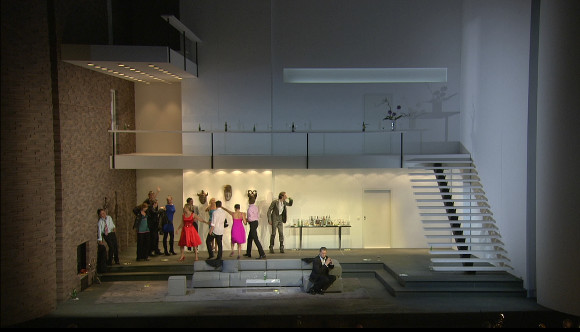
I’ve watched the Blu-ray version of the 2006 Salzburg production of Le Nozze di Figaro a few times now but sitting through it with notepad at the ready made me realise how much I hadn’t seen on the previous viewings.  My notes are copious.  I usually take a couple of pages or so.  This time I covered four pages and it could easily have been more.  You have been warned.

1.stairs Continue reading

Farewell Ileana

Ileana at the Stella Maris competition

It’s that time of year again. With a few months left in the opera season in Toronto today saw the first “farewell” concert by a departing member of the COC Ensemble Studio. It was a solo recital by dramatic soprano Ileana Montalbetti, quite possibly the best sounding thing ever to come out of Saskatoon. Ileana is the only full on dramatic soprano I’ve seen in the few years I’ve been following the Ensemble Studio and, as ES boss Liz Upchurch pointed out, they are rare so it’s always interesting to see another one come along. Fair to say too, I think, that it’s not the voice type that is treated most kindly by a piano recital in a fairly intimate space. That said, it was a very enjoyable performance.

Ileana kicked off with O Sachs! Mein Freund! from Die Meistersinger. Any reservations I have about dramatic sopranos and piano recitals come redoubled in spades where “big” opera arias are concerned. The kind of volume and tone needed to sing against a large orchestra in a big theatre tends not to sound too lovely when throttled back with only a piano for support and, honestly, I don’t think this piece was a great idea.

Things improved enormously in the next section though. This was the song cycle Ekho Poeta; Pushkin texts set by Benjamin Britten and written for the Rostropoviches. It’s a rarity; a Britten song cycle I don’t recall hearing before, and it’s very good. It was a much better vehicle for Ileana who displayed plenty of power, well controlled vibrato and pleasing and varied tone colours especially in the middle register. Her high end was much sweeter here than in the Wagner too. Where she needed a lot of attack, as in the rather spiteful Epigramma she could certainly produce it. Being Britten, the piano part in these pieces was really quite demanding too so kudos to pianist Rachel Andrist for excellent and sympathetic musicianship.

The second half of the programme was all Strauss. It started with Arabella’s final aria, which I enjoyed more than the Wagner but about which I have similar reservations as a recital piece.  Then we got a selection of songs from Op. 37, Op. 48 and Op. 32 before finishing up with Zueignung from Op. 10. This was all good stuff with more excellent control and very good German diction. The final number was particularly lovely. For an encore we got a spirited rendering of Sweet Polly Oliver in the Britten setting.

I think Ileana is a very considerable talent and I’m sure she’ll do well in the wider operatic world.  Liz Upchurch and the COC certainly seem to think so.  Liz  “leaked” that Ileana will be back in an as yet unannounced major role. Putting two and two together and making something like e^iπ and adding in a dose of wishful thinking I’m wondering if there is any connection between Ileana’s first piece today and the long rumoured Toronto debut of a certain ex-pat Canadian baritone.

Also, à propos not much, it was nice to see a certain world famous dramatic soprano in sneakers and sans make up watching from the standing room section.

Orgasm and murder

Martin Kušej’s 2006 production of Shostakovich’s Lady Macbeth of the Mtsensk District for De Nederlandse Opera is occasionally puzzling but mostly brilliant.  The performance, with a strong cast centering on Eva-Maria Westbroek’s Katerina, inspired conducting from Mariss Jansons and consistent excellence from the Royal Concertgebouw Orchestra in the pit and the Chorus of De Nederlandse Opera on stage is unbeatable.  Combine that with decent video direction and superb audio-visual quality and the Opus Arte Blu-ray package becomes very attractive indeed.

1.boriskaterina

Continue reading

University Avenue at night

Toronto’s Four Seasons Centre is an utterly gorgeous theatre.  You can find lovely photographs of it all over the place including as the background to this blog. The front of house area is all glass fronted and looks over University Avenue; one of downtown Toronto’s busiest, and noisiest, streets.  There are three hospital ERs within five minutes walk of the FSC so you can work out the siren potential.  Add to that the subway runs under the building and you get some idea of the brilliant engineering required to isolate it acoustically.  Any way, that’s just a preamble to saying that at night, and perhaps especially on a dreary winter evening like last Tuesday, one can see some striking vistas.  I was in the house to see Saariaho’s L’Amour du Loin for a second time and I was up in Ring 3.  In the interval I was struck by the view across the atrium to the street.  I only had my iPod for photography purposes so it’s not a great shot but I rather like it.

Russell Braun and friends

The free concert series that the COC puts on in the Richard Bradshaw Amphitheatre at the Four Seasons Centre often has interesting programs and frequently the performances are very good indeed. It’s also pretty good value for money. It’s not often though that the line up is as starry as today’s gig. Baritone Russell Braun was joined by his L’Amour du Loin costars Erin Wall (soprano) and Krisztina Szabó (mezzo) plus Ensemble Studio tenor Chris Enns.  On the piano were COC Music Director Johannes Debus and Carolyn Maule.

They kicked off with Brahms’ Liebeslieder-Walzer.  They were performed with verve and skill and quite a bit of humour but I’m afraid it was still Brahms.  In my book Brahms should be loved from afar.  I much preferred the selections from Schumann’s Spanische Liebeslieder which followed.  I particularly liked Russell’s rendering of Flutenreicher Ebro which showed great feeling for the words and real skill in articulating different moods through voice colour.  Krisztina also gave us a ravishing version of Hoch, hoch sind die Berger.

The revelation for me though was John Greer’s settings of Canadian folk songs; All Around the Circle.  Looking at the words I thought this was going to be really hokey but in fact both the vocal arrangements and piano accompaniments are really pretty sophisticated and right up there with better known English and Australian folk song settings for voice and piano.  The quartet gave them all they had.  Lots of attack, good ensemble work and tons of humour.  (One needs humour with a line like “She’ll be waiting for me there with the hambone of a bear”!).  Terrific piano playing here too from Johannes and Carolyn.  It was fun!  (And great value for money)

Pelléas et Mélisande in the Valleys

The Gramophone Classical Music Guide 2010 describes the DVD of the 1992 Welsh National Opera performance of Debussy’s Pelléas et Mélisande thusly:

This is, in every respect, a model of what a DVD ought to be, a perfect realisation in picture and sound of Debussy’s sole and inspired opera.

Followed by a good deal more in the same vein.  This, regrettably, tells us more about the Gramophone Guide than about this DVD(1).  Actually it’s not bad at all by 1992 standards but “a perfect realisation” it isn’t.

Peter Stein’s production is semi-abstract and monotone.  The tone is “dark”.  There’s some interesting lighting but visually it’s pretty nondescript.  The director’s focus is clearly on the actors and their interactions and in a work like Pelléas et Mélisande that makes sense.  There is some very good acting, especially from Alison Hagley as Mélisande.  The tower scene is brought off rather well with perhaps the most extravagant hair extension in the history of opera.  This also features in a disturbingly violent Act 4 Scene 2.  Act 4 also sees a brief appearance by a live sheep, no doubt in deference to local sensibilities.  I’m not entirely convinced that Stein gets enough complexity from his cast to really raise the psychology beyond the cardboard cut out level.  Donald Maxwell’s rather crude and coarse Golaud doesn’t really make a case for his descent into jealousy, madness and murderous rage based on not much at all really.  He’s not helped by the rather colourless Pelléas of Neill Archer.  On the other hand Alson Hagley conveys the fragility and mystery of her character exceptionally well.  (I also wondered whether a visual reference to Gerald of Wales’ Melusine was being made in the tower scene but maybe that’s over-theorising).  She’s very much in the same frantic and febrile mould here as Natalie Dessay on the Theater an der Wien recording.  Kenneth Cox gives a strongly characterised Arkel with particularly good chemistry with Hagley.  Stein uses a boy treble, Samuel Burkey, in the role of Yniold.  It works dramatically but I don’t much care for it musically.

In general the singing is very good.  All the principals have adequate French at least, though they can’t quite match Vienna’s line up of Francophone star talent.  Pierre Boulez conducts.  He gets a very detailed, transparent reading from the WNO orchestra while occasionally pushing out a genuinely Wagnerian dramatic climax.  No complaints here.

Stein also directed for TV/DVD.  It’s pretty conventional 1992 TV direction.  There are lots of close ups but generally there’s no sense that one is missing anything.  Although recorded live, there is no applause and no sign of an audience.  During the orchestral interludes we get film of the orchestral score which is an interesting treatment but tends even more to make this like a film rather than a theatre performance.

The picture is average DVD 16:9 and the sound options are PCM stereo, Dolby 5.1 and DTS 5.1.  The surround tracks were created from an original stereo source using DG’s AMSI II technology.  The DTS track is very decent but not quite up to best modern standards.  Extras include a trailer, a picture gallery and some DG promo material.  Subtitles are French, English, German, Spanish and Chinese.  There’s a trilingual booklet with track listings, synopsis and a short, not very useful essay.

This is a good (though far from perfect!) effort.  It’s definitely worth a look though I personally prefer the more recent Vienna recording.

fn1. I’ve long been skeptical about reviewers who claim that the best recording of a well known work is one made by Fritz Busch in his garden shed in 1935.


Ponderings on the Subject of Love

Julie Makerov and Anne Larlee in the Richard Bradshaw Amphitheatre

For the Valentine’s Day lunchtime concert at the Four Seasons Centre American dramatic soprano Julie Makerov chose a series of art songs by English and American composers on various aspects of love.  I was familiar with the English works by Quilter and Britten, though more used to hear them sung by male singers, and not at all familiar with the American works by Berger, Barber and Heggie.  It made for an interesting mix.

A dramatic soprano wouldn’t normally be my first choice for a song recital but Ms. Makerov is very skilled.  She scaled her voice back nicely and had her vibrato well under control.  She also had excellent diction and a good feel for the text.  She didn’t have the most interesting range of tone colour I’ve ever heard but it was a most musical and enjoyable performance.  She performed the whole set from memory which is nice.  The highlights for me included a couple of Quilter settings; Weep You No More Sad Fountains and The Faithless Shepherdess, and a really moving account of Britten’s setting of O, Waly, Waly.  I also really liked the three songs by Berger; In Time of Silver Rain, Heart and Carolina Cabin.  In case we thought the whole thing too serious she encored with an appropriately over the top rendering of Heggie’s Alas, Alack.

Anne Larlee, on piano, once again showed what a fine accompanist she is and there was a very good cameo for cellist Paul Widner in Heggie’s What My Lips Have Kissed.

It was well worth braving the driving sleet of a truly dreich Toronto day.


On accents in opera

Generally speaking , as far as I can tell, opera is sung as far as possible without a particular class or regional accent.  Each language has a well understood sung form that isn’t exactly like RP speech but is clearly close to it.  I know that there are a few Italian works where a comprimario role takes a Sicilian accent and Baron Ochs in Rosenkavalier is supposed to be comically rural but these are minor exceptions for effect.  Why then the tendency for modern works in English to require exaggerated accents?  And why is it so uneven?  Nobody expects the characters in Peter Grimes or Albert Herring to sing with Suffolk accents but apparently Anna Nicole requires singers to do a really bad fake Texas accent and A Streetcar Named Desire seems to be thought to require a similar treatment.

Does the same thing happen with modern operas in other languages and does anybody have any explanation for why it’s suddenly crept into the English language repertoire?  The only explanation I can offer for Anna Nicole is that it’s part of a whole cultural appropriation/condescension thing that is going on in that work that I find quite intolerable.

They shoot horses don’t they?

Just back from the HD broadcast of the Met’s Götterdãmmerung.

Musically, I was really quite impressed. I thought Luisi’s take on the score was original, valid and enjoyable. His tempi were generally quite quick and there was a taut, sinewy quality to the strings that really brought out the shape of the music. No romantic wallowing here! I really liked the Gibichungs; Wendy Bryn Harmer as Gutrune, Iain Paterson’s Gunther and, especially, Hans-Peter König’s Hagen. All were well sung and characterful. Jay Hunter Morris as Siegfried and Deb Voigt as Brünnhilde were really exciting in the Act 1 love duet and Deb nailed the Immolation scene, almost managing to overcome the staging. So much for the music, what about the production?

Continue reading