Unknown's avatar

About operaramblings

Toronto based lover of opera, art song, related music and all forms of theatre.

Watching DVDs the Handel way

There’s been a bit of jokey banter in comments on posts about various Historically Informed Productions about Historically Informed Audiences.  The serious point being that we don’t watch opera in the same way the audience did in Handel’s day and, of course, we don’t perceive it in the same way.  There’s nothing one can do about the perception but it did occur to me that the way I watch DVDs is, in some ways, more like Handel’s audience than the way I watch/listen when I am at a live performance.  This struck me yesterday as I was watching a rather good production from Zürich of Handel’s Orlando.  I’ll be writing more about that later.  Continue reading

War in opera

As November 11th comes around for the 94th time since the guns were, very temporarily, silenced I thought it might be interesting to look at how war has been seen by librettists and composers over the years. Very early on we get a very gritty take on the subject in Monteverdi’s extremely compact Il combattimento di Tancredi e Clorinda but not so long after the path for the next three centuries is set with Purcell’s broadly comic King Arthur.  As far as I can see from Purcell to 1945, with very minor exceptions, the message is largely “war is fun”.  War is an excuse for a big parade (Aida; unless Tim Albery is directing!), an excuse for a drinking song (Faust), just plain comedic (La Fille du Regiment), a plot device (Cosí fan tutte) or a background event (Tosca, various versions of the Armida story).  The only opera, pre 1945, that I can think of that deals with the horror of war is Les Troyens, and that of course takes place in a distant, mythical, past.

Continue reading

A more enchanted island

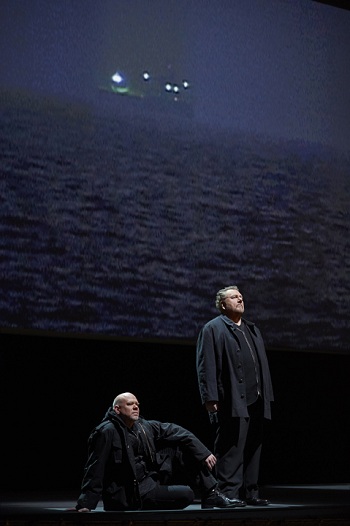
Thomas Adès’ The Tempest has had something like eight runs since its premiere at Covent Garden in 2004.  It recently opened at the Metropolitan Opera in a new production by Robert Lepage which was broadcast as part of the Met in HD series this afternoon.  It’s an interesting work musically.  Some of the vocal writing is reminiscent of Britten.  It all tends to a high tessitura for the voice type concerned and goes to extremes in that direction for the soprano part of Ariel where parts are so high that clear articulation of the words is impossible.  Writing for voice and orchestra ranges from dissonant to extremely lyrical (the act 2 duet between Miranda and Ferdinand).  Key and time signature changes are legion and many of the intervals for the singers are extreme.  It must be extremely difficult to perform but it’s rather lovely to listen to.

Continue reading

Upcoming Toronto gigs


(l – r) Laura Albino and Adam Luther in the Canadian Opera Company’s Xstrata Ensemble Studio School Tour production of The Brothers Grimm, 2009.
Photo Credit: Photo: Anand Maharaj © 2009

Since my last post on upcoming Toronto opera and opera related events a few extra things have come up.  November 16th is turning into a pretty crowded evening.  I’m going to Toronto Masque Theatre’s Purcell fest, Fairest Isle, which is also on on the 17th.  Also on that night is the Glenn Gould School’s fall performance; a double bill of Ned Rorem’s Three Sisters Who Are Not Sisters and François-Joseph Vézina’s Le Lauréat.  Finally, you can also catch Opera by Request performing Tchaikovsky’s Eugene Onegin (also on the 25th) or catch them on the 17th when they are doing Bizet’s Les Pecheurs de Perles.

Later in the month there is the final audition for the COC’s Ensemble Studio.  This is always a great opportunity to see the best of the next generation of Canadian singers as they compete for a place in Canada’s premier young artists program.  There are still a few $15 standing room tickets available from the COC box office or website.

Into December when the COC Studio Ensemble are presenting three performances of Dean Burry’s The Brothers Grimm on December 7th and 8th.  The performance on the 7th will be the 500th for this work making it much the most performed classical work by a Canadian composer.  Finally, on December 15th there’s a holiday party/fundraiser for the awesome Against the Grain Theatre Company.  Folks who can stage an opera at the Tranzac ought to know how to party.

Cheap enough for beggars

Last night I went to see Essential Opera’s cheap and cheerful production of Brecht and Weill’s The Threepenny Opera.  It was a semi staged production in the relatively small Heliconian Hall.  Semi-staged in this case meant sung in costume from music stands with very basic blocking.  Accompaniment was by Cathy Nosaty on piano and accordion which actually suited the music pretty well.

The singing was good, sometimes very good.  Probably the stand out was Laura McAlpine’s Jenny.  Of all the singers on display she was the one who seemed most immersed in the sound world of the piece and could vary style and technique appropriately.  Erin Bardua’s Lucy Brown was really quite idiomatic too.  The others were more consistently operatic which sounded a bit odd in places but worked surprisingly well in, for example David Roth and Heather Jewson’s rather refined refined and bourgeois Peachums.  Obviously this approach also worked for the character who are usually sung operatically; Macheath, Brown and Polly for example.  The ensembles were all also very effective.

Continue reading

Chill out dude

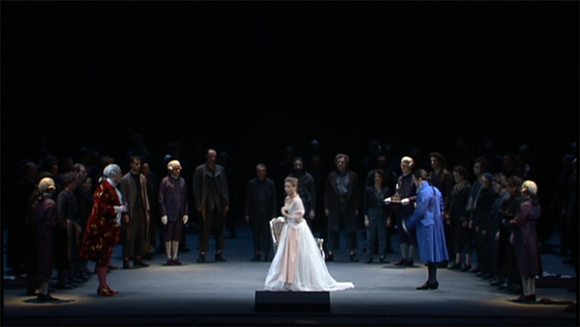
The problem with reviewing Doris Dörrie’s 2002 Berlin production of Così fan tutte is that pretty much everything that can be said about it already has been.  It’s like trying to write about Willy Decker’s “red dress” Traviata.  So I’ll try and be brief and to the point.  On the surface the idea is a bit outlandish.  Mozart and da Ponte’s satire about sexual fidelity is updated to the 1970s though to me, who grew up in the 70s, it seems much more like the 60s.  That said, it works.  It’s lively, funny, musically top notch and the presentation on DVD is very decent.

Continue reading

Almost ideal Idomeneo

The 2006 Salzburg production of Idomeneo seems to me to be just about ideal.  The production is clean and consistently interesting without ever getting too far away from the core story and the pretty much unbeatable cast is backed up by the period sensibilities of Roger Norrington and the Salzburg Camerata and Bachchor.  The only fly in the ointment is the utterly heinous video direction.

Continue reading

Time is a funny thing

A series of blog posts discussing time, perceptions of time and historically informed performance (HIP) plus seeing Opera Atelier’s Der Freischütz got me thinking along some curiously convergent lines and arriving at the conclusion that HIP isn’t and can’t be what it is often purported to be; a fairly faithful attempt to reproduce a work as it would have been seen by its first viewers or “as the composer intended” or something like that.  Not, of course, that even if it was, we would see and hear it as the original audience did but that perhaps is a topic for another day.

Continue reading

Boulevard Solitude

My DVD of Hans Werner Henze’s Boulevard Solitude arrived the day before his death at the weekend and so went straight to the top of the reviewing pile.   It’s an intriguing piece.  It’s based on the same Abbé Prevost novel as all the other versions of Manon but updated to the period of composition (1952) and told from the viewpoint of des Grieux rather than Manon.  In this version des Grieux picks Manon up at a railway station while she is on her way to finishing school in Lausanne.  They run away to Paris but des Grieux is broke and Manon’s brother pimps her to a rich old man, Lilaque.  The brother robs the old man’s house which gets them both kicked out.  Manon has a brief fling with des Grieux before her brother pimps her out again; this time to Lilaque’s son.  By this time des Grieux has a pretty serious cocaine problem.  The cocaine, naturally, is supplied by Lescaut.  Lescaut is in the process of stealing a painting from Lilaque fils when Lilaque père shows up.  Lescaut hands Manon a gun and she kills the old man.  In the last scene we are back at the railway station where a disconsolate des Grieux waits for one last glance at Manon as she is taken to prison.

Continue reading

Forge a magic bullet and your lifestyle will improve

There’s a lot to like in Opera Atelier’s current production of Weber’s Der Freischütz but also some things that are just plain puzzling.  I enjoyed it but certain aesthetic choices made no sense at all to me.

Let’s start with the good stuff.  The OA template was relaxed quite a bit, particularly in the dance department.  Allowing the women to dance in point shoes allowed for a degree of choreographic flexibility that was most welcome to me.  This, from a dance point of view, was the best OA production I have seen.  The singing, though stylistically inconsistent, was also uniformly excellent.  Meghan Lindsay’s Agathe was superb.  She had much the most dramatic voice on display and, to me, was the truest to the real sensibility of the piece.  Carla Huhtanen, as Aanchen, was also excellent though in such a different way that wondered whether they were in the same production.  Solid singing from the men too especially Krešimir Špicer as Max who was very stylish, if not especially heroic.  The design and lighting elements were also not too constrained by baroque considerations and worked pretty well.

Meghan Lindsay and Krešimir Špicer in Opera Atelier’s production of Der Freischütz (Bruce Zinger photo).

Continue reading