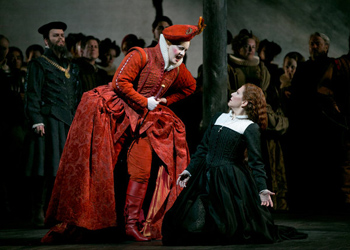
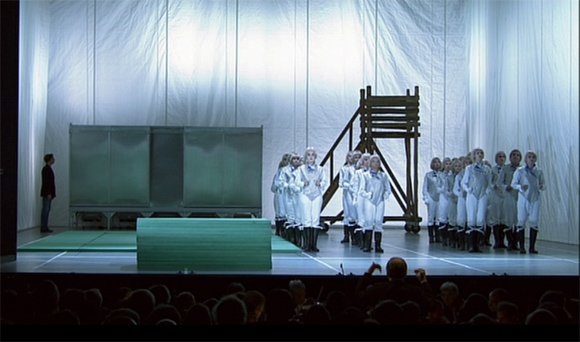
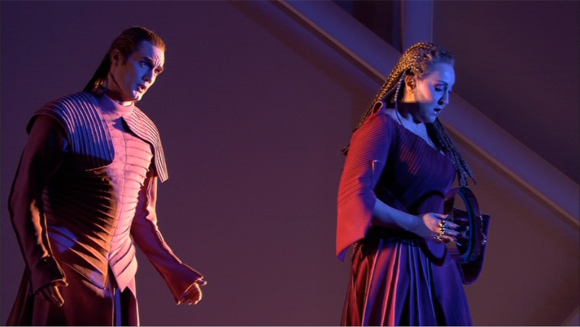
Robert Carsen’s 2004 production of Der Rosenkavalier at the Salzburg Festival was apparently enormously controversial at the time. In many ways that says more about the iconic status of the piece in Salzburg tradition than about Carsen’s production. There are a few controversial elements. He has updated the period to 1914 and the third act is set in a brothel with a fair amount of nudity. Beyond that, the production is pretty faithful to the libretto and has, I think characteristic Carsen touches like long lines of tables and chairs and a certain geometric elegance. He seems to be using the sides of the stage to comment on the action which tends to be fixed centre stage. I say seems because the video direction (by Brian Large) is utterly perverse and makes it extraordinarily difficult to see what Carsen is doing, let alone decode it. We see the whole stage, maybe, for three seconds in the whole piece. Otherwise 99% of what we get is either close up and even closer up or apparently shot from the restricted view seats high up and close to the side of the stage. The other 1% is just plain nuts and includes a section of the Sophie/Octavian duet in Act 2 where, on stage, Octavian is maybe twenty feet to Sophie’s right but on camera he’s standing right up close on her left hand side. I could go on but I won’t. Suffice it to say the video direction comes close to wrecking an otherwise excellent DVD.
Author Archives: operaramblings
Ein sonderbar Ding
Coincidence and irony just ran into each other at high velocity. Last night my DVD of Boulevard Solitude arrived which, among other things, sent my mind back to the long, hot summer of 1976 when, between IRA bomb scares and hitch hiking around Germany I saw the Covent Garden premiere of We Come to the River; a work which deeply confused my teenage self and put something of a damper on my infatuation with European Modernism. So, I’m a bit ambivalent about Henze’s music but nonetheless much saddened by the news of his death for truly he was one of the giants of Modernism. By way of irony the news arrived while I was listening to Adrienne Pieczonka singing “Die Zeit; die ist ein sonderbar Ding”. So very, very true.
There’s a thoughtful obituary over at The Boulezian.
The COC Annual Report 2011/12
The Canadian Opera Company’s Annual report is out. You can find it here. It not unreasonably lauds the COC’s considerable artistic achievements over the last year as well as its extensive and commendable outreach activities. It also contains, albeit in no great detail, the financials. Now, as a former management consultant, I know that’s the one bit of an Annual Report that’s hard to spin though most CFOs will try. Being the analyst that I am I ran a few numbers and the results were a bit disturbing. It was obvious that the financial position had deteriorated though the extent only revealed itself when I looked back to 2009/10 as a comparator. Here are a few statistics comparing 2011/12 with 2009/10.
- Capacity (i.e. seats to be sold): up 7% (this is approximate and calculated from ticket sales and reported capacity figures)
- Seats sold: down 8%
- Average price per seat sold: down 10% (From $97.97 to $87.86; which seems quite low really)
- Leading to a drop in ticket revenue of 18%
Rigoletto in Zürich
This is another of those Arthaus Blu-ray disks that’s sold at a silly cheap price as a carrier for two hours of trailers from the Arthaus catalogue. That said, it’s very high quality indeed. GIlbert Deflo’s production is, in the end, quite conventional though with careful and effective Personenregie. He does trick us a bit at the start. The scene opens with what is, apparently, a rather louche 16th century court entertainment/orgy. There are bare breasted women and dancers of both sexes dressed as Satanic imps. Everyone is in period costume including Rigoletto with jester hat, bells etc. The scene is, perhaps, what we expect. The “ladies” are very receptive to the duke’s advances. The men are resentful but not actively so. Then in comes Monterone in mid 19th century dress to denounce the proceedings and we, perhaps slowly, realise that this is a costume party. From there on there’s nothing very tricksy. The story gets told effectively and straightforwardly. We have been pulled, effortlessly, from the time of the libretto to the time of first performance and the parallels are drawn.
Good news!
Intermezzo reports that Harrison Birtwistle’s 1991 (revised 1994) opera Gawain is to be performed at the 2014 2013 Salzburg Festival. I saw this when originally broadcast on TV in the UK and really want to see it again. I’m hoping that there will be a DVD release as it’s unlikely(!) that I will make it to Salzburg. I’m half surprised that it hasn’t been performed again or spread beyond Covent Garden (same is true of The Minotaur of course). But only half surprised. There seems to be a real reluctance currently to produce work that is seen as less “accessible”. There are exceptions of course. Saariaho seems to be quite fashionable for example but overall, and especially on this side of the Atlantic, the modernist tradition seems to have been firmly rejected.
The dream is over but the night not yet
So closes Aribert Reimann’s 2010 opera Medea. It’s a two hour piece in four “pictures” that premiered at the Wiener Staatsoper in 2010 and the Blu-ray/DVD recording is taken from that initial run. Actually there’s a good deal more nightmare than dream in this version as, I suppose, there is in just about any version of the Medea story. This one draws on Franz Grillparzer’s version for the libretto and is entirely concerned with events after Jason and Medea reach Corinth. It’s unusually sympathetic to Medea herself with Jason and Kreon very much the villains.
A journey through space and time?
Tan Dun’s Marco Polo is hugely ambitious. He uses Marco Polo’s legendary journey as a metaphor for Space and Time. He fuses a range of Western musical styles with Chinese, Tibetan and Indian instruments and vocal styles. Although most of the work is sung in English there are sections in Italian and Chinese and other bits in a sort of random polyglot. The cast includes a range of real, allegorical and psychological figures. Marco and Polo are in fact two characters; one representing action and the external and the other the psychological and internal. Kublai Khan, Dante, Shakespeare, Sheherazada and Mahler put in appearances and much of the narrative is carried by a Chinese opera singer playing the part of Rustichello; “the questioner”. To be honest, despite having read the booklet, watched Reiner Moritz’s “Making of” documentary and studied the chart below, most of the time I had no idea what was actually happening. It’s really all too abstract and involved to really work as music drama.
Traditional Traviata
The 2007 recording of Verdi’s La Traviata from Milan’s Teattro alla Scala is extremely traditional but very satisfying. Liliana Cavani’s production is set in the mid 19th century with entirely conventional sets and costumes (with the obligatory cleavage) and nothing in the direction that adds up to an original concept or idea. Act 1 is set in a glitzy ballroom. Act 2 scene 1 takes us to a slightly odd sort of country house bedsit with billiard table In Act 2 scene 2 we are back with the glitz with actual gypsies and bare chested matadors. Act 3 is set in a suitably dark invalid’s bedroom. Angela Gheorghiu’s Violetta goes from ballgown to nightdress to ballgown to nightdress while maintaining Ange levels of, you guessed it, cleavage. The guys are all in evening dress or operetta dress uniforms. It’s all pretty and doesn’t distract from the music.
Continue reading
Another Big COC Podcast
A couple of weeks ago we recorded another Big COC Podcast. It’s now available on the COC website and from iTunes. This time the panel was myself, Wayne Gooding from Opera Canada magazine and Gianmarco Segato and Gianna Wichelow from the COC.
Topics covered included Robert Everett-Green’s Globe and Mail article on Il Trovatore and the persecution of the Roma, upcoming opera productions across Canada (mostly Verdi!), an interview with Marilyn Gronsdal on her Montreal remounting of Christopher Alden’s production of Der Fliegende Holländer; seen at the COC in 2010, and that hardy perennial, HD cinema transmissions of opera with especial emphasis on the Met.
Heading into winter
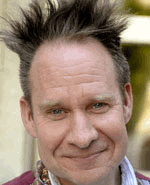
The leaves have turned and the Canadian Opera Company Season is underway so winter can’t be far away. I’ve now seen both the COC fall productions so I need to find alternative fare between now and February when things kick off again. So far I’ve found two live shows of interest in town. At the end of October Opera Atelier is putting on Weber’s Der Freischütz. This is a departure for OA who have previously (bar once) not put on anything later than Mozart and that in a rather idiosyncratic style. I think it’s an interesting move and I hope it stimulates the creative juices at OA and sparks some of the innovation that made OA such an exciting company ten or twenty years ago. If it turns into an exercise in persuading us that 19th century Romanticism is really just an extension of the Baroque I shall probably be feeling like the guy in the picture. The other live show is Essential Opera’s The Threepenny Opera being presented in concert at Heliconian Hall on November 7th. Essential Opera I suppose is a semi-pro outfit operating on very small budgets and The Threepenny Opera seems like a good fit. I felt that last year’s attempt at something grander was rather a case of biting off more than they could chew. Continue reading