Unknown's avatar

About operaramblings

Toronto based lover of opera, art song, related music and all forms of theatre.

L’Elisir di Steakhouse

Today was the first MetHD broadcast of the season and we got Bartlett Sher’s new production of Donizetti’s L’Elisir d’Amore.  It’s what I would call a “steakhouse production”.  It’s like a meal in a top end steakhouse.  Your steak is a fine piece of meat, they don’t mess it up and ditto your baked potato.  And it’s all served in luxurious surroundings with attentive service.  It’s a terrific steak dinner but it costs the same as the tasting menu at a place with two Michelin stars and it’s still just a steak dinner.

So, a brilliant cast; Netrebko, Polenzani, Kwiecien and Maestri, singing and acting up a storm in a production that was pretty much devoid of ideas beyond a few odd costuming choices.  Since when did Italian peasant girls get to dress like they are attending a ball in a Jane Austen novel?  Still the girl singing Nanetta was cute and had the best dress.  Gary Halvorson’s video direction was about par for the course in terms of virtually incessant close-ups.  Not a bad way to spend a Saturday afternoon but ultimately forgettable.

Die Fledermaus redux

Mireille Asselin as Adele – Photo: Michael Cooper

I was back at the Four Seasons Centre last night for another look at the new Die Fledermaus; this time with Mireille Asselin as Adele.  There were a number of things about the production that I noticed more on a second look.  The most notable was the lighting (by Paul Palazzo).  It’s superb.  It’s atmospheric without falling into the trap of being so dark one can’t see anything.  Obviously too I saw the kind of prefiguring that goes on throughout the production differently knowing where things were going to go.  It’s clever and insightful without being too intrusive.  I also noticed one or two bits of comic business that either passed over me on opening night or have been added since.  Was the Fidelio joke there on opening night?  My overall verdict hasn’t changed.  It’s a funny, sexy production that can be enjoyed on many levels and one of the best things I’ve seen in ages.

So how was Mireille?  She was very good and very different from Ambur Braid.  Mireille is pretty much your classic soubrette; what I guess we are now calling an -ina voice.  It’s not a particularly big voice but she’s accurate and musical.  She’s also a very decent actress.  One feels that she’d be an ideal Adele in a perfectly conventional Fledermaus.  For this rather spikey, edgy version though I’d go with Ambur.  Her bigger, almost abrasive, voice and her more flamboyant acting (considerably helped by her rather striking appearance) really fit this production.  I’m glad I got a chance to see both of them.

Full review of the opening night with Ambur Braid as Adele

In the news

The good news this week is that Canadian Opera Company have extended the contract of Music Director Johannes Debus through 2017. This follows the announcement of a contract extension for General Director Alexander Neef. So, not only does COC get to keep a very good conductor who is well liked by the orchestra but it keeps the Neef/Debus team together for at least another five years. Neef and Debus seem to work together extremely well so this bodes well for a continuation of the combination of varied repertoire, interesting productions and starry casts that we have seen recently at the Four Seasons Centre.  Continue reading

Beyond Good and Evil

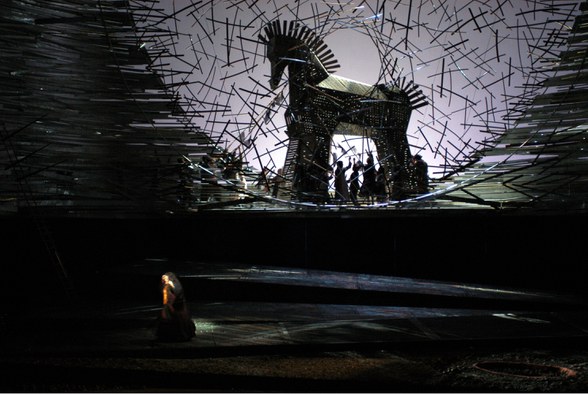
Rameau’s Zoroastre is a tragédie lyrique in five acts.  It’s basically a story of love, power and revenge coupled with a metaphysical struggle between Good and Evil.  It has a seriously convoluted plot involving demons, incantations, good and evil spirits, a magical talisman book and human sacrifice.  Watching the illustrated synopsis on the disk is strongly recommended!  Being the baroque French beast that it is this work also has lots of ballets.  Pierre Audi’s production was staged and filmed at the court theatre at Drottningholm and is a sort of almost, but not quite, HIP concept, somewhat akin to Robert Carsen’s production of Les Boréades.

Continue reading

Fifty shades of grey

Verdi’s Il Trovatore notoriously has an episodic and highly improbable plot.  It’s also famously difficult to cast.  Creating a compelling production and staffing it with capable singers therefore presents a formidable double challenge.  The current Canadian Opera Company production gets it half right.  The problem is Charles Roubaud’s much travelled production.  There’s not an idea in it.  It’s not surprising that the director’s programme notes run to three short paragraphs.  Roubaud sets each scene in a sort of grey box of towering walls.  Unfortunately each grey box is just different enough that that the curtain comes down at the end of each scene and the stage crew spend what seems like an interminable amount of time setting up the next grey box.  We just aren’t used anymore to sitting quietly through interminable scene changes.  We expect slicker stagecraft and in a modern opera house there’s really no excuse for this 19th century approach.  Within in each grey box the grey clad cast come and go and in between mostly stand around.  Blocking is perfunctory, acting superfluous and old fashioned “park and bark” the order of the day.  It’s the sort of production that might have passed muster thirty years ago but really doesn’t cut it in 2012.
Continue reading

COC’s Fledermaus succeeds on several levels

Christopher Alden’s recent productions in Toronto; Rigoletto and Der Fliegender Holländer, were controversial, rather cerebral affairs that delighted his fans but tended to puzzle, and even infuriate, the more conservative critics and opera goers.  His Die Fledermaus, which opened last night at the Four Seasons Centre, has something for everybody.  There are two main threads uniting the three acts.  The first is the piece as an allegory of Austrian bourgeois society from an insecure pre WW1 period through a period of unbridled hedonism in the 1920s to the beginnings of Fascism.  The second is a much more explicit depiction of Falke as the ringmaster of the whole circus.  He goes from manipulative Freudian psychiatrist in Act 1 to Orlofsky’s confidante in Act 2 to, bat costumed, sitting astride the giant watch that hangs above the stage; the only character aloof from the takeover of the drama by the sinisterly Fascistic Frosch. All this is strung together by prefiguring later elements in earlier scenes.  In Act 1 the party goers from Act 2 invade the scene via the fractured wall of Rosalinde’s bedroom as Gabriel imagines the delights to come.  A silent but frenetic Frosch appears on stage at various points in the first two acts although his identity isn’t apparent until the coup de theâtre that carries us into Act 3.  Additionally Alden does not shy away from bat imagery, including it’s darker overtones.  There are bat shadows on the backdrop during the overture, Falke first appears as a Dracula look alike, the ‘ballet’ are batgirls and we close out with Falke, again dressed as a bat, overseeing the denouement.  There’s a lot going on  and I shall be very happy to see this again and delve deeper (a recurrent theme with Alden productions).  Continue reading

Maybe opera is not made for film… shit!

So says Rolando Villazón towards the end of the “Making of” documentary that accompanies Robert Dornhelm’s 2008 film of Puccini’s La Bohème.  Fortunately for us Dornhelm, Villazón and the rest of those involved provide another piece of evidence that films of operas can indeed be made, and made very successfully.  This one is a curious hybrid.  It uses just about every technique that I’ve seen used in such a venture.  The whole thing was originally recorded in the studio and most of the film is lip-synched using a mixture of the singers and actors who weren’t art of the singing cast but some of the arias were sung on set to a taped orchestral track.  I’m not sure why and I couldn’t tell which was what.  It all works pretty well anyway.

Continue reading

Sneak preview of Die Fledermaus

Female chorus member – Sketch: Constance Hoffman

There’s an event on in Toronto this weekend called “CultureDays”.  The COC’s contribution last night was an open orchestra dress rehearsal of Christopher Alden’s new production of Die Fledermaus preceded by a talk in the Richard Bradshaw Auditorium by set designer Allen Moyer and costume designer Constance Hoffman moderated by the CBC’s Brent Bambury.  The event was “first come, first served” and restricted to 500 tickets so we decided to be early.  Doors opened at 1815 for a 1830 talk so the plan was to meet the lemur at the opera house at 1700, grab a bite to eat and then join the line-up.  I got there early as I was through at work and preferred to sit in the sunshine at the Four Seasons Centre rather than at my desk so I got there around 1615.  There was already a line up!  By the time the lemur showed up just before 1700 there was quite a line up so we changed plan and the lemur went off to fetch burritos to eat in the line.  Just as well as they ended up turning people away.  Continue reading

Picture quality – DVD vs. Blu-ray

As regular readers know posts on this blog frequently feature screen caps from the DVD or Blu-ray disk reviewed.  In the process of garnering the screen shots I have found out one or two interesting things about the picture quality of the originating disk.  Using vlc to play disks gives a window the size of the image in pixels.  (I use vlc because for some reason screen caps from DVDPlayer come out blank.)  Older opera DVDs have a picture that is nominally 720 pixels wide giving a 720×540 window for 4:3 pictures.  In practice there are often black bars at the side of screen reducing this a little and sometimes older TV derived material isn’t even really up to even that quality so this really represents an upper bound on the amount of information available.  More recent 16:9 DVDs tend to be a bit more information rich; 830×468 pixels seems quite common and some HD derived material checks in at around 850×480.  It does mean though that very few operas will fit on a single DVD9 disk.  Continue reading