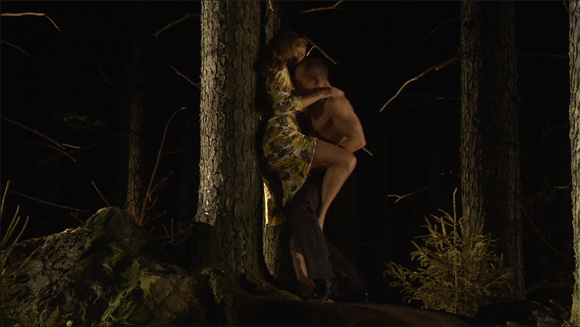
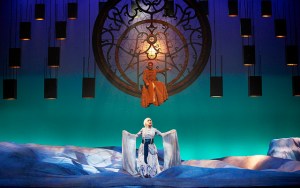
Robert Carsen’s clean, refined production of Handel’s Semele originated in Aix, was recorded in Zürich and eventually made it’s way to Vienna and Chicago. In many ways it is classic Carsen. It’s elegant and uncluttered, is strong on the detailed Personenregie, has a consistent design concept but isn’t really pushing a concept driven agenda. It’s also quite funny without descending to priapic donkeys. Also there are lots of chairs.
Author Archives: operaramblings
The review – COC Studio Ensemble in concert

(front row, l-r): Ambur Braid and Cameron McPhail; (second row, l-r): Jenna Douglas, Claire de Sévigné and Mireille Asselin; (third row, l-r): Neil Craighead, Owen McCausland and Sasha Djihanian; (fourth row, l-r): Rihab Chaieb and Timothy Cheung. Photo: Chris Hutcheson
So, as promised here are my thoughts on yesterday’s Ensemble Studio recital at the Four Seasons Centre. It’s always interesting to see the Ensemble Studio together; to see how returning members have developed since last heard and to hear the newcomers. This is what we got.
Soprano Claire de Sévigné gave us “Chacun le sait” from La fille du régiment. It’s a good piece for a young singer and shee sang it with spirit and enthusiasm and acted with gusto. Perfectly idiomatic French too of course. She has a lovely voice and is clearly one to watch.
Here we go again
Today was the first concert of the season in the free concert series at the Four Seasons Centre featuring the very talented artists of the COC’s Ensemble Studio. I promise that there will be a proper review very soon but right now all I can offer is a treat for that section of my readership who have a thing for cross dressing mezzos. You know who you are!
The Scrapheap of Capitalism
The 2010 La Fura dels Baus Madrid production of Weill’s The Rise and Fall of the City of Mahagonny is much the best version of the piece I’ve seen on DVD. The production starts and ends on a rubbish dump and the dump and its people, curiously reminiscent of the vegetarian terrorists in Delicatessen, are present pretty much all the time. It doesn’t pull any punches and tackles Brecht’s characteristically unsubtle parody of commodity capitalism straight on and without sentimentality or apology. Perhaps the most effective scene is the sort of “orgy by Frederick Taylor” that accompanies Second comes the loving match in Act 2 but there are lots of telling moments from the widow Begbick first appearing from a derelict fridge to the pyre of mattresses on which Jim is executed. Curiously perhaps the piece is given in Michael Feingold’s English translation but it’s a very good translation and little or nothing is lost.
Not a DVD review
There are an awful lot of opera DVDs about. It sometimes seems like there’s a new Tosca or Traviata out every week, often for no apparent reason. It’s perhaps surprising then that some works don’t make it to DVD. One particularly egregious case would seem to be John Adams’ Nixon in China. It’s a good piece and has had plenty of productions both in North America and elsewhere. A couple of years ago I saw it twice in 24 hours; on a Friday evening at COC followed by the HD broadcast from the Met the following afternoon and I’ve been listening to an audio recording of the COC version on my walk to and from work. But there’s no DVD! I guess that the Met probably planned to release the HD recording but James Maddalena, the Nixon in the recording, was so obviously ill I was actually surprised that he continued after the interval and I guess that scuppered that. Continue reading
PSA
I know things have been a bit slow around here lately. Bear with me. I’m dealing with starting a new, very demanding job and with having had cataract surgery last week. That makes it quite hard for me to spend as much time looking at a computer screen as my job requires, let alone blogging in addition. Normal service will be resumed eventually.
Kušej’s Elektra
I don’t think Richard Strauss’ Elektra is an easy opera to stage. The story is straightforward and really well known and the opera is constructed largely as a series of dialogues so designing visual and dramatic elements that enhance the drama is a real challenge. In his 2005 production for the Opernhaus Zürich Martin Kušej tries hard to do so but rather comes up short. Fortunately his detailed direction of the singers is effective and pretty much makes up for the “Kušej bingo card” elements of the production.
Chav Giovanni
Calixto Bieito’s 2002 production of Don Giovanni from Barcelona’s Liceu theatre is a drink and drug fuelled nightmare. The general atmosphere will be familiar enough to anybody who has been around the “entertainment district” of a large city around chucking out time. Besides chemical stimulants and a great deal of enthusiastic bonking there’s also lots of violence, some of it quite disturbing, and buckets of blood but, as far as I could tell, only one rape. It’s bold and never dull but I think it stretches the libretto to its very limits and perhaps beyond.
La Clemenza di Tito – Paris 2005
The Opéra national de Paris 2005 production of Mozart’s La Clemenza di Tito is very fine. Ironically it’s actually quite a conventional production overall though one scene, the one where Tito makes his first appearance, is so weird that it provides the generic name used in some circles I frequent for an entirely inexplicable production element (see below).
The Big COC Podcast
The first in a new series of the Canadian Opera Company’s The Big COC Podcast is now up on the COC website and at iTunes. (On iTunes search for “The Big COC Podcast”). It features Gianmarco Segato of the COC, Wayne Gooding of Opera Canada, Leslie Barcza of barczablog and myself. You can hear us talk about operetta in general, the COC’s upcoming Die Fledermaus, Evgeni Nikitin’s tattoos, John Teraud’s “boulder and a hard place” article and the problems of getting the word out to potential audiences in a post-newspaper world.