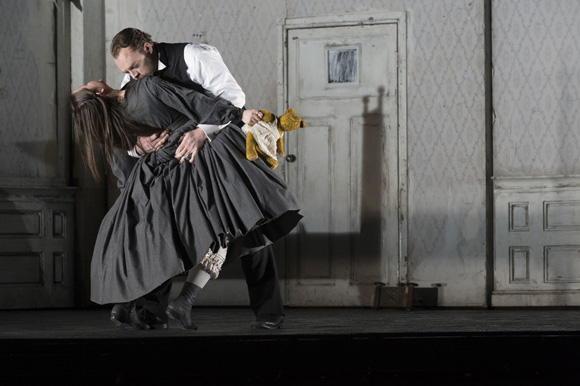
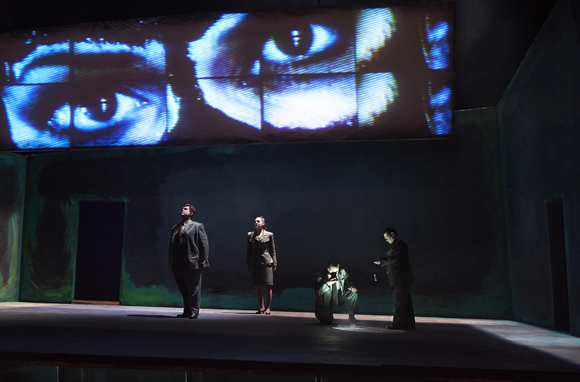
Rameau’s Castor et Pollux is a tragédie lyrique in five acts. It’s a mythology based libretto which, ultimately, celebrates the fraternal love of the twins who rise to immortality while rather callously discarding the female human love interest. Pierre Audi’s 2008 production for De Nederlandse Opera nods both to the baroque and to the mythological by staging the work in a rather abstract Sci-Fi sort of way but with moving sets and Fx that suggest, rather than reproduce, the stagecraft of the baroque.
Author Archives: operaramblings
First of the year
Yesterday saw the first free lunchtime concert of 2013 at the Four Seasons Centre. Five singers from the COC’s Ensemble Studio gave us a programme of works by Mozart and Salieri, mostly comparative rarities. I enjoy hearing the singers of the Ensemble Studio because it’s not just a chance to hear some good singing but also to see how voices are developing and make some guesses about whether one is seeing a future star.
New additions to the COC Ensemble Studio
The COC today announced six new singers will join the Ensemble Studio for the 2013/14 season. If you read my review of the Ensemble Studio competition in November you’ll not be surprised. The three prize winners; bass-baritone Gordon Bintner, tenor Andrew Haji and mezzo Charlotte Burrage are among the six as is my pick, dramatic soprano Aviva Fortunata. The remaining two are baritone Clarence Frazer and mezzo Danielle MacMillan who were also quite impressive in the competition.
The Ensemble Studio is losing Mireille Asselin, Neil Craighead, Rihab Chaieb, Chris Enns and Ambur Braid as well as both pianists; Timothy Cheung and Jenna Douglas, at the end of this season though all of them can be seen in some capacity in La Clemenza di Tito next month. Rihab is also appearing in Dialogues of the Carmelites in the spring. There’s no word on new non-singing talent for Ensemble. I’m going to be really interested to see what’s next for these guys. We’ve had some good times together.
Ideas for new operas
So riffing off an idea raised in comments over at Likely Impossibilities, what books, films, plays, stories or other source material would you like to see made into an opera? Feel free to suggest a composer and librettist and even cast it if you so wish! To start the ball rolling I’ll offer up a few suggestions.
Secret Senta
Martin Kušej’s production of Der fliegender Holländer for De Nederlandse Opera recorded in 2010 is high concept and it’s worth looking at the interviews with the cast and conductor before watching the main event. Certainly the essay in the booklet will do little to prepare you. For Kušej, Daland’s ship is a cruise ship or pleasure yacht full of expensively dressed partygoers. The Dutchman’s “crew” are refugees or desperate economic migrants. The Dutchman himself has made his pile in human trafficking. The framework of the “outsiders” wanting a share of the “insiders'” goodies is the backdrop for the interpersonal drama of Senta, the Dutchman and Erik.
Now includes dwarf tossing
Berlioz’ Les Troyens is opera on a grand scale. Only a really big company like the Met could possibly afford to stage it. Yesterday’s performance used a chorus of 110, a larger orchestra, at least twelve soloists and a bunch of dancers. It also lasted 5 1/2 hours including the intervals. Was it worth it? For the most part I’d say yes.
Traditional Wozzeck from Vienna
The 1987 recording of Berg’s Wozzeck from the Vienna State Opera is a bit of a mixed bag. Claudio Abbado’s reading of the score is incredibly intense and powerful and he gets great support from the orchestra, There’s also some very good singing. Dramatically it’s a bit of a mixed bag and the DVD production isn’t particularly good. Continue reading
Opera in translation
The issue of performing opera in translation has come up in comments on other blogs a couple of times recently. I posted a few fragmentary thoughts in various places but feel that I need to get my thinking straight, coherent (hopefully) and in one place. Basically what was bugging me was a recurrent theme that only the original language (not always as simple as it sounds) was acceptable. Clearly this flies in the face of a long history of performance practice in major opera loving countries and, like most absolutist statements, looks quite dodgy when subjected to any sort of analysis
How much of what we did was good?
Two years ago I got a chance to see a live COC performance of John Adams’ Nixon in China followed, on the next day, by a live cinema broadcast from the Met of the same piece. I wrote them up at the time on Dreamwidth. I’ve now got my hands on the recently released Blu-ray/DVD release of the Met broadcast. Interestingly it’s just that; a Blu-ray and DVD copy of the recording in the same box for a pretty typical opera video price. I think it’s a neat solution to the two SKU dilemma of releasing on Blu-ray and DVD separately. Packaging aside, how does it look after a lapse of two years?
Statistical round up of 2012
Who comes here, what are they looking for and what do they find?
The anglophone world unsurprisingly contributes most visitors. More than half of my roughly 47,500 visitors came from the US, Canada or the UK. The next biggest contributors were Germany, France and Austria. There were visitors from 117 countries in all.