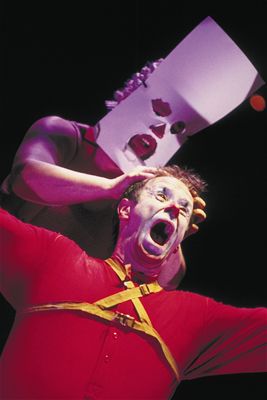
I don’t know whether I’d call this opera or not but it’s certainly music theatre and of a rather interesting kind. Obeah Opera is an a cappella theatre piece in which an all-female cast examines the story of the Salem Witch Trials from the perspective of enslaved African women. it’s being workshopped, in preparation for next year’s PANAMANIA; the arts and culture program of the Pan Am games, at the Dancemakers Studio in the Distillery (9 Trinity St, studio 313) on Sept 11, 12 and 13 at 8pm and Sept 14 at 2pm. It’s directed by Weyni Mengesha with music direction by Andrew Craig.
Author Archives: operaramblings
2014-2015 events at UoT
The University of Toronto Faculty of Music has released its schedule of events for the 2014/15 season. There’s a lot of interesting stuff for the opera and vocal music fan (and much else besides). Highlights include:
Opera
The first of two major productions is Gilbert and Sullivan’s HMS Pinafore which will play November 27th-30th. Michael Albano directs and Sandra Horst and Russell Braun will share conducting duties. The second, Dominick Argento’s Postcard from Morocco, will run March 12th to March 15th with Michael Cavanagh directing and Les Dala conducting. Both shows will be in the MacMillan Theatre.
Fit for a king?
There have been over thirty operas dealing with Montezuma, last emperor of the Aztecs from Vivaldi in 1733 to Bernhard Lang in 2010. The second such premiered in 1755 and was rather remarkable. The idea originated with Frederick II of Prussia who decided to fit in an opera before his next war against the Austrians. He wrote a French prose libretto which was turned into an Italian text by his court poet Giampietro Tagliazucchi and then set by his court composer Carl Heinrich Graun. It’s pretty clear that Frederick identied himself with the idealized enlightened monarch Montezuma, the ultimate noble savage, and his betrayal by forces loyal to the Habsburgs and Catholoicism. The ideas earlier expressed in Anti-Machiavel are very much to the fore as are Frederick’s own rather odd ideas on fate and his own mortality(1). Basically this Montezuma is deposed and executed and his world goes up in flames.
This season’s free concerts in the RBA
The Canadian Opera Company has just announced the 14/15 line up for the free lunchtime (mostly) concerts in the very beautiful Richard Bradshaw Amphitheatre at the Four Seasons Centre. Highlights, from my point of view, include recitals by Jane Archibald, Krisztina Szabó, Lauren Segal, Colin Ainsworth, Joshua Hopkins, Robert Gleadow, Barbara Hannigan and Ekaterina Gubanova. There will also be ten concerts by the Ensemble Studio plus the Quilico competition. The Canadian Art Song Project will showcase Allyson McHardy in a new song cycle by Marjan Mozetich. There’s also a themed series of concerts to commemorate anniversaries of the First and Second World Wars, and the fall of the Berlin Wall. This will comprise six concerts drawn from the Vocal, Chamber Music and Piano Virtuoso programs.
That’s just the tip of the iceberg. There are vocal, chamber, piano, dance, jazz and world music programs to suit a very wide range of tastes. And it’s all free. Full details at http://www.coc.ca/PerformancesAndTickets/FreeConcertSeries.aspx
Routine Don Pasquale
Once in a while one comes across an opera DVD that’s so “ordinary” that it’s extremely difficult to write about it. The 2002 Cagliari recording of Donizetti’s Don Pasquale is one such. Stefano Vizioli’s production is set in 1750s Rome and plays the piece about as straight as a madcap comedy can be played. The singing is rather good and, if the acting is a bit Brian Rix farce that’s hardly inappropriate. At the heart of the piece is Alessandro Corbelli who must be close to being the ideal Pasquale. He gets good support from Eva Mei as Norina and Antonino Siragusa as Ernesto. Roberto de Candia is also quite good as Malatesta but he’s not Mariusz Kwiecien. The chorus is a lot livelier than the average Italian chorus and the orchestra, from Bologna, might be a bit thin on string tone but isn’t bad at all and Gérard Korsten’s conducting is perfectly OK.
The deal at the Met
The more I look at it, the more surprising the deal reached between management and unions at the Metropolitan Opera seems. I have never seen a North American management cede so much power to the unions representing its workforce. It appears that the structure, apparently described in the draft contract as an “Efficiency Task Force” will have a substantial role in the overall management of the enterprise comparable to, perhaps more powerful than, the supervisory boards that operate in countries like Germany. This is a monumental change in governance model. Most North American opera companies operate with a pretty much all powerful General Manger loosely supervised by a board that is too large to be an effective oversight vehicle, not helped by the fact that the sole qualification for membership is a large wallet and a willingness to open it. This gives GMs the choice of operating as a dictator, which is what has happened at the Met for decades, or, smarter, operating with a handpicked subset of the board as an advisory group. Neither approach provides much in the way of checks and balances.
Autocorrect Opera
Loose TEA Theatre’s new show Autocorrect Opera opened last night on the steamy outdoor patio of Atelier Rosemarie Umetsu. It’s a double bill of one acters adapted for the age of the smartphone and the text message. The first piece; Sravinsky’s Mavra was played fairly straight. The young girl Parasha does open the piece with a lament about her boyfriend not texting her and the final denouement is brought on by a missed text but otherwise the plot isn’t much altered though we get a neat updating to the home of a contemporary, status conscious bourgeois with references to the price of Ferrari tyres etc. Good performances all round with Morgan Strickland as a well sung, angsty Parasha, Greg Finney, with his characteristic power and comic timing, as the rich and rather obnoxious father. Keenan Viau, coming in at short notice for an indisposed Daniel Wheeler, was the convincingly annoying neighbour and Justin Stolz was excellent as the extremely unconvincing cross dressing pizza boy, boyfriend, maid. So, good fun but maybe not taking the theme of the evening as far as it might have gone.
Colourful Vixen from Glyndebourne
Melly Still’s 2012 Glyndebourne production of Janáček’s Cunning Little Vixen is straightforward and rather beautiful. Certainly the staging matches the magic of this extraordinary score. There are really two ideas underpinning the designs. The animals are very human rather than the furries sometimes seen. Their specific nature is hinted at rather than made terribly explicit. They are differentiated from the humans by being very boldly coloured. In contrast, the human world is a sort of monochrome 1920’s Moravia; all greys and browns. Within this framework there are some neat touches. The foxes carry their tales and use them to great demonstrative effect. The chickens are portrayed as sex workers with the cockerel as, sort of, their pimp. It’s not overdone and it’s very effective. The sets are centred round a stylized tree with other structures as needed being erected on the fly with flats so the action never really stops.
El Niño
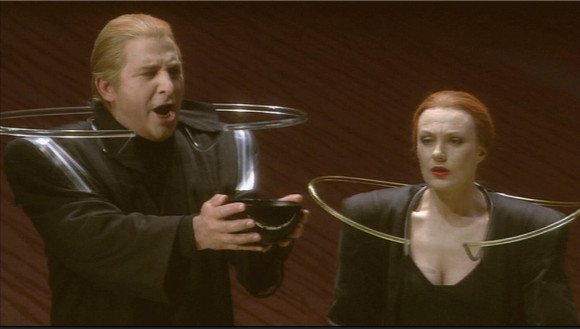
John Adams’ El Niño was conceived as an oratorio but thoughts turned to it being staged early in the creative process. The final result, as staged at Paris’ Châtelet in 2000, defies easy characterization. There are singers and dancers on stage but they don’t represent unique characters. So, for example, at one moment Willard White is Herod and at another Joseph. To further complicate matters video is constantly projected onto a screen above the stage space. It was specially created for the piece being shot on location in Super 8. There’s no clear narrative either. To some extent it tells the Christmas story but it’s at least as much about the feminine experience of giving birth as anything from Isiah or the Gospels. It also uses a very eclectic mix of texts; from the Bible, from the Apocrypha, from female Latin American poets, from Hildegard of Bingen and so on. There are lots off Sellars’ trademarks in the staging too; semaphore and so on. Does it work? I don’t really know as it’s really hard to tell from the video recording (see para 3).
Bard of sex and Eros kinky
The sudden death of Italian opera has always intrigued me. Works, by Italians or to Italian libretti, dominated opera houses, at least in the English speaking world, for centuries. The Metropolitan Opera even commissioned new work in Italian (Puccini’s La Fanciulla del West, 1910). But after Turandot (1924) new works in Italian pretty much dried up. I can’t think of a single one that could be considered a repertory staple and even more recherché pieces like Pizzetti’s Assassinio nella Cattedrale are few and far between. Indeed, since WW2 at least, the dominant language for new operas has been English with German some way behind and the odd work in French or something more obscure. So, I was intrigued to get my hands on a recording of Luca Mosca’s 2007 work Signor Goldoni; a commission for Venice’s La Fenice inspired by the 18th century Venetian playwright and librettist Carlo Osvaldo Goldoni. What’s really surprising is that the libretto (perhaps we should say “book”) by Italian writer Gianluigi Melaga, is in English! Apparently librettist and composer consider that English is better adapted to the kind of word play they were aiming for than Italian.