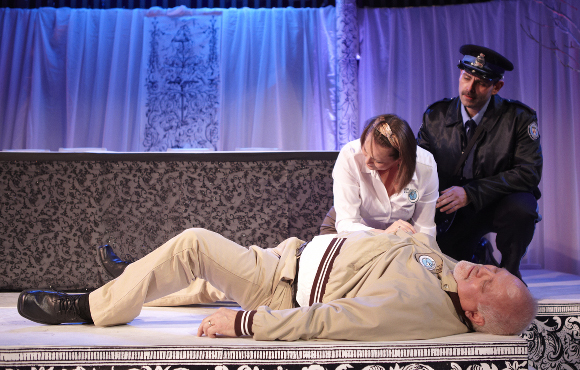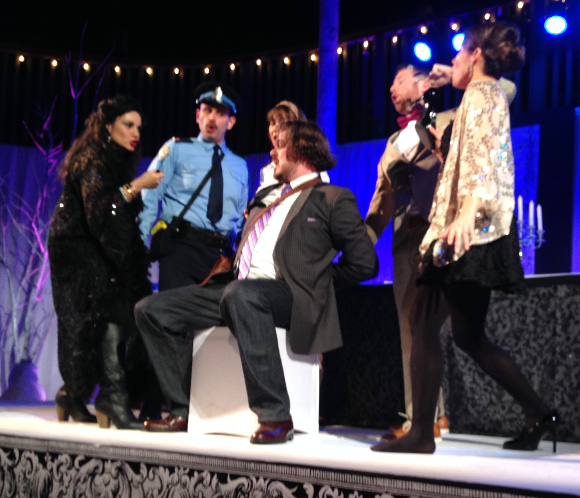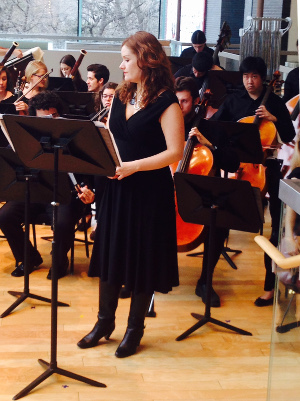
Obeah Opera is an ambitious work using music, words and dance to explore some aspects of the 17th century Salem witch trials through the eyes of enslaved African women. It’s being presented by Nightwood Theatre and Culchaworks Arts Collective as part of the New Groundswell Festival. The central character is Tituba, a traditional healer and practitioner of Obeah; a traditional religion or system of magic. The narrative takes us through the transportation of the women from Barbados to be sold in Salem and their lives as domestic servants to the pivotal point where Tituba saves the life of the sick daughter of the local minister and is accused of witchcraft. Along the way we get some very high energy action from the large cast, especially where African themes are explored. It’s an all female cast and the music is all sung a capella. This was also a workshop of a work in progress intended for the arts festival at next year’s Pan-Am games so last night did not represent the finished product.
Author Archives: operaramblings
Pergolesi double bill
Pergolesi’s relatively popular comedy La serva padrona was originally intended to be performed as an intermezzo for his opera seria Il prigionier superbo. It’s therefore fitting that recordings by substantially the same forces, though recorded two years apart, should be released as a package. The recordings were made at the Teatro G.B. Pergolesi in Jesi in 2009 and 2011 respectively. Both performances were directed by Henning Brockhaus and feature the Accademia Barocca di I Virtuosi Italiani conducted by Corrado Rovaris. The works are presented on separate disks rather than the having the two halves of the intermezzo inserted in the intervals of the more serious work as they would originally have been performed.
And so it begins
So, after the rather scattered events of the summer last night’s fundraiser for Opera 5 at Atelier Rosemarie Umetsu felt like the start of a new season. It was well attended and organised in an intriguing and fun format. Basically, Team Day and Team Night were competing to see who could raise the most money. There were four rounds in which a singer from each team presented an aria, song or MT number. The one with the most pledges got to sing his or her “show off” aria. For an additional donation, the loser got to do the same. Given that some of the city’s best young singers were performing it was to be expected that it was a good show.
La Monnaie, a python and the Holy Grail
There’s a bit at the end of the first act of Parsifal where Gurnemanz looks at Parsifal and says “you haven’t understood anything have you?” or words to that effect. Watching Romeo Castellucci’s 2011 production for Brussels’ La Monnaie theatre my sympathy was very much with the Pure Fool. This is one of the most incomprehensible productions I have seen. Act 1 is very dark. Most of the time only a tiny fragment of the stage is lit. The first thing we see is a snake in its own tiny patch of light. Then we are in a forest and the Grail Knights appear to be part of the forest. Whether they are just wearing suits of leaves or are actually plants is unclear. Kundry, in a white hoodie, and Parsifal in street clothes are recognisably human. Titurel and his squires wear overalls and hard hats. One of them carries a chain saw. The “swan” appears to be a lit up tree branch though later it appears as a very decomposed skeleton. The Grail Scene is played out with a white curtain, with a small black comma on it, across the entire stage. The curtain is withdrawn and we see fluorescent lights above the greenery, which takes up much less space than one has so far imagined. Is Monsalvat a grow-op and the knights marijuana plants?
Make him cry blood
Written on Skin; music by George Benjamin, text by Martin Crimp, was first seen at the Aix en Provence festival in 2012. The following yewar it was given, in the same production by Katie Mitchell and with substantially the same cast, at Covent Garden. Both versions were televised and now the ROH version has been released on DVD and Blu-ray. It’s an unusual, complex and rewarding work. 21st century angels decide, for reasons not entirely clear, to return to the 13th century to create and participate in a human drama. The medieval humans are The Protector; a rich man of mature years utterly confident of his privileged position and his own righteousness, and his wife Agnès; younger, illiterate, downtrodden. Into their world comes The Boy; one of the angels in fact, who will create for The Protector an illuminated book; a precious object celebrating his wealth and worthiness. Inevitably, The Boy and Agnès fall in love and The Protector’s revenge, whipped up by the angels, is quite revoltingly violent. It’s essentially a simple and classic plot but Crimp shapes it skilfully with carefully placed anachronisms and by using the device of having the characters, sometimes, narrate their own actions in the third person. Benjamin’s score is in a modern idiom. He’s not afraid of atonality and he uses a very wide range of colours to create a score that ranges from meditational to almost unbearably violent. Certainly words and music work together here to great effect.
Toronto Operetta Theatre and Toronto Masque Theatre 14/15
Toronto Operetta Theatre and Toronto Masque Theatre have announced their respective 2014/15 season line ups. TOT will present three shows. The first is a zarzuela; Federico Chueca’s La gran via. Jose Hernandez conducts and the cast includes Margie Bernal, Fabian Arciniegas, Pablo Benitez and Diego Catala. There’s one performance on November 2nd. The Christmas show will be Gilbert and Sullivan’s The Mikado. Singers include Lucia Cesaroni, Mia Lennox, David Ludwig and Giles Tomkins with Derek Bate conducting. There are six performances scheduled between December 27th and January 4th. Finally, and perhaps most exciting, is a revival of Victor Davies’ 2008 piece Ernest, the Importance of Being. It’s based on the Wilde play and will star Jean Stilwell as Lady Bracknell. Larry Beckwith conducts. There will be four performances on April 29th and May 1st to 3rd. All three shows will be directed by Guillermo Silva-Marin and will be staged at the St. Lawrence Centre for the Arts. (www.stlc.com)
Ciro in Babilonia
Ciro in Babilonia is an early work by Rossini composed for the lenten season when only works on biblical/religious themes were permitted. This doesn’t really fit that description. Sure, the story of Belshazzar and the writing on the wall gets a brief look in but it’s almost interpolated in the story, from Herodotus, of Cyrus’ capture, together with wife and child, by Belshazzar. It’s a tale of arrogant kingship, religious faith and marital devotion. Typical opera seria stuff really. It’s a bit thin plot-wise though which probably explains its relegation to obscurity. This first modern production was created at Caramoor, then translated to the Rossini festival at Pesaro, where it was recorded in 2012.
Fun with Opera 5
The always entertaining Opera 5 have a couple of events coming up. Firts there’s a fundraiser at Rosemarie Umetsu’s called Equinox: Day vs. Night. Two teams of singers, Team Day and Team Night, will battle for the greatest prize of all: Ruler of the Sky! It’s on Tuesday September 9th at 6pm and there will be drinks and food provided by the University Avenue Fionn MacCools 181 University Avenue. We are promised performances by Claire de Sévigné, Lucia Cesaroni, Peter Bass, Jeremy Ludwig, Beste Kalender, Maika’i Nash and more. Let’s hope it’s a bit cooler than last year! Tickets are $25 and can be purchased here: https://be-mused.ca/group/opera5
Then there’s the show postponed from the Spring which will open the new Alliance Française de Toronto – Centre cultural Theatre. It features performances of Reynaldo Hahn’s L’île du rêve and Jacques Offenbach’s Ba-ta-clan. Performances are at 7.30 pm on September 19th, 20th and 21st. The Alliance Française is at 24 Spadina Rd (just north of Bloor) and just happens to be where I learned that the First Gulf War had begun. Tickets as above.
The way by swan
No Madelaines were harmed in reviewing this DVD. It’s a 1992 recording from the Wiener Staatsoper of, of course, Lohengrin and its main claim to fame is that stars Placido Domingo (note no further jokes about water fowl despite the prominent role of Heinrich der Vogler). It’s one of those DVDs from the 80s and 90s that are a bit frustrating. The singing is very good indeed. Domingo is superb and the rest are at least very good plus Abbado conducts with real flair but the production is dull as ditch water and the video quality is awful.
That elusive new audience
The other night I was chatting to some folks at a performance by Loose TEA Theatre and a comment was made to the effect that it was companies like Loose TEA and Against the Grain who were creating the future audience for opera. I didn’t think about it much of the time but it turned into a sort of brainworm that wouldn’t go away. I don’t think the idea was that somehow innovative “pop up” type companies would replace the likes of the COC; at least not this side of nuclear war or total economic collapse (neither of which seems impossible it has to be said). So the hypothesis has to be that this sort of endeavour makes a significant contribution to replacing the aging “big house” audience. As I began to mull that over and further stimulated by yet another fact free piece in The Guardian on “opera snobs” (courtesy of Schmopera) I started to develop a number of lines of enquiry that aren’t exactly tangential to the original hypothesis but rather seem more like a set of eigenvectors defining the problem space. Which is a mathematician’s way of saying that what follows is kind of all over the place.