Unknown's avatar

About operaramblings

Toronto based lover of opera, art song, related music and all forms of theatre.

Are you my mother?

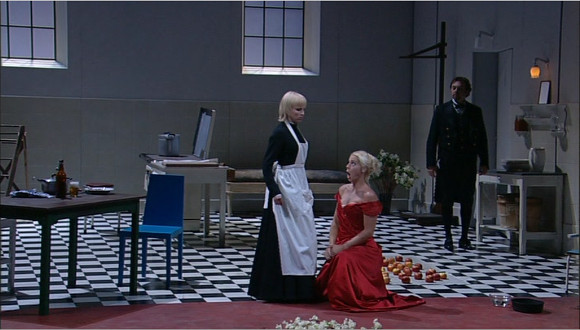
Donizetti’s Lucrezia Borgia is based on one short episode in the storied life of the famous female pharmacist.  In it she twice poisons her son; once at the insistence of her husband, the second time by accident.  The second time her son refuses the antidote preferring to die with his equally poisoned buddies but learns in his dying breath that Lucrezia is indeed his mother.  It’s pretty unusual for a bel canto opera in that the leading female role (a) has agency, (b) doesn’t go mad and (c) doesn’t die.

1.mumson Continue reading

Moving into October

October is the month things usually really get going again in Toronto and this year is no exception.  The calendar for the first third of the month is very busy.  Highlights include three free concerts in the Richard Bradshaw Amphitheatre, the opening of two productions at the Canadian Opera Company and Nuit Blanche events at the Canadian Music Centre and the UoT Music Department.

fall101308_6 Continue reading

With tender pity swells

Here’s another fine example of how well Handel’s oratorios can work when staged.  It’s a recording of Hercules made at Paris’ Palais Garnier in 2004.  The staging is by Luc Bondy and William Christie and Les Arts Florissants are joined by a youngish cast of extremely good singers.  It’s compelling stuff.  I think what, for me, makes the oratorios much more interesting than most of Handel’s opera seria is structural.  The operas tend to alternate recit and da capo aria with maybe a duet or chorus to close an act but they are pretty predictable.  In the oratorios Handel makes much more use of ensembles and the chorus and, for me, that’s vastly preferable.

1. Lichas_Dejanira Continue reading

Here we go again

Yesterday lunchtime saw the first free lunchtime concert of the season in the Richard Bradshaw Amphitheatre.  Following tradition, it was presented by the members of the Ensemble Studio.  Or, to be more accurate, by six of the nine as an unprecedented three singers had fallen victim to the virus that is apparently sweeping the Toronto opera world (HighCbola?).

Credit: (l-r) Jennifer Szeto, Andrew Haji, Karine Boucher, Charlotte Burrage, Clarence Frazer, Jean-Philippe Fortier-Lazure, Iain MacNeil. Photo: Karen Reeves

Credit: (l-r) Jennifer Szeto, Andrew Haji, Karine Boucher, Charlotte Burrage, Clarence Frazer, Jean-Philippe Fortier-Lazure, Iain MacNeil. Photo: Karen Reeves

Continue reading

Roots

durhamcathedralI was talking to Leslie Barcza of barczablog at a concert yesterday.  He asked me what I was most looking forward to in the upcoming season and I was a bit stumped for an answer because there’s lots of good stuff in Toronto this season but nothing that really sets my pulse racing.  Finally I answered with the TSO’s Dream of Gerontius, which, it turns out, is not exactly high on Lesley’s bucket list.  This led to a brief discussion about how origins affect our reactions; that is until the actual concert interrupted our talk.

Continue reading

Historic Ariadne

Opera videos of performances before 1980 are quite rare and are mostly films.  Recordings of live performances are extremely uncommon and often quite interesting.  A couple have just been rereleased on DVD.  The one reviewed here is an Ariadne auf Naxos from the 1965 Salzburg Festival (the other is a recording, in German, of Don Giovanni with Fischer-Dieskau – watch this space).  It’s an old ORF TV broadcast with a grainy 4:3 black and white picture and less than stellar mono sound but it does provide an idea of what audiences saw and heard fifty years ago.

1.haushofmeister Continue reading

Abstraction from the Seraglio

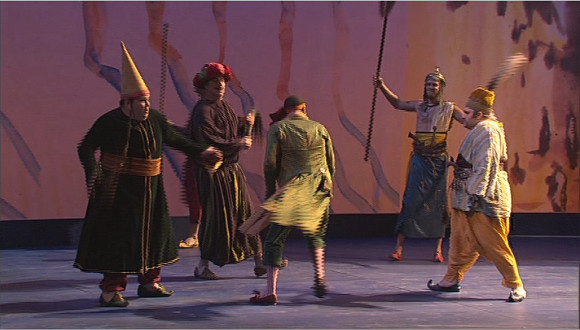
Mozart’s Die Entführung aus dem Serail is a problematic opera.  It’s got some great music but the libretto is pretty weak and its depiction of Turks is pretty unflattering.  Maybe it seemed edgy less than a hundred years after the Ottomans besieged Vienna but today it just seems mildly embarrassing.  Fortunately it’s a singspiel with dialogue rather than opera with recitatives so it’s fairly easy to play with the story line.  For his 1998 production Stuttgart at the Staatsoper Stuttgart, Hans Neuenfels goes much further.  He double each of the singers with an actor and pretty much rewrites the dialogue.  He also introduces an element of metatheatre.  This is a performance and everyone knows it.  For example when Pedrillo is asked how he’s going to get hold of a ladder for the escape scene he replies that he’ll use the one they always use in this opera.

1.osmins Continue reading

Opera 5 do Hahn and Offenbach

Opera 5’s latest show presents two rarely seen French one act operas.  First up was Reynaldo Hahn’s  1897 work L’île du rêve.  It’s one of those French officer falls in love with beautiful sixteen year old girl on tropical island and then “duty” calls and he dumps her and she dies of a broken heart pieces.  The only twist is that here he offers to take her back to France but the ruling princess advises her that, away from the island, she will lose her charms and he’ll come to despise her so she doesn’t.  A touch of French worldliness colouring this rather overdone plot device perhaps?  The staging, by Aria Umezawa, is fairly simple though clearly a lot of thought went into how to make the intimate scenes between the principals work.  There are also some rather beautiful projections involved.

O5-Offenbach & Hahn-L'ile 1 Continue reading

The other Plymouth pilgrims

I suppose in some ways Bellini’s I Puritani is the perfect bel canto opera.  It has lots of great tunes, a wicked coloratura soprano part and an utterly ridiculous plot (my comments on the plot can be found in my review of the Met/Netrebko recording) and, of course, a mad scene.  In this recording from Barcelona’s Liceu the soprano role of Elvira is taken by Edita Gruberova, surely one of the greatest ever in this genre.  At 54 she doesn’t look ideal for the young bride to be but she can act and she gives a master class in bel canto style. What she has to yield to Netrebko in terms of looks and physical commitment she makes up for in sheer technical prowess.

1.soldiers Continue reading

Natalie Dessay showcase

Le miracle d’une voix is a compilation of scenes from various recordings in which Natalie Dessay featured made between 1993 and 2003.  It’s especially interesting in that a couple of pieces feature more than once.  There are three Les oiseaux dans les charmilles; Olymia’s aria from Les contes d’Hoffmann and two Grossmächtigen Prinzessin from Ariadne auf Naxos.  Thrse demonstarte what I have always believed to be Dessay’s greatest strength; her ability to recreate a character to fit in a particular production.  The two Zerbunetta arias illustrate this perfectly.  In the first, a Salzburg production from 2001, Zerbinetta is a depressed, heavy drinking, prostitute who celebrates a kind of deeply sad sisterhood with Ariadne before being dragged off by a very sleazy Russell Braun.  In the second, from the Palais Garnier in 2003, she’s a bubble headed tourist in bikini and wrap who pesters poor Ariadne all around what looks like a Mediterranean building site.  They are completely different characterisations but both highly effective.  The same is true of the three Olympias who range from very conventional doll to inmate in some sort of asylum or home.

1.zerbinetta Continue reading