Moving into February

footstepsIt’s getting pretty busy in Toronto.  Here are a few upcoming things of interest that I haven’t already mentioned.

This year, the Faculty of Music’s annual student composer project is a co-production with Campbell House Museum, the 19th century home of Sir William Campbell, Chief Justice of Upper Canada. Footsteps in Campbell House is a series of pieces by student composers to words by Michael Albano.  The audience moves around the house exploring the lives of those who livedd there.  There are five performances on January 30th and 31st and February 1st.  Each performance is limited to 35 people.  Tickets are $20 and available here.  I’m really intrigued by this but there’s no way I can go.   Continue reading

Canadian Opera Company announces rather more than just the 2015/16 season

Last night was the “event” at which the COC brass and guests, with a bit of help from Brent Bambury, announced the upcoming season to a packed house of subscribers and friends.  What struck me was how much news was packed in.  It was far more than the usual schedule presentation with announcements of several major new projects.  But first the season.   Continue reading

I ask on my knees, as a blessing, for death

So sings the heroine of César Franck’s early piece Stradella, Léonor, during her abduction and imprisonment by the Duke of Pesaro.  I felt pretty much the same watching the 2012 production from L’Opéra Royale de Wallonie.  The company has a well deserved reputation for reviving neglected works from the French repertoire.  I suppose once in a while if one does that one is pretty sure to come up with a complete turkey and, frankly, that’s how I’d classify Stradella.  Franck left it in piano score and it was orchestrated recently by Marc van Hove so the 2012 Liège production is the premiere.  The plot is essentially trivial.  Stradella, a singer and protegé of the Duke of Pesaro is in love with Léonor, an orphan.  They plan to marry secretly but the duke is also obsessed by the girl and has her kidnapped.  Stuff happens and they both end up dead and the duke repents.  Stradella and Léonor are united in Heaven.  The music is rather dull and highly sentimental.  The sentimentality is reinforced both by the injection of a bunch of morbid religiosity into the plot and the overuse of a children’s chorus.  In fact I ended up wondering whether “Stradella” wasn’t the brand name for a Belgian artificial sweetener.

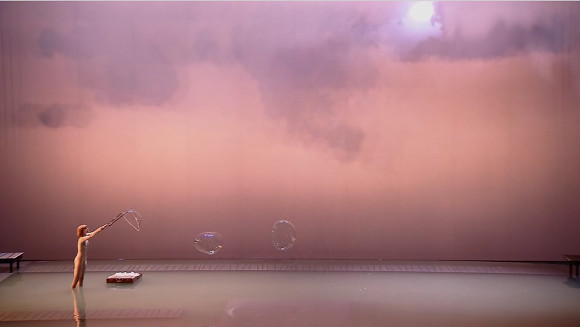
1.bubbles Continue reading

On reviews and reviewing

kc_criticsJenna over at Schmopera recently published a piece on companies comping or refusing to comp critics with reference to recent spats at La Scala and Opera Australia.  I was going to comment but on reflection I felt that I had rather more to say on the subject than was appropriate to a comment.  I was also reflecting on a brief conversation I had on Sunday with a fellow blogger in which he described his relationship (briefly and in passing) with the company whose event we were attending as “parasitic”.  I didn’t and don’t agree with that statement.  I think there’s a symbiotic relationship between “critics” (for want of a better word) and the promoters of the product they review.  Arts organisations need publicity.  It’s part of what puts bums in seats.  Critics need material to write about.  We get comped because we do something that companies need.  Not because we are special little snowflakes.  Not because there’s some sort if inherent media right to free tickets.  And above all not because it’s somehow to do with free speech; a term that has been abused so much in the last week that it almost makes me want to throw up.  So, as far as I am concerned an opera company has an absolute right to comp or not to comp an individual or an organisation as they choose.  Of course if one chooses to blacklist the Sydney Morning Herald’s main critic it’s going to have repercussions and, frankly, if I were editor of that paper, Opera Australia would be ignored.  And, equally frankly, the actions of that company seem to be the sole work of a petulant GM with an oversized ego, but there you go.

Continue reading

In 1618 twelve million people lived in Germany

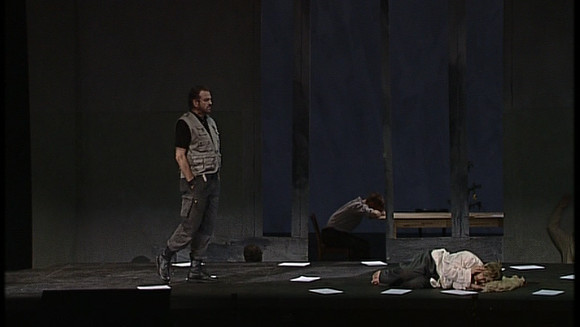
Sometimes one comes across a previously unfamiliar work that just blows one away.  Karl Amadeus Hartmann’s Simplicius Simplicissimus did that to me.  It’s a work written by Hartmann in 1934/5 as he watched the early years of Nazi power and the banning of “degenerate” art.  By the time it got its premier in 1949 it’s story of a Germany physically and morally ravaged by war would seem all too prescient.  It’s a simple story based on the early chapters of a novel by Grimmelshausen set during the Thirty Years War(1).  It concerns a simple shepherd boy who is drawn into the conflict.  There are three scenes.  In the first, the entirely innocent boy witnesses the brutal destruction of the farm he works on by vagrant Landsknechten.  In the second he is befriended by a hermit and undergoes a sort of moral education before once again being left abandoned by the hermit’s death.  In the thirdhe becomes jester to the drunken and corrupt Governor; the idiot who tells the truth, until all is overthrown by a Peasant’s Revolt.

1.landsknecht Continue reading

More news and stuff

pmcgUpcoming gigs that haven’t made it onto the page here yet include Tapestry Songbook V which will include highlights from works such as: The Perfect Screw (Abigail Richardson/Alexis Diamond), a cheeky comedy about a woman in search of the perfect screw—a Robertson or a Philips; The Shadow (Omar Daniel/Alex Poch-Goldin), a melodrama where a mailman disguises himself as a suave bachelor at the turn of 20th century Barcelona; In this World, George is Heartbroken (Lembit Beecher/Hannah Moscovitch), a psychological exploration of the demented imagination of a middle aged couple paralyzed in routine; and Noor over Afghan (Christiaan Venter/Anusree Roy), a story of a woman who, upon discovering her terminal illness, begs her sister to take her place at the altar as she flees on her own wedding day.  The performers will be (now fully bipedal) baritone Peter McGillivray and pianist Stephen Philcox.  It’s at 8pm at the Ernest Blamer Studio and the $24 tickets include a reception afterwards.  The snag?  The COC’s Don Giovanni opens that evening.

Also coming up is The Whisper Opera, a Soundstreams presenetation in partnership with New York’s International Contemporary Ensemble (ICE).  The venue, The Theatre Centre at 1115 Queen Street West only seats 52 and there are only six performances and we are promised it will never be recorded or done on a bigger scale.  Sounds intriguing.  Anyway, right now, the first three performances are being discounted 40% (regular $57.50 – do the math) from the Royal Conservatory Box Office using promo code LISTEN.  Good until January 16th.

First we take Manhattan

Irving-BerlinYesterday the Talisker Players ventured into new territory for them with a program of Irving Berlin songs entitled Puttin’ on the Ritz.  I’m no expert on Broadway in general or Tin Pan Alley in particular but, I suppose like most people, I’ve been exposed to a lot of this music through TV and films.  The Talisker presentation was interesting and unusual in that they employed a string quartet and two classically trained singers rather than a dance band or a pianist and voices from a different tradition.

Continue reading

Anne Sofie von Otter and Angela Hewitt at Koerner Hall

hewittI don’t usually give colloborative pianists headline billing but last night’s packed Koerner Hall recital certainly had an element of “They came for Ms. von Otter but stayed for Ms. Hewitt”.  Hewitt was phenomenal in a program that interspersed solo piano pieces with sets of songs.  In the songs she was simultaneously an individual voice and supportive of her colleague while the solo piano pieces were breathtaking; elegant Scubert and Brahms before the interval, staggeringly virtuosic Chabrier after.  She’s also fascinating to watch.   Continue reading

Poppea; stylised but stylish

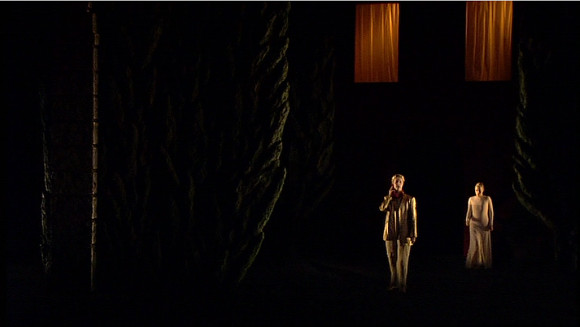
Klaus Michael Grüber’s production of Monteverdi’s L’incoronazione di Poppea, recorded at the Aix-en-Provence festival in 2000, is both stylish and stylised.  The stage and costume designs, by Gilles Aillaud and Rudy Sabounghi, are extremely elegant and, at times, very beautiful.  The Seneca scenes at the beginning of Act 2, set in a sort of lemon grove, are especially effective as ai the use of painterly backdrops looking like Greek vase paintings reinterpreted by a fauviste.  The director complements the designs with a somewhat formalised acting style that fits rather well. He also makes some changes to the narrative to tighten up the drama, dispensing with Ottavia’s nurse and ending with Pur tí miro, rather than Poppea’s coronation.  Coupled with excellent acting performances it’s a straightforward but effective way to tell the story.

1.entrance Continue reading