Voicebox: Opera in Concert 2014/15 season

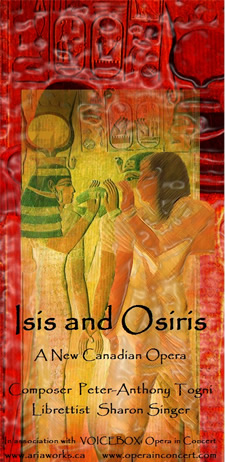
Isis and OsirisAccording to Schmopera, the line up for 2014/15 for the Voicebox: Opera in Concert season at the Jane Mallett Theatre will be Manuel de Falla’s La Vida Breve, Weill’s Street Scene, Charpentier’s Louise and the premier of Isis and Osiris by composer Peter-Anthony Togni with a libretto by Sharon Singer, both Canadians.  The only one of these I’m at all familiar with is La Vida Breve, which is rather good (DVD review).  However there’s plenty of information on Isis and Osiris available here and here.  The latter link includes almost 18 minutes of music from the piece.

All in all, as one has come to expect from Voicebox, an interesting line up.  More details here as they become available.

Cheap enough for beggars

Last night I went to see Essential Opera’s cheap and cheerful production of Brecht and Weill’s The Threepenny Opera.  It was a semi staged production in the relatively small Heliconian Hall.  Semi-staged in this case meant sung in costume from music stands with very basic blocking.  Accompaniment was by Cathy Nosaty on piano and accordion which actually suited the music pretty well.

The singing was good, sometimes very good.  Probably the stand out was Laura McAlpine’s Jenny.  Of all the singers on display she was the one who seemed most immersed in the sound world of the piece and could vary style and technique appropriately.  Erin Bardua’s Lucy Brown was really quite idiomatic too.  The others were more consistently operatic which sounded a bit odd in places but worked surprisingly well in, for example David Roth and Heather Jewson’s rather refined refined and bourgeois Peachums.  Obviously this approach also worked for the character who are usually sung operatically; Macheath, Brown and Polly for example.  The ensembles were all also very effective.

Continue reading

The Scrapheap of Capitalism

The 2010 La Fura dels Baus Madrid production of Weill’s The Rise and Fall of the City of Mahagonny is much the best version of the piece I’ve seen on DVD.  The production starts and ends on a rubbish dump and the dump and its people, curiously reminiscent of the vegetarian terrorists in Delicatessen, are present pretty much all the time.  It doesn’t pull any punches and tackles Brecht’s characteristically unsubtle parody of commodity capitalism straight on and without sentimentality or apology.  Perhaps the most effective scene is the sort of “orgy by Frederick Taylor” that accompanies Second comes the loving match in Act 2 but there are lots of telling moments from the widow Begbick first appearing from a derelict fridge to the pyre of mattresses on which Jim is executed.  Curiously perhaps the piece is given in Michael Feingold’s English translation but it’s a very good translation and little or nothing is lost.

Continue reading

One can rob a bank or use a bank to rob others

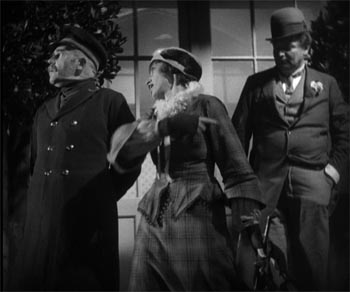
I don’t really know whether the collaborations between Brecht and Weill deserve to be called operas but some of them at least are sung by opera singers and produced in opera houses so I think they are legitimately within the ambit of this blog.  Arguably the best known of them all is Die Dreigroschenoper which premiered in Berlin in 1931.  I’ve seen it a couple of times in English translation and, like most people I guess, I’m familiar with the music (in both English and German) through recordings by people like Lotte Lenya, Ute Lemper and Robyn Archer.  With that background I was very interested to take a look at the 1931 film of the work directed by GW Pabst. Continue reading

Against the Grain’s Seven Deadly Sins

Last night we headed out to that part of the formerly industrial west end much beloved by tiny arts organizations to see a thoroughly eclectic series of performances by Against the Grain Theatre. This is the company that previously brought us a genuinely Bohemian La Bohème at the Tranzac club. Last night’s show cunningly built on that success by using the undoubted crowd pleaser, Lindsay Boa-Sutherland, to headline a performance of Weill’s Die sieben Todsüngen. Since the orchestra was replaced by two superbly virtuosic pianists in Daniel Pesca and AtG music director Christopher Mokrzewski it made sense to include two fiendish pieces for two pianos; Steve Reich’s Piano Phase and John Adams’ Hallelujah Junction. The program was balanced up for “virtue” with Britten’s Abraham and Isaac. So, a thoroughly eclectic but oddly coherent line up.

Continue reading

Curiously bland Brecht/Weill

Brecht and Weill’s Rise and Fall of the City of Mahagonny is an awkward work for an opera company. It’s been said, rightly I think, that one can/must situate it in a triangle of which the vertices are opera, musical theatre and Brechtian theatre. John Doyle’s 2007 production for Los Angeles Opera is strong on the opera and musical theatre dimensions but decidedly unBrechtian. Despite a good idiomatic translation by Michael Feingold this production seems unwilling to skewer capitalism in the manner Brecht intended. It’s the polar opposite of the Salzburg recording that left no Marxist cliche unexplored. Maybe it’s a failure of nerve. Maybe capitalism in LA is already such a parody of itself that further skewering is impossible. Who knows? Even Act 2, which is all about the commoditization of basic human pleasures doesn’t really fire. Sure we get excess and commoditized sex but there’s no sense that the commoditization is dehumanising or transgressive. Sex for sale? Of course! It does get a bit darker in the final act with the trial and execution of Jimmy and finishes strongly on “Still we only built this Mahagonny” but by then it’s very much too little, too late. The lack of edge is reinforced by the orchestra under James Conlon. It’s all just too civilized. There’s none of the spiky dissonance one is used to in the score and the brass, in particular, sound like they are playing in the Palm Court of the Hilton.
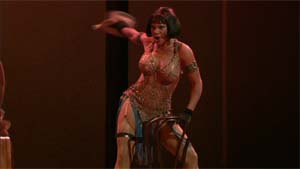
It’s a shame because the singing performances are mostly very good. The leading female roles are played by Patti LuPone and Audra McDonald who both have Broadway backgrounds. LuPone sounds like that’s where she’s from too though McDonald manages a much wider range and pretty much steals the show. It helps that she is very good looking and practically naked. The guys are mostly from opera backgrounds; notably Anthony Dean Griffey as Jimmy McIntyre and Donnie Ray Albert as Trinity Moses. Both sing well and idiomatically. The sets are sort of Vegas lite with none of the inexplicable weirdness of the Salzburg production but not much interest either. Again things look up a bit in the last act with effective use of a giant video screen in the trial scene and moving slogans over the finale. Blocking is very Broadway, especially the big chorus numbers that look more Rodgers and Hammerstein than Brecht and Weill.
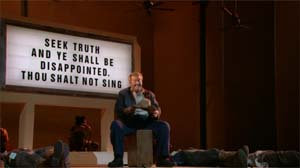
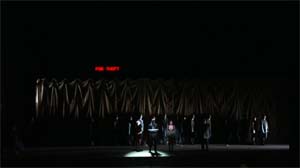
Video direction is by Gary Halvorson and it’s judicious. There’s often not much set to look at so we might as well have close ups of Ms. McDonald. The technical package is solid. The picture is high quality 16:9. The sound choices are PCM stereo, DD 5.1 and DTS 5.1. The last is nicely balanced and clear There are French, German and Spanish subtitles. There’s a useful essay in the booklet which gives full track listings and a 20 minute interview with the director.

Freedom for the Rich

Brecht and Weill’s Rise and Fall of the City of Mahagonny might seem a peculiar choice for the Salzburg Festival but it was performed there in 1998 and was broadcast by ORF and subsequently issued as a DVD on Kultur in North America and Euroarts in Europe.

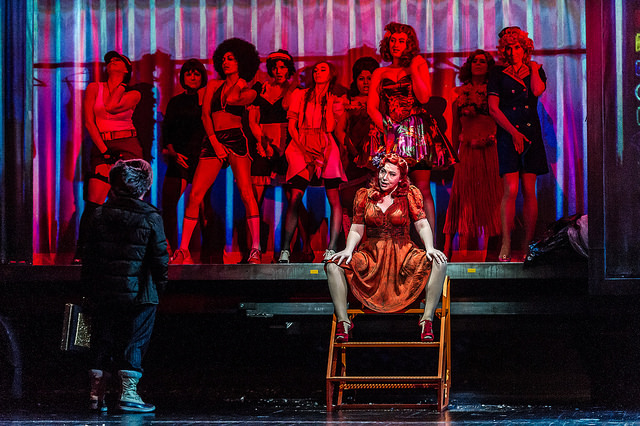
The musical style is pretty similar to most other pre USA Weill works; it sounds more like cabaret than grand opera and feels as if it would benefit from a more intimate setting than the Grosses Festspielhaus. One also feels that the director (Peter Zadek) is trying a bit too hard to fill up the space; There’s lots of “stuff” and busy action that doesn’t seem to add any meaning. It’s a problem I’ve also noticed with the Met HD broadcasts. A bigger problem though lies in the casting. Voices that can fill a huge theatre are maybe not the most idiomatic for this music. The problem really comes over with the women. Dame Gwyneth Jones as the widow Begbick is truly a piece of WTF casting. Catherine Malfitano as Jenny (a role created by Lotte Lenya) is better but still a bit overly operatic. She does act very well though. The one clear success is Jerry Hadley as Jim Mahoney who seems to manage to be idiomatic and to project enough sound. His is a great performance. Among the other characters I thought Wilbur Pauley as a lean, even cadaverous, Trinity Moses really stood out. The orchestral playing is precise and jazzy at the same time. Dennis Russell Davies gets some really good playing from the Vienna Radio Symphony Orchestra.

The staging is eclectic and inevitably didactic. Brecht leaves no Marxist cliche unemployed and the staging and direction follows suit. The best examples are early in the second act where Jacob Schmidt is eating himself to death in a scene reminiscent of The Meaning of Life closely followed by a good deal of nudity and more; it seems to be veering towards anal fisting at one point, to underscore the commoditised nature of sex in capitalist society. During this extended indictment of commercialism, Mahoney moves through the orchestra into the audience and we get the irony of him singing surrounded by the Salzbourgeoisie in their finery. Subtle? Not so much. There’s also lots of weird symbolism in the sets; disembodied Statue of Liberty, elephant statues etc, that I just don’t get. All in all, this isn’t a bad production but it’s not one I can imagine watching very often and I feel like I want to see the more recent LA version to see if it’s more successful.

Technically, the DVD is of its era. The picture is 16:9. The only sound option is Dolby Digital 2.0. There are English subtitles only (This production is sung, mostly, in German). Brian Large (surprise!) directed for TV. For once, I don’t mind that he used a lot of close ups as much of the action cropped seemed to serve little purpose but to fill up space.

And in today’s “only connect” trivia moment I can point out that the premiere of Mahagonny was conducted by Alexander Zemlinsky whose Florentine Tragedy will be directed in Toronto this season by one Catherine Malfitano.

Here’s a link to the “Loving” scene from Act 2. Don’t play this at work!