Cavalli at the court of Louis XIV

Cavalli’s Ercole Amante is an oddity.  It was intended as a wedding present from Cardinal Mazarin to Louis XIV but got hijacked by Lully who inserted a bunch of ballets for the king to dance stretching out the piece to something like six hours.  It wasn’t a great success.  It’s also a very odd story for a piece intended for a royal patron as I explained in reviewing an earlier recording.  It’s also in Italian which may make the only French court work to be performed in that language.

1.allegory

Continue reading

La nonne sanglante

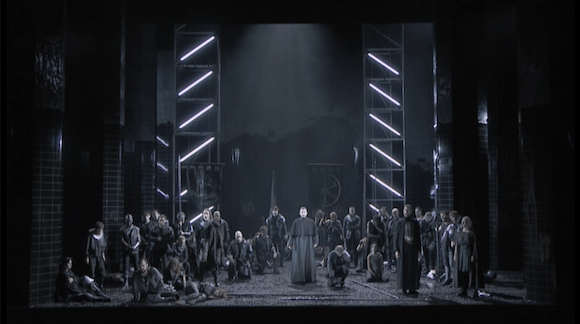
I guess there are two ways one can approach “Gothic Horror”.  Either one takes its conventions at face value as in, say, Bram Stoker’s Dracula or one treats it tongue in cheek; Jane Austen’s Northanger Abbey of the BBC Dracula from earlier this year.  It’s no surprise that in La nonne sanglante Gounod very much takes things at face value and, equally unsurprisingly chucks in a fair amount of Catholic religiosity complete with the unlikeliest characters wandering off to Heaven at the end.

1.feud

Continue reading

Dark Rusalka from Glyndebourne

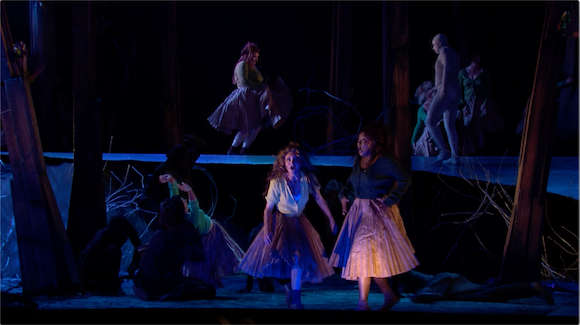
Melly Still’s production of Dvorák’s Rusalka, recorded at Glyndebourne in 2019 got rave reviews and, judging by the audience reaction on the recording. was enthusiastically received in the house.  Unfortunately I don’t think it works all that well on video despite some rather stunning stage pictures and generally strong performances.

Continue reading

Cendrillon – dream or nightmare?

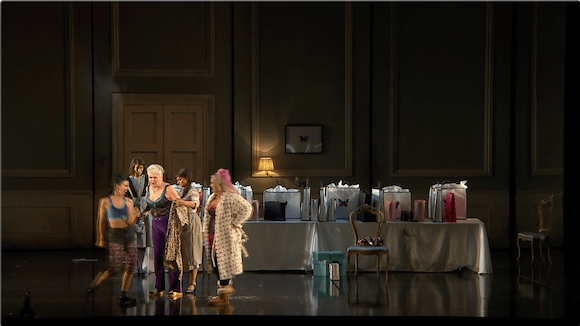
The libretto of Massenet’s Cendrillon is much more ambiguous than Rossini’s straightforward La Cenerentola and given that we all “know” the Cinderella story exploiting those ambiguities is likely to prove attractive to a director.  Fiona Shaw, whose Glyndebourne production was revived in 2019 under the revival direction of Fiona Dunn, finds rather more than. most.

1.shopping

Continue reading

The Magic Flute in the Hotel Sacher

Canadian design/direction team Barbe & Doucet were engaged to create a new production of Mozart’s Die Zauberflöte at Glyndebourne in 2019. As they explain in the introductory feature The Making of the Magic, they had refused for 20 years to tackle this work because of what they saw as its inherent racism and sexism. Part of the interest therefore in watching this recording is to see whether and how they deal with those two issues.

1.3ladies Continue reading

Le postillon de Lonjumeau

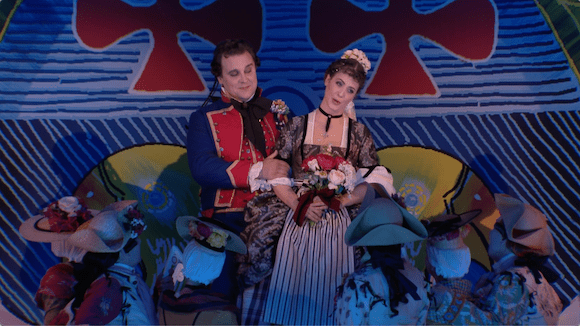
Most people probably know Adolphe Adam as the  composer of the music for the ballet Giselle but he was more than that. He was also a scholar who worked hard to study and revive the work of Rameau and other pre-Revolution composers. So, when tasked with composing a piece for the Opéra Comique he chose to combine elements that had produced previous “hits”; a vocationally based plot, a love story and so on with a Louis XV setting that allowed him to include pastiche Baroque. The result was Le postillon de Lonjumeau; a work that had much success across Europe during the mid 19th century (Wagner conducted it in Riga) but which had long disappeared from the repertory when the Opéra Comique revived it in 2019. Denise Wendel-Poray reviewed it in the Summer 2019 issue of Opera Canada and it has now been released on DVD and Blu-ray.

1.marriage

Continue reading

Abstracting the Dutchman

Olivier Py’s production of Wagner’s Der fliegende Holländer, filmed at the Theater an der Wien in 2015, is quite unusual.  Usually opera productions either play the story more or less straight or work with a concept of the director’s that is not obviously contained in the libretto.  Py doesn’t really do either of these.  What he does is present the narrative as Wagner wrote it but with visuals that act as a sort of commentary on, rather than a literal depiction of, the action being described.  One of the things this does is make the viewer realise just how much Wagner is describing!  There is much more tell than show.

1.satan

Continue reading

Butterfly in the 1950s

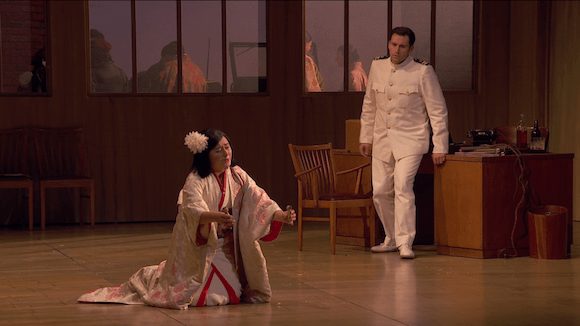
My quest to find a production of Puccini’s Madama Butterfly that has anything insightful to say about the piece continues.  This time it’s the 2018 production from Glyndebourne directed by Annilese Miskimmon.  I was interested to see how a female director would treat the obvious problems with the piece.  Miskimmon’s solution is to shift the setting to early 1950s Nagasaki and to treat Butterfly as one of many real and fake war brides.  Apparently there was a thriving fake war bride business at the time.  The obvious problem of a Nagasaki setting is just ignored.

1.butterflypinkerton

Continue reading

Creepy Wozzeck

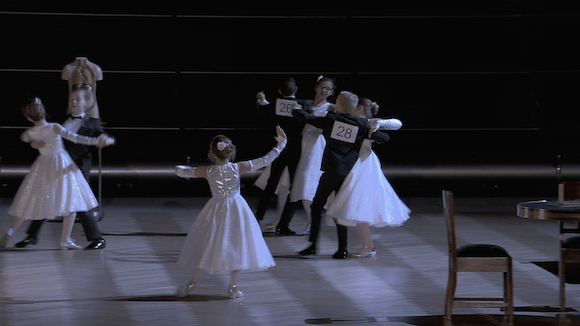
Alban Berg’s Wozzeck seems to attract just about every possible treatment from directors other than a straightforwardly literal one.  Krzysof Warlikowski’s approach, seen at Dutch National Opera in 2017, is to go back to the original story on which the Büchner play, in its turn the source for the opera, is based.  Wrapped around that are several interesting ideas which I can’t fully unpack but which make for a rather creepy but compelling production.  Alas, the disk package has nothing to say about the production so, interpretively, one is on one’s own.

1.dancers

Continue reading

More than the kitchen sink

I’m a bit surprised that Berlioz’ 1838 opera Benvenuto Cellini hasn’t come my way before. It’s got all the operatic elements; romance, politics, murder (and the Pope) etc and some really rather good music.  There’s a lovely duet between Cellini and his girl, Teresa, in the first act and Cellini’s aria Sur les monts les plus sauvages is long and demanding in the way that Rossini writes long and demanding tenor arias.  The plot maybe has a few holes.  One might expect that after the pope has decreed that Cellini will be hanged if he doesn’t finish a statue by nightfall that he might just get on with it rather than running around fighting duels and stuff but there you have it.  It’s French opera after all.

1.celliniarrives

Continue reading