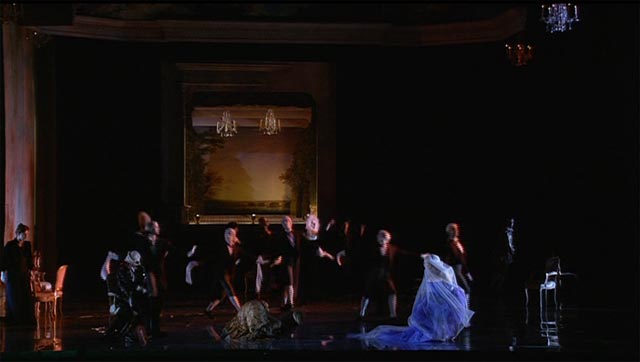
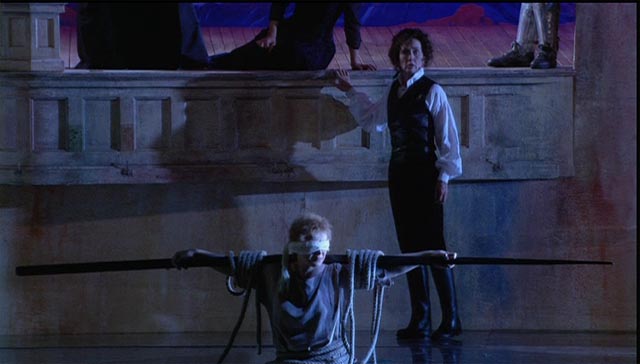
Handel’s Ariodante has, broadly, the same plot as Much Ado About Nothing. The King of Scotland’s daughter is framed as “unfaithful” by the bad guy’s disguised accomplice. Her fiancé goes off the deep end. The bad guy betrays his accomplice. She rats on him. He gets killed. All is revealed. Everybody but the bad guy lives happily ever after. In this 1996 production for English National Opera, David Alden seems to be turning it into a very dark plot with madness, intense and perverse sexual desire, hints of anal rape and a nude drowned in a tank. All in all, a pretty run of the mill Regie approach. Flippancy aside, it actually works quite well. It’s a bit of a slow starter. Act 1 is mostly scene setting and it’s not easy to see what Alden is driving at. Ariodante (Ann Murray) in particular seems to be prey to emotions that have, as yet, no obvious origin. To be honest I was quite puzzled at the end of Act 1 though there appeared to be much that was visually striking going on. At least, that’s what I’m guessing because video director Kriss Rusmanis does his level best to hide most of the stage most of the time.
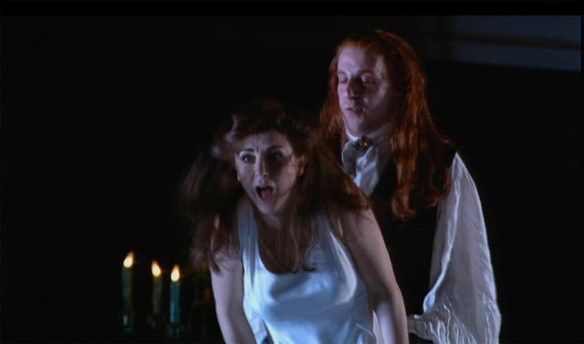
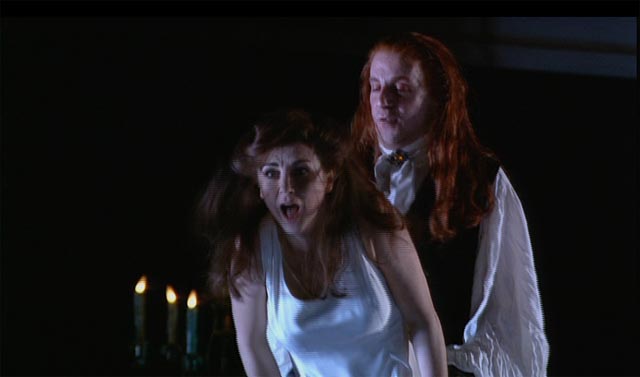
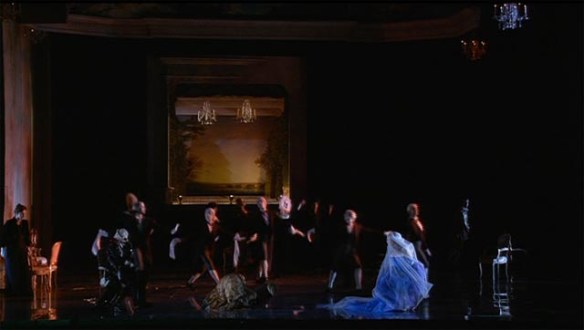 It picks up in Act 2 where we get more extreme emotion but it’s clearer why. In Act 1 Polinesso (Christopher Robson) is obviously the bad guy but his real nastiness emerges in his treatment of his accomplice/lover, Dalinda (Lesley Garrett). Among other indignities, anal rape appears to be suggested before he drags her off to have his henchmen finish her off. To be fair, Dalinda’s attitude to her treatment is quite equivocal so we can add this to a long list of opera productions with sado-masochistic sub texts.
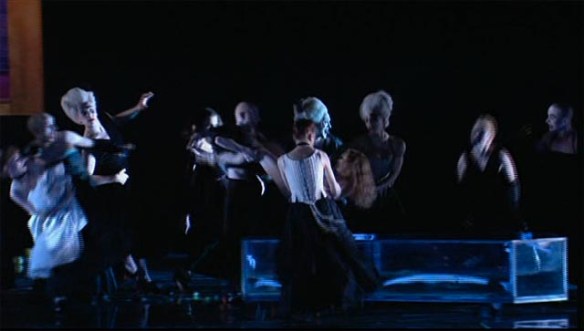
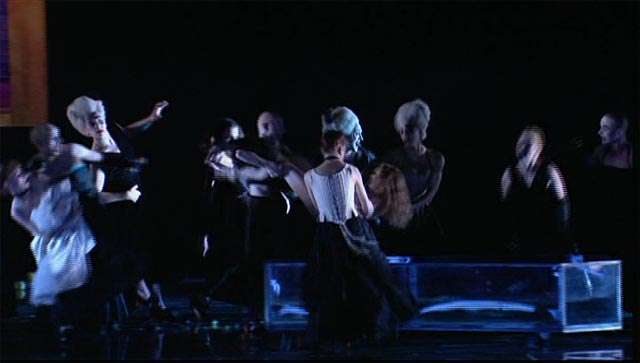
  Act 3, in which all is revealed is also dramatically strong besides having some of the best music. All three acts have fairly lengthy ballets. These are strikingly choreographed by Michael Keenan-Dolan. At least the bits we can see on the DVD are. There’s a particularly effective “nightmare” sequence in Act 2 where the princess Ginevra (Joan Rodgers) is trying to make sense of what has happened to her. The sets are quite painterly with effective use of an upstage window which is used to frame subtextual elements while the main action goes on in front. So, all in all, it works pretty well though it would hardly be David Alden if nothing seemed gratuitous!
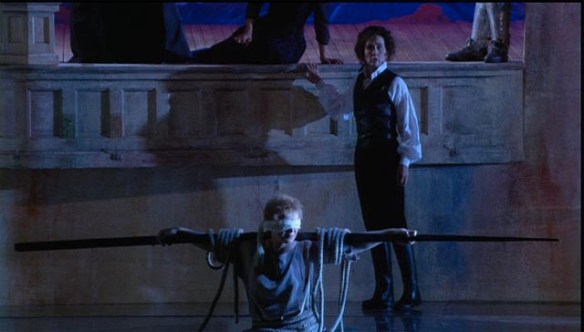
 Like the drama, this got better musically as time went on. In Act 1 I was really questioning the decision to cast a mezzo in the alto castrato role and a traditional countertenor in what was originally a breeches mezzo role. It does work out. Ann Murray sings brilliantly and muscularly throughout and makes, in the end, a completely convincing Ariodante. Christopher Robson’s Polinesso doesn’t totally convince me. That voice type just doesn’t make for a particularly convincing villain but it does make more sense as his sheer nastiness comes out in his excellent acting. Joan Rodger’s Ginevra definitely gets better as things progress. I think she sounds strained in her upper register in the first act. The notes are there but it isn’t a very beautiful sound. In Acts 2 and 3 she sounds much more at ease despite having to sing while being put through not far short of torture(1).
 Lesley Garrett’s Dalinda was a pleasure from first to last. The King of Scotland is Gwynn Howell. It’s the sort of bluff, thankless role that Howell seems to play rather often. He sings perfectly well and is bluff. Paul Nilon sings Lurcanio, Ariodante’s brother. he doesn’t have a lot to do but he does have one glorious duet with Dalinda in Act 3. This is closely followed by another lovely duet between Ginevra and Ariodante. I wish there were more duets and ensembles in Handel operas. They happen rarely but when they do they are usually wonderful. Ivor Bolton conducts the ENO orchestra and they sound OK for a modern band (not my first choice for Handel!). Tempi seem on the slow side. The rival DVD version of this opera comes in 20 minutes shorter. Whether that’s due to cuts or tempi though I can’t say. The ENO chorus doesn’t sound great but this may be the recording, see below.
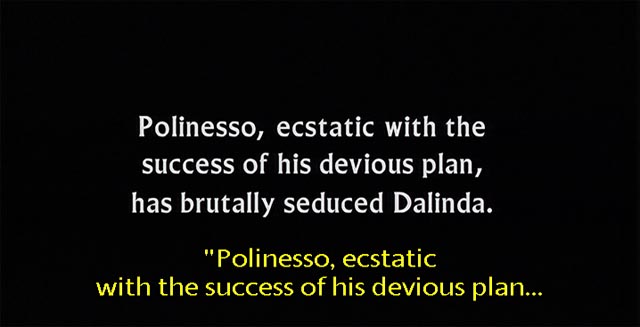
Musically and dramatically I think this is a recommendable performance. Unfortunately, as a DVD, it’s very hard to find good things to say about it. It was recorded for broadcast on the BBC and is given a treatment I’ve not seen before. I assume it’s taken from a live performance but there is no applause and no curtain calls. What we do get are silent film like “story boards” at key points like the beginning of each act.
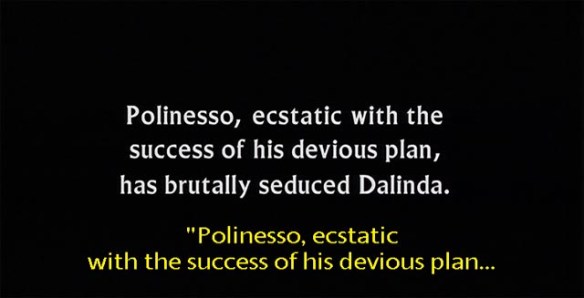 For example “Polinesso takes advantage of Dalinda’s blind devotion to further his ambition”. Weirdly, the subtitles repeat the message. I don’t particularly like this approach but it’s not fatal. What is is the failure to show us enough of the stage to figure out the director’s intentions. I ranted about this yesterday so I won’t labour the point but it pretty much wrecks this disc. Technically it’s not so hot either. The picture is OK 16:9, no more. There are two sound tracks; Dolby 5.1 and Dolby 2.0. The surround sound version is about the worst sound I’ve ever encountered on an opera DVD. It’s mixed so that the subwoofer booms out the bass line in a most unmusical fashion. It’s horrible. The stereo track is OK though it gets a bit odd in parts of Act 3, especially the final chorus. Either that or the ENO Chorus really is having a bad night. The only sub-titles are English and there is no documentation beyond a chapter list. (This is the North American release on Image. It wouldn’t be unprecedented for the European version to have more acceptable sound).
It’s a bit of a shame. I would really like to have a proper look at this production.

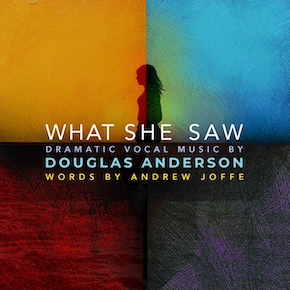 What She Saw is a new album of vocal music by New York composer Douglas Anderson. There are two works on the record. There’s a cycle of eleven Cassandra Songs for mezzo-soprano and piano and a monodrama for mezzo-soprano, piano and percussion called Through/In.
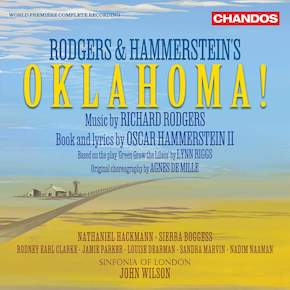 So, you may ask, what is Opera Ramblings doing reviewing a recording of Rodgers & Hammerstain’s Oklahoma!? Well, it’s a project in the same vein as my reviewing the Bru-Zane recordings of more or less forgotten late 18th and 19th century French operas. It’s an attempt to put the piece in the context of its early performances and also to look at how it was originally performed for, like many early 19th century French operas, if and when Oklahoma! does get performed it’s usually in a style very different from the original The occasion for doing so is a new Chandos recording that attempts to reconstruct the sound of the original 1943 Broadway run. That the recording is very high definition and released in SACD format only increased my interest.
 operaramblings