Apparitions

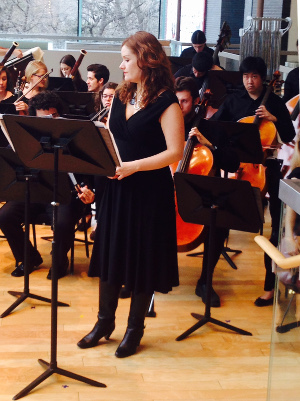
JTwGGSNMEConductor Brian Current and the Glenn Gould School New Music Ensemble presented three pieces, one of them a world premiere, today in the Richard Bradshaw Amphitheatre.  The performances were prefaced by a really rather informative and informal chat by Brian on “how to listen to contemporary music”.  It was engaging and totally non-patronising.

And so to the music.  The first piece was Marco Stroppo’s 1989 piece élet… fogytigian, dialogo immaginario fra un poeta e un filosofo; a piece evoking an imaginary dialogue between a Hungarian poet and an Italian philosopher who never actually met, or so the composer told us.  The first movement was bright and aggressive, very much in the European manner of the 70s and 80s with the second even more explosive before, in the third movement, settling into an exploration of string colour.  The composer explained this as being like three walls of a house, painted different colours, slowly rotating.  It’s the kind of piece one needs to hear more than once.

Continue reading

Gleadow and Segal go nomadic

2014-10-23-COC-Gypsy-031

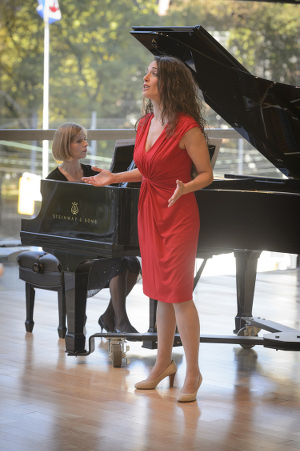
Lauren Segal performs in the Richard Bradshaw Amphitheatre. Photo: Chris Hutcheson

Today’s lunchtime concert in the RBA was given by mezzo-soprano Lauren Segal and bass-baritone Robert Gleadow with Sandra Horst at the piano.  The programme was titled Gypsy Songs, Travel Songs.  First up was Robert, who looks considerable less rakish without a beard, with three songs from Vaughan Williams’ Songs of Travel.  All three; The Roadside Fire, Bright is the Ring of Words and Whither Must I Wander are familiar recital fare but sung as well as this are a joy to hear.  Gleadow has a big, full sound with quite a range of colour but he can also float very beautiful high notes.  It was very impressive.

Lauren came next with Dvorák’s Cigánské melodie.  These songs cover a wide range of moods, all vividly captured by Segal.  Her voice is dark toned and very mezzo; no soprano 2 here!  Onewould think her perfectly suited for gloomy Slavic rep until, as she did later, she cut loose on de Falla’s Siete canciones populares Españolas.  Here she was every bit the dark eyed Spaniard singing with fiery passion of love and loss.  Both sets ended with fierce, bravura numbers brought off with panache.  The lady knows how to work a crowd!

Continue reading

Born out of Wenlock

Ever since they were first published the poems that make up AE Housman’s A Shropshire Lad have exerted a fascination over English composers.  Today in the Richard Bradshaw Amphitheatre we heard two first year members of the Ensemble Studio give performances of two settings that take quite different approaches to the texts.

Continue reading

A Play of Passion

Colin_Ainsworth_Headshot2Tenor Colin Ainsworth and pianist Stephen Ralls today presented three song cycles written for them by Derek Holman.  The first, The Death of Orpheus (2004) sets two translations of Ovid by Arthur Golding; on the subject of Orpheus in the underworld sandwiching Shakespeare’s Sonnet XVIII.  The parts form an interesting contrast.  In the Ovid, Golding chose to write in rhyming iambic heptameters but Holman’s setting completely ignores that, breaking and reshaping the lines very freely.  The piano line too is spare and more a commentary on the vocal line than a support.  In contrast the Shakespeare is set much more “faithfully”; piano and vocal line both reflecting more closely the metre of the verse.  Holman also rarely repeats a phrase of the text) it happens maybe five times in the eleven songs in today’s programme) which puts quite a burden on the listener given the allusive complexity of Ovid/Golding’s verse. Continue reading

Here we go again

Yesterday lunchtime saw the first free lunchtime concert of the season in the Richard Bradshaw Amphitheatre.  Following tradition, it was presented by the members of the Ensemble Studio.  Or, to be more accurate, by six of the nine as an unprecedented three singers had fallen victim to the virus that is apparently sweeping the Toronto opera world (HighCbola?).

Credit: (l-r) Jennifer Szeto, Andrew Haji, Karine Boucher, Charlotte Burrage, Clarence Frazer, Jean-Philippe Fortier-Lazure, Iain MacNeil. Photo: Karen Reeves

Credit: (l-r) Jennifer Szeto, Andrew Haji, Karine Boucher, Charlotte Burrage, Clarence Frazer, Jean-Philippe Fortier-Lazure, Iain MacNeil. Photo: Karen Reeves

Continue reading

This season’s free concerts in the RBA

rbaThe Canadian Opera Company has just announced the 14/15 line up for the free lunchtime (mostly) concerts in the very beautiful Richard Bradshaw Amphitheatre at the Four Seasons Centre.  Highlights, from my point of view, include recitals by Jane Archibald, Krisztina Szabó, Lauren Segal, Colin Ainsworth, Joshua Hopkins, Robert Gleadow, Barbara Hannigan and Ekaterina Gubanova.  There will also be ten concerts by the Ensemble Studio plus the Quilico competition.  The Canadian Art Song Project will showcase Allyson McHardy in a new song cycle by Marjan Mozetich.  There’s also a themed series of concerts  to commemorate anniversaries of the First and Second World Wars, and the fall of the Berlin Wall. This will comprise six concerts drawn from the Vocal, Chamber Music and Piano Virtuoso programs.

That’s just the tip of the iceberg.  There are vocal, chamber, piano, dance, jazz and world music programs to suit a very wide range of tastes.  And it’s all free.  Full details at http://www.coc.ca/PerformancesAndTickets/FreeConcertSeries.aspx

War and Peace

sasha-djihanianLunchtime today at the RBA saw members of the COC orchestra get together with soprano Sasha Djihanian for a concert of works by Handel and Albinoni.  I realised that I really don’t listen to enough baroque chamber works.  The first work on the program was Handel’s Trio Sonata No.2 in D Minor.  It’s compact, playful and doesn’t overstay its welcome.  I stupidly didn’t make a note of who played on what piece so I’ll just credit the ensemble at the end of the post.  The other chamber work on the program was Albinoni’s Sonata à cinque in C major.  This was fun too with lots of fugue elements and dance rhythms and some serious toe tapping by violist Keith Hamm.

Continue reading

From dark to light

dover-beach-1upphl0Today’s recital in the RBA was given by Russell Braun. Carolyn Maule and members of the COC orchestra.  The programme, Journeys of the Soul, divided into two quite distinct halves.  In the first, Russell was joined by Marie Bedard and Dominique Laplants (violins), Keith Hamm (viola) and Paul Widner (cello) in a performance of Samuel Barber’s Dover Beach; a setting of a text by Matthew Arnold.  It’s a very dark text and rather an extraordinary choice for a twenty year old.  The music is equally dark and brooding.  It’s a great work for Russell though and plays well to the colours of his voice and his keen attention to text.  It was a pleasure to hear in the very intimate atmosphere of the RBA.

Continue reading

Of love and longing

allysonMcHardy200x250Allyson McHardy’s lunchtime recital in the Richard Bradshaw Amphitheatre today was unusual and effective; combining contrasting works by Brahms, Robert Fleming and Britten.  Accompanied by Liz Upchurch on piano throughout, she was joined for the first set; Brahms’ Two Songs for Alto, Viola and Piano, Op. 91 by the COC’s principal violist, Keith Hamm.  They were rather beautifully sung and played and were true to music and text; both of which are a bit too German Romantic for my taste. Continue reading

Liebeslieder-Walzer

I only managed to get to the first half of yesterday’s Ensemble Studio lunchtime concert.  It was Brahm’s Liebeslieder-Walzer Op. 52 performed by Claire de Sévigné, Charlotte Burrage, Andrew Haji and Gordon Bintner with Liz Upchurch and Michael Shannon providing the four handed accompaniment.  I’m not a huge Brahms fan and this was pretty much that late 19th century sentimental stuff I don’t really get; somewhat schmaltzy waltz rhythms setting somewhat schmaltzy texts.  It was well done though.  Haji, in particular, sang with a fine attack and the different voice combinations made interesting contrasts.  I thought the music came off best when the girls sang together and when the guys sang together.  Both pairs have voices quite different in timbre and blended to good effect.  The more complex four voice sections seemed to come a bit unstuck in the RBA.  I’m 99% sure it was the acoustic not the singers but certainly textures got quite muddy at times.  The accompaniment was, unsurprisingly, very good indeed.  Work pressures meant I had to leave before the second half of the programme which featured John Greer’s Liebesleid-Lieder.