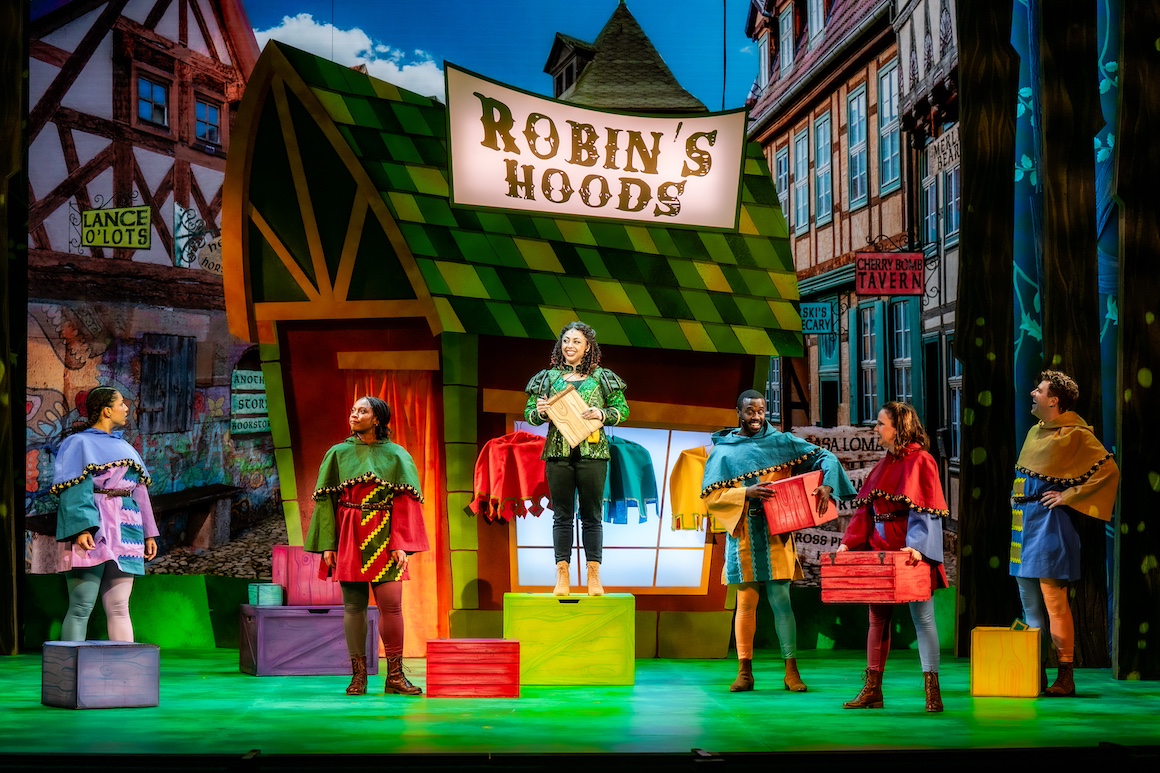
So, Saturday night I reacquainted myself with pantomime after a gap of sixty years or so. I think the last panto I saw was Aladdin at the Alhambra in Bradford c.1965. Well why not? Much has changed and Canadian Stage’s Robin Hood; written by Matt Murray and directed by Mary-Francis Moore discards much that would once have been seen as de rigueur. I guess much more fluid gender roles, general acceptance of same sex relationships and, maybe, less familiarity with the canonical stories means that what once seemed risqué now seems passé and absent a general idea of how the story should go there’s more freedom to experiment.
Tag Archives: murray
Der Wald
Dame Ethel Smyth’s one act opera Der Wald is certainly of some historical interest. It was the first opera by a woman given at the Metropolitan Opera. That was in 1903 and 113 years would pass before the Met did another one; Kaija Saariaho’s L’Amour de loin in 2016.
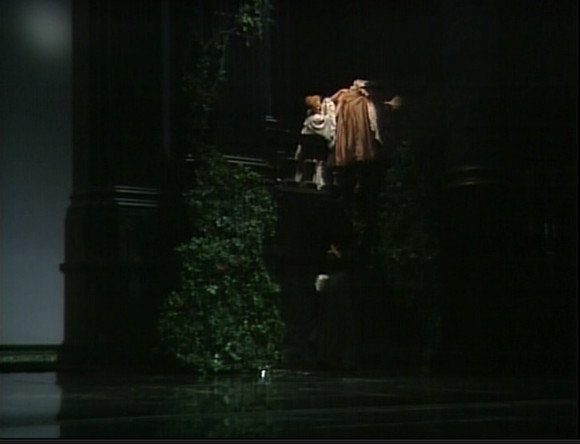
It’s about an hour log and in English (sort of). Musically it’s pretty good but the libretto is rather awful. The plot concerns a forester and his fiancée, a deer hidden in a well (and anyone who has seen Tosca knows what a good idea that is!), a vengeful aristocrat who happens to be the mistress of the local lord and a peddler. In a nut shell, the hero Heinrich chooses to be executed for poaching rather than “serve” the lady Iolanthe. I suppose that’s no dafter than a lot of opera plots but throw in a sort of archaic English that makes the libretto sound like it was written by a drunk Pre-Raphaelite and ’tis pity ’tis so twee. Continue reading
Street Scene in Madrid
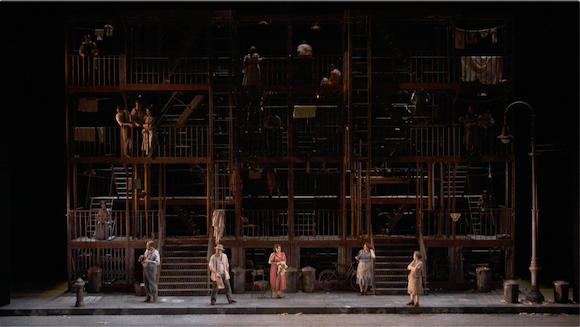
It’s not easy to figure out how to stage Kurt Weill’s Street Scene. On the one hand it’s a gritty story of violence and poverty and hopelessness. On the other hand it’s got classic Broadway elements; romance, glitzy song and dance numbers etc. It’s also, cleverly and deliberately, musically all over the place with just about every popular American musical style of the period incorporated one way or another.

60s Figaro from Glyndebourne
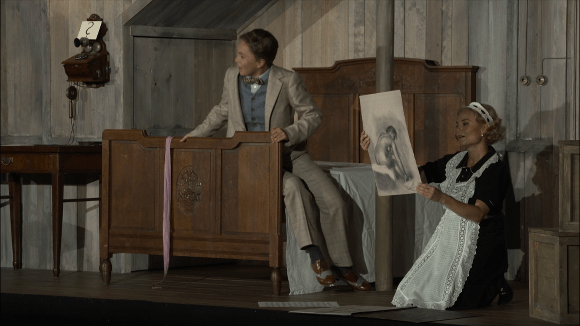
No opera says Glyndebourne like Mozart’s Le Nozze di Figaro. It opened the first season in 1934 and inaugurated the new theatre in 1994. Michael Grandage’s production which opened in 2012 was, I think, Glyndebourne’s fifth. In any event it’s a fairly traditional affair though with the setting updated to the 1960s (though still set in a palace in Seville and I’ve got a nagging feeling that late Franco era Spain didn’t have much in common with the Haight and Carnaby Street but there you go). The updated setting does allow for some visual gags with ridiculous 1960s dance moves but otherwise it could pretty much be anywhere, anytime. There’s no concept and Grandage’s focus is on the interactions between the characters and the way they can be expressed in a relatively intimate house.

Completing the Bechtolf trifecta – Le nozze di Figaro
Sven-Eric Bechtolf’s stagings of the Mozart/da Ponte operas in Salzburg concluded in 2015 with Le nozze di Figaro. I think it’s the most successful of the three. Bechtolf’s strengths lie in detailed direction of the action rather than bold conceptual statements and Nozze is probably the least in need of, and the least amenable to, the big Konzept. There aren’t any real dramaturgical problems to solve. It just works as written. I don’t think that’s so true for Don Giovanni or Così.

Don Tom
There are over 40 video recordings of Don Giovanni in the catalogue, dating back to 1954, and Thomas Allen sings the title role in quite a few of them. This one was recorded at La Scala in 1987 and features a very strong cast in a careful, traditional staging. It’s also pretty decent technical quality for the era. The director was Giorgio Strehler in a comparatively rare opera outing. His sets and costumes are of some vague aristocratic past with liveried footmen, big hats and twirling capes. It’s quite handsome but not in any way revelatory. Nor is any aspect of the production really. We are clearly in an aristocratic milieu. Tom Allen’s Don Giovanni is arrogant and proud with plenty of swagger. There’s no hint of ambiguity about Edita Gruberova’s Donna Anna or Ann Murray’s Donna Elvira and Francisco Araiza is a properly dutiful chump of a Don Ottavio. It’s all quite serious with comic relief only in the most obvious places. Having said that, there are some very effective scenes; especially the ending which has a an interesting lighting plot and manages not to be anti-climactic.
More Toronto news
On April 11th FAWN Opera is workshopping L’Homme et le Ciel; music by Adam Scime and libretto by Ian Koiter. It’s PWYC and it’s at the Ernest Balmer Studio at 8pm. Partrick Murray conducts, Amanda Smith directs and the singers will be Giovanni Spanu, Larissa Koniuk and Adanya Dunn. I wish I could go but I can’t.
On the 26th at 8pm the Aradia Ensemble, conductor Kevin Mallon, will be joined by Claire de Sévigné and Maria Soulis for a programme of Vivaldi’s sacred music. It’s at St. Anne’s Anglican church on Gladstone Avenue which sounds worth a visit in itself. Apparently there is a Byzantine dome and decoration by members of the Group of 7. Tickets are $35 ($20 seniors).
Die tote Stadt
My acquaintance with Korngold’s Die tote Stadt has been pretty much limited to recital and competition performances of Glück, das mir verlieb, better known as Marietta’s Lied and, apparently, the last opera aria to become a hit single and Fritz’ act 2 piece Mein Sehnen, mein Wähnen. So, I was quite glad to get my hands on a complete recording of this lushly lyrical and rather weird piece. The “dead city” of the title is Brugge and the story concerns a wealthy man, Paul, who has turned his house, and his life, into a shrine to his dead wife Marie. He encounters a dancer, Marietta, who very closely resembles his late wife. What follows is wild and chaotic and is, ultimately, revealed to be a dream. Paul realises that only in the next world can he be reunited with Marie.
A rather straightforward Cenerentola
Rossini’s La Cenerentola takes almost three hours to tell a very straightforward version of the Cinderella story. Generally directors, despairing of the this, either camp it up (for example the Els Comediants production seen, inter alia, in Houston and Toronto in recent years) or they try to find a few more layers of meaning as in Ponnelle’s film version. Michael Hampe does neither in his 1988 Salzburg production, preferring to tell the story as a straightforward morality tale. I guess if one really loves the music and it’s really well sung this could work but, ultimately, I found it rather dull. Continue reading
Mozart’s Mitridate – ROH 1993
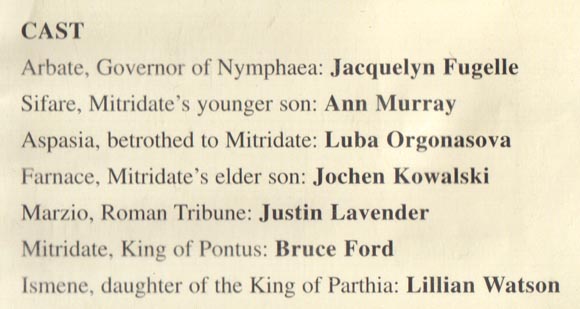
Mitridate, rè di Ponto is a three act opera seria by a fourteen year old kid called Mozart with a libretto based on Racine. Like most operas with a libretto based on Racine, and there are many, it isn’t exactly a barrel load of laughs. While it’s fair to say that the music may well be the best ever composed by a fourteen year old and it is recognisably Mozart it’s still not really quite enough to carry three hours of recitative and da capo arias about the troubled love life and familial relations of a first century BC King of Pontus and his fractious sons. In short, it gets a bit tedious. For a modern audience it’s not improved by the fact that all the male voices are high. Originally the score called for three castrati and two tenors. In the 1993 Royal Opera House production two of the three castrato roles were taken by mezzos and the third, inevitably the baddy, by a countertenor. For the record, here’s the full cast:
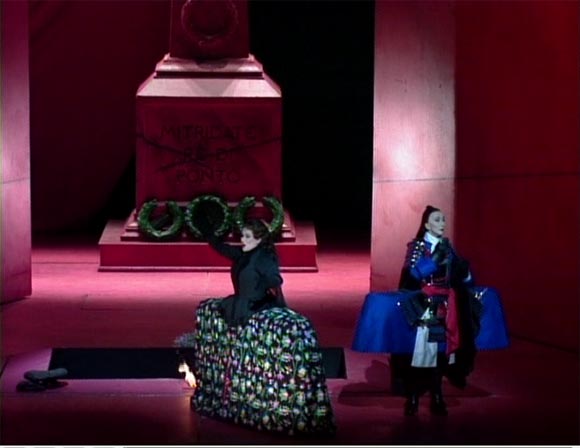
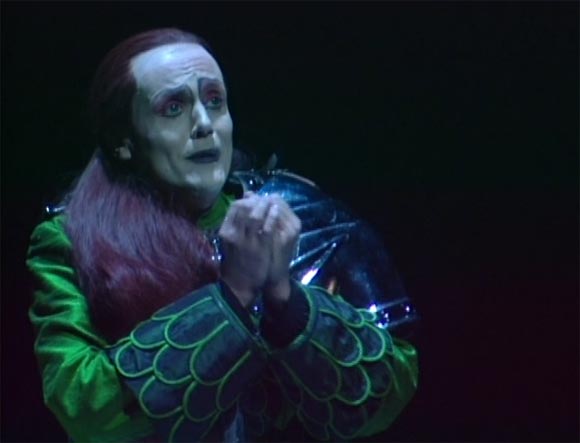
The director – Graham Vick, designer – Paul Brown and choreographer – Ron Howell do a pretty good job of injecting some life into the production with fairly extreme use of colour in the costume design, sets and makeup. The choreography and blocking is also quite striking at times but it still ends up being rather a wash of coloratura. The singers too do a worthy job but after a while it all starts to sound the same. Good work too from conductor, Paul Daniel, and the ROH orchestra but ultimately a bit blah.
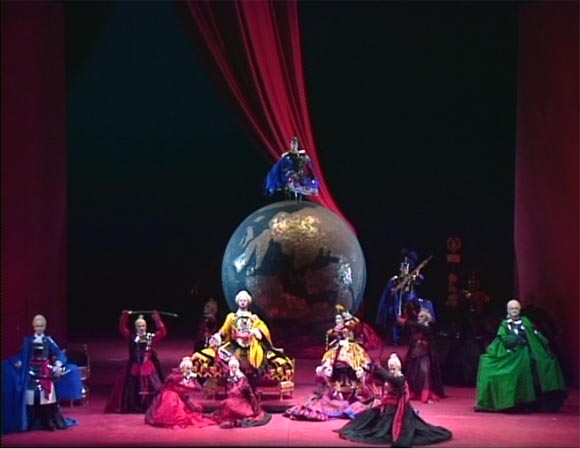
Video director Derek Bailey does a pretty good job for the period. It’s hard to object to closing in on the singer during a da capo aria and he does pull out when there is stage wide action. He’s not helped by pretty average picture quality that lacks the definition needed to make long shots fully effective. Technically it’s a typical Kultur release of the period. The less than brilliant picture is coupled with so-so Dolby 2.0 sound, hard coded English sub-titles and minimum documentation. It’s also a bit quirky in that the overture comes on, with lead in credits, as soon as the disc is inserted. There’s no “set-up” menu.