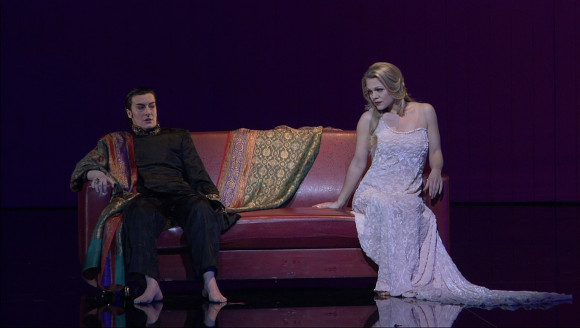
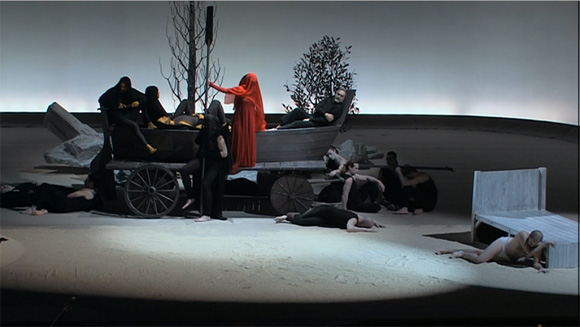
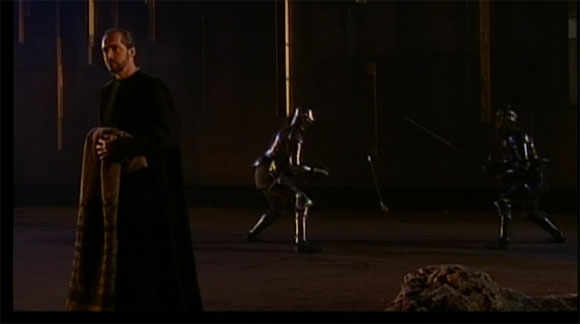
Monteverdi’s L’incoronazione di Poppea was the “shabby, little shocker” of the 17th century. It’s about lust, obsession, murder and revenge. So, it’s a bit surprising that all too often it comes off as elegant but deadly dull. That’s rather the case with Pierre Luigi Pizzi’s production filmed at the Teatro Real in 2010. Despite having Danielle di Niese, something of a specialist Roman sex kitten, in the title role it’s all rather bloodless. It starts off OK with the gods and goddesses of the prologue being wheeled about on platforms but after that he gets rather static. Sets and costumes are almost unrelieved grey/silver tones (including a rather fetching pair of silver lamé booty shorts for Damigella) although Nerone himself seems to be dressed as a giant black chicken in Act1 (know you of such a bird, Baldrick?). The only real breaks in the (literal) monotony are the bright red robe Ottone borrows from Drusilla for the attempted murder and the sparkly gold outfits that appear for Nerone and Poppea at the end. It’s also rather dark most of the time.
Tag Archives: monteverdi
David Alden’s Poppea
I’m never quite sure what to expect from David Alden. Some things are predictable; striking images, bold colours and a degree of vulgarity, but beyond that it’s hard to be sure. Sometimes he seems to be trying to be deep (his Lucia for example), sometimes more kitschy (Rinaldo) and there’s always a slight undercurrent of him thumbing his nose at the audience. His production of L’incoronazione di Poppea at Barcelona’s Liceu is a curious combination of all these things and I think it works pretty well.
Ponnelle’s Ulisse
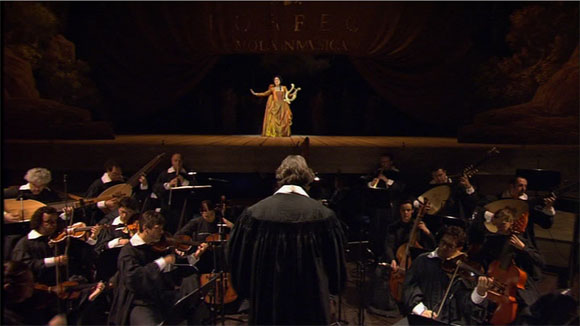
Il ritorno d’Ulisse in Patria is the third of the Ponnelle/Harnoncourt Monteverdi collaborations and perhaps the best. Itseems to stick closer to the original Zürich staging and be less obviously a film though it was recorded in the studio and lip synched. The orchestra and conductor are visible and, in Act 3, Irus descends into the pit throws himself all over Harnoncourt. It’s the conductor too who gives him the knife he kills himself with. Is this the first (of many) times when Harnoncourt has been drawn into the theatrical action?
Campy Poppea
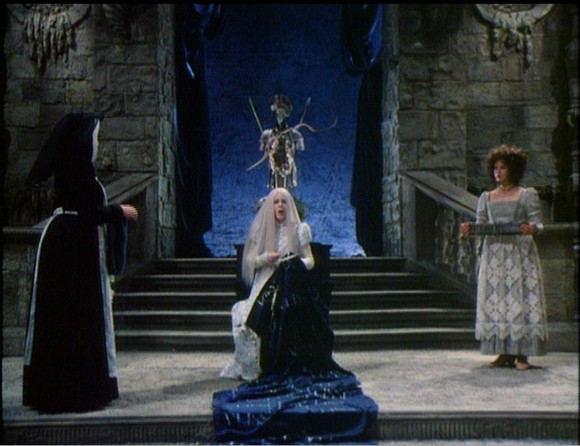
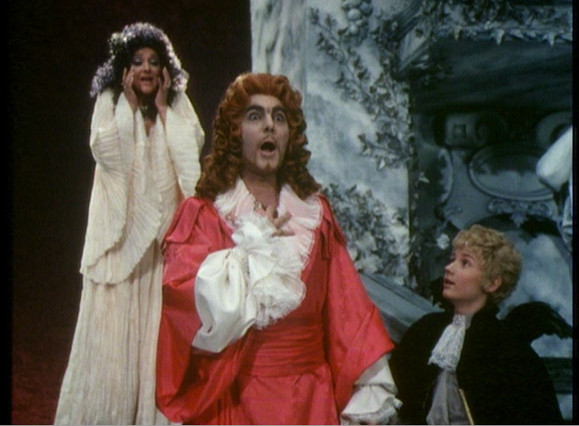
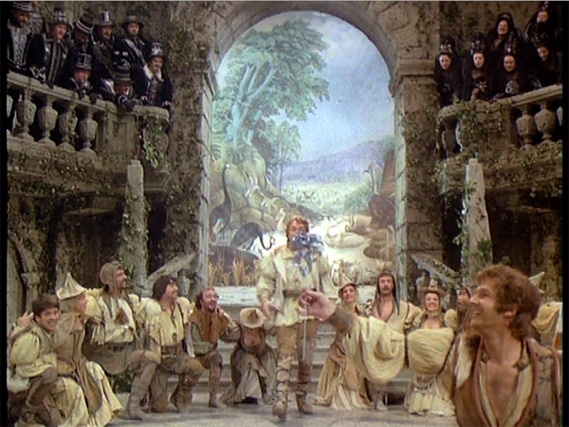
J-P Ponnelle’s 1979 film of Monteverdi’s L’incoronazione di Poppea with Zürich forces conducted by a young Nikolaus Harnoncourt is like his Orfeo only more so. Sets and costumes are that rather odd “ancient baroque” that Ponnelle is so fond of. The acting is stylized and hyperkinetic and so is the camera work with close ups from weird angles all over the place. So far, so Ponnelle.
Another Ulisse
William Christie and Les Arts Florissants recorded Monteverdi’s Il ritorno d’Ulisse in patria in Aix-en-Provence, five years before their Madrid recording. The Aix production was directed by Adrian Noble and featured real life couple Kreśimir Śpicer and Marijana Mijanović as Ulisse and Penelope.
Elegant and Powerful Ulisse
Monteverdi’s Il ritorno d’Ulisse in patria hasn’t proved as popular as his other late work L’incoronazione di Poppea but, given as compelling a performance as it got at the Teatro Real, it’s a bit hard to see why that is. On this 2007 recording we have an elegant and interesting production by Pier Luigi Pizzi, an excellent cast headed by Kobie van Rensburg and Christine Rice and the incomparable William Christie and his Les Arts Florissants. It’s a compelling package.
Back to the beginning
Monteverdi’s L’Orfeo is one of the few 17th works still in the canonical opera repertoire though little performed before the “early music revival”. So it was quite a bold step when the Opernhaus Zürich in the 1970s staged all three extant Monteverdi operas in productions by J-P ponelle and with Nikolaus Harnoncourt leading an orchestra of period instruments. All three productions were subsequently made into lip-synched films and have been re-released on DVD by Deutsche Grammophon as a boxed set.
War in opera
As November 11th comes around for the 94th time since the guns were, very temporarily, silenced I thought it might be interesting to look at how war has been seen by librettists and composers over the years. Very early on we get a very gritty take on the subject in Monteverdi’s extremely compact Il combattimento di Tancredi e Clorinda but not so long after the path for the next three centuries is set with Purcell’s broadly comic King Arthur. As far as I can see from Purcell to 1945, with very minor exceptions, the message is largely “war is fun”. War is an excuse for a big parade (Aida; unless Tim Albery is directing!), an excuse for a drinking song (Faust), just plain comedic (La Fille du Regiment), a plot device (Cosí fan tutte) or a background event (Tosca, various versions of the Armida story). The only opera, pre 1945, that I can think of that deals with the horror of war is Les Troyens, and that of course takes place in a distant, mythical, past.
Monteverdi’s L’Orfeo at the Liceu
Director Gilbert Deflo was inspired by the Hall of Mirrors in the ducal palace in Mantua, scene of the first performance of Monteverdi’s L’Orfeo, to try and create something similar for the much larger Gran Teatre del Liceu in Barcelona. The result is an almost extreme HIP approach. Sets, costumes, acting and singing style are all what we have come to expect from HIP performances of baroque works. In this case even the conductor and orchestra wear period dress which is quite effective as conductor Jordi Savali looks remarkably like Monteverdi. For reasons I don’t understand though the lighting plot is one that could never have been realised with baroque forces. To further advance the “hall of mirrors” idea Deflo makes quite a lot of use of mirrors on stage reflecting the house back on itself which doesn’t really come off on video but I imagine, based on my experience with the COC’s staging of Semele, that it could work well if one was in the right part of the theatre. There’s also a fair amount of characters entering via the auditorium including a dramatic entrance for Savali as the brass and percussion play the opening toccata from stage boxes.
22 minutes of Monteverdi
Monteverdi’s Il combattimento di Tancredi e Clorinda must be, at twenty two minutes, one of the shortest operas around. In typical Monterverdi style though it crams a lot of music and emotion into a very short space. Based on a story by Torquato Tasso, it concerns a Christian knight, Tancredi, and a Moorish princess, Clorinda. Somehow they have managed to fall in love but are still fighting on opposite sides They meet on the battlefield but as each has their visor down they don’t recognize each other. They fight a long and bloody single combat in which Tancredi mortally wounds Clorinda. When their helmets are removed they recognize each other and Clorinda asks Tancredi to baptize her so they can be united in heaven. It’s pretty dodgy theology but great theatre.