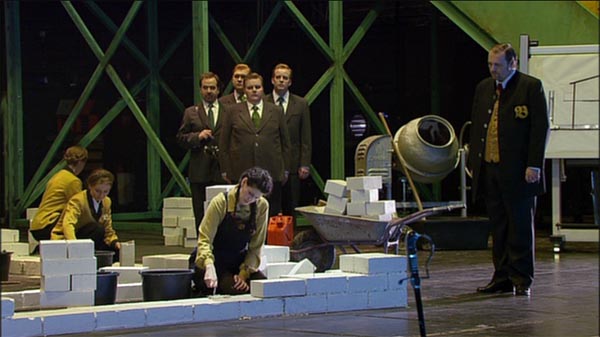
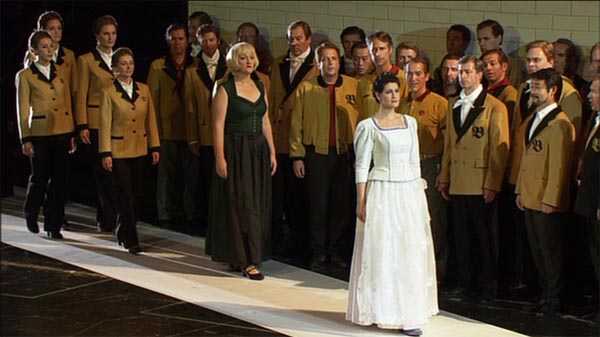
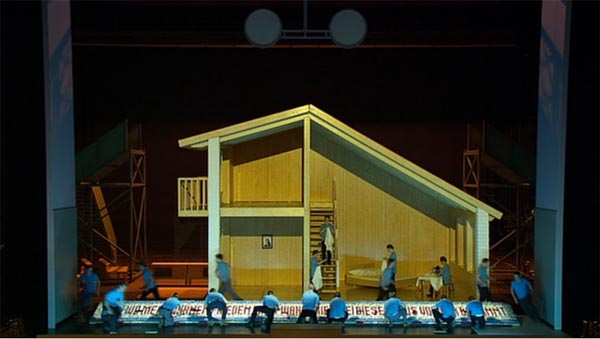
I guess Richard Jones’ 2009 Munich production of Lohengrin isn’t to everyone’s taste but I found it quite compelling. He’s set it in the 1930s and Elsa is building a house; a symbol for rebuilding the state and society of Brabant torn apart by the loss of her brother and general internal disorder. In the prologue we see her designing the house on a drawing board and then it gets built by stages culminating in a topping out ceremony as Elsa marries Lohengrin. At key points of the action the symbolism is manifest. Telramund kicks over half finished walls in the scene where he accuses Elsa and Lohengrin, having defeated Telramund in the duel, joins Elsa for a spot of bricklaying. After Elsa breaks her oath to Lohengrin he burns the house down so the final scene is played out on a more or less empty stage. There’s some really skilled stage handing going on to support all that! For contrast, and to facilitate the practicalities of the concept, some of the scenes are played out in front of a plain flat decorated solely with some coats of arms and a door. The alternation of very stark and very busy is intriguing. Inevitably there are times when the concept is stretching possible interpretations of the libretto right to the limit and the duel between Lohengrin and Telramund is a bit lame but mostly for me it worked.
 Within the overall concept Jones has obviously given a lot of thought to the relationships between the characters. The Personenregie seems almost obsessively detailed and he seems to have taken his cast along with him because the acting is first class. Every look and gesture, especially from Wolfgang Koch as Telramund and Anja Harteros as Elsa, carry a depth of meaning. It’s very impressive.
 The singing performances are very strong across the board. Again, for me, Koch and Harteros are the standouts. Harteros is really lovely to listen to even when she’s cranking out the decibels and Koch was never less than musical even in his angry outbursts where the temptation to shout or bark must be strong . Michaela Schuster as Ortrud and Jonas Kaufmann in the title role are pretty much as good. Schuster gets a bit strident but that’s not inappropriate to the role and Kaufmann has moments when he is just gorgeous to listen to. His hushed and unearthly “In fernem Land” was gripping. Christof Fischesser was a solid Heinrich and Evgeny Nikitin (a superb Dutchman in Toronto a few months later) made more of the Heerrufer than some might. All of this is very well supported by the orchestra under Kent Nagano.
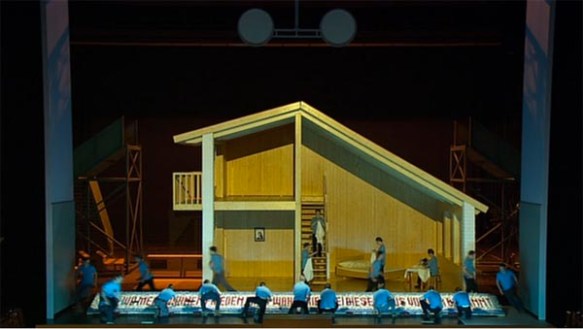 The production for DVD is pretty good. Karina Fibich directs for video. She gives us a pretty good idea of the overall set and blocking and rations her closeups. It’s hard to argue with going to close up when there are just one or two singers in front of a flat. She gets a bit overambitious in the more crowded scenes and experiments with camera angles that are quite confusing. Sometimes the shot even seems to be behind the action. Overall though it’s a decent presentation and it’s backed up by a sharp 16:9 anamorphic picture and solid DTS 5.1 sound (LPCM stereo as an alternative). There are English, French, Spanish and Chinese subtitles. There are no extras but the trilingual booklet (English, French, German) includes a synopsis and a short essay about the production.






 operaramblings