Tosca noir

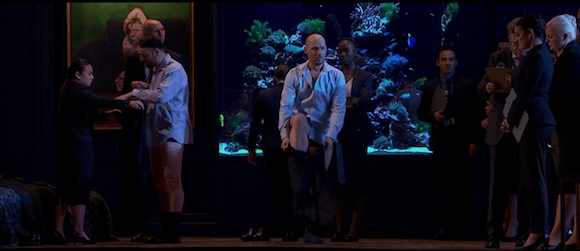
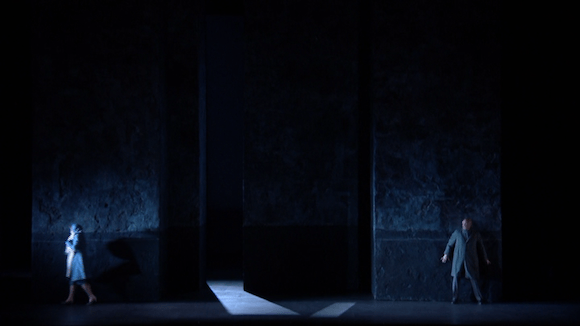
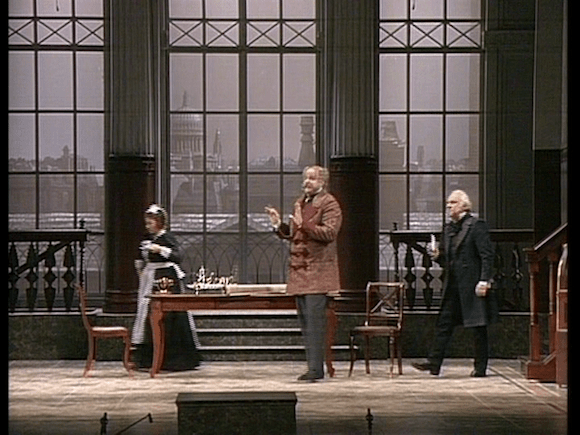
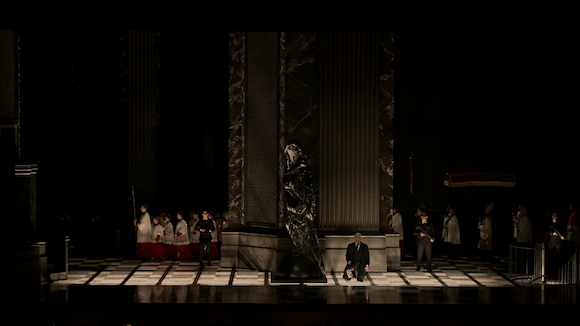
The 2018 Salzburg Easter Festival production of Puccini’s Tosca was directed by Michael Sturminger.  The only Sturminger works I’ve seen before are his rather odd Mozart collaborations with John Malkovich; The Giacomo Variations and The Infernal Comedy so I really wasn’t sure what to expect.  The production riffs off film noir and is updated to more or less the present.  It opens with a shoot out between Angelotti and the police  but that lasts only a few seconds and the first act and the first half of the second act are fairly conventional, bar Scarpia on an exercise bike as Act 2 opens.  That said, it’s big and monochromatic and it does have a noir feel.  It starts to get a bit more conceptual around the Scarpia/Tosca confrontation.  It’s an interesting take on Scarpia; perhaps more bureaucrat than psychopath.  The relationship between the two is well drawn and Anja Harteros does a really convincing job of her build up to killing Scarpia including a first class Vissi d’arte sung from some unusual positions.  There’s a hint of what’s to come at the very end of the act when an “I’m not dead yet” Scarpia is seen crawling towards his phone.
1.church

Continue reading

Creepy Wozzeck

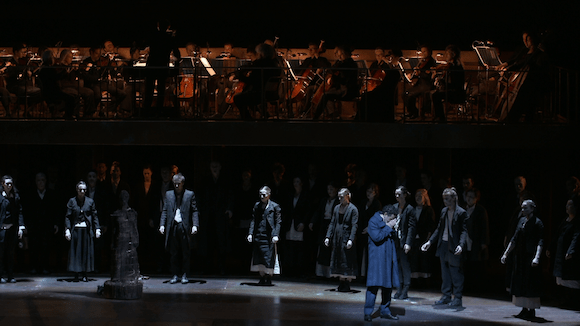
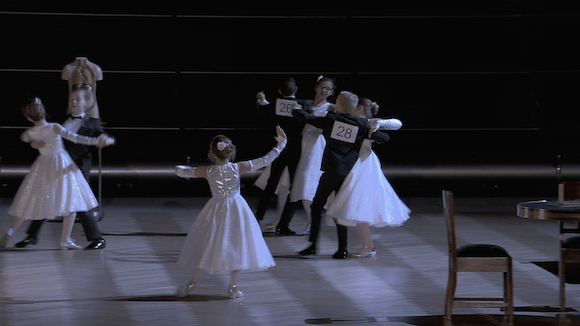
Alban Berg’s Wozzeck seems to attract just about every possible treatment from directors other than a straightforwardly literal one.  Krzysof Warlikowski’s approach, seen at Dutch National Opera in 2017, is to go back to the original story on which the Büchner play, in its turn the source for the opera, is based.  Wrapped around that are several interesting ideas which I can’t fully unpack but which make for a rather creepy but compelling production.  Alas, the disk package has nothing to say about the production so, interpretively, one is on one’s own.

1.dancers

Continue reading

More Lessons in Love and Violence (and frustration!)

I requested a review copy of the Blu-ray release of George Benjamin’s Lessons in Love and Violence when it came out in December.  There was a bit of a hiatus in supplies from them which resumed again recently but when several packages arrived without the Benjamin piece I decided I was out of luck so I wrote a review based on a copy of the BBC’s broadcast of the work.  That was two days ago.  Today the Blu-ray arrived!  I’ve watched enough of it to convince myself that I only need to make minior changes to the review which I have done.  The revised review is here.

Lessons in Love and Violence

George Benjamin’s latest opera Lessons in Love and Violence debuted at Covent Garden last year.  It was broadcast on the BBC and is still available on the web from Arte and has also been released on DVD and Blu-ray.  This review is based on the Blu-ray version.

1.trousers

Continue reading

The actual Paris Orphée

Gluck’s Orfeo/Orphée is one of those works where things get a bit complicated because an Italian and a French version wre produced and then all kinds of mash ups of the two versions.  It’s a bit like Don Carlo/Don Carlos or Guglielmo Tell/Guillaume Tell.  The original Orfeo ed Euridice, which premiered in Vienna is quite short and has Orfeo written for a castrato.  The Paris version spreads the piece out over three acts, adds both new vocal music and lots more dance music and has Orphée written for haut-contre.  Today, when people do the French version they usually cut some of the new music and use the higher Orphée music; casting either a mezzo or a counter-tenor.  This is true of both recordings  (Paris 2000 and Munich 2003) which have come my way in the past.

1.opening

Continue reading

Karajan’s Walküre – 50 years on

To quote a quite different opera, “it is a curious story”.  In 1967 a production of Wagner’s Die Walküre, heavily influenced by Herbert von Karajan [1] who conducted the Berlin Philharmonic for the performances, opened the very first Osterfestspiele Salzburg.  50 years later it was “remounted” with Vera and Sonja Nemirova directing.  I use inverted commas because it’s actually not entirely clear how much was old and how much new.  It might be more accurate to describe it as a homage to the earlier version.  In any event, it was recorded, in 4K Ultra HD, no less and released as one of the very first opera discs in that format.

1.tree

Continue reading

Arminio

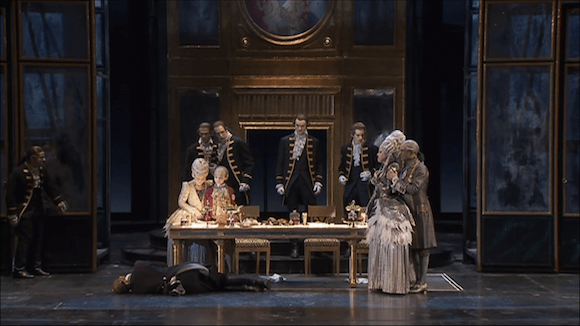
Handel’s Arminio was written for Covent Garden and while admired by the cognoscenti at the time it wasn’t a commercial success.  It’s a well worked three act opera seria with nothing much to distinguish it from others of its ilk.  For what it’s worth it’s set during Augustus’ attempt to conquer the land between the Rhine and the Elbe but its themes of death or glory and love versus duty, all with an impausible reconciliation ending, could easily be set anywhere.  Actually it almost wilfully ignores history as the libretto claims it happened in 9AD when the real Arminius (Hermann the Cherusker) decisively defeated Varo (also in the opera) in the Teutoburger Wald ending Roman hopes of extending the Empire beyond the Rhine.(*)

1.dinner

Continue reading

Król Roger

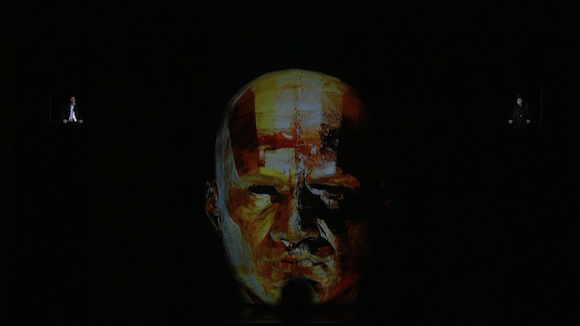
Karel Szymanowski’s 1924 opera Król Roger is surely the only opera in Polish in anything like the standard rep.  Maybe that’s one reason it’s not performed all that often because it’s really rather good and Kasper Holten’s 2015 production at Covent Garden makes a pretty good case for it.  The story is set in 12th century Sicily, though as we shall see , that really doesn’t matter.  The Church is complaining to the king about a heretical prophet, the Shepherd, who is leading people astray with a strange doctrine of Love and Nature.  Roger’s queen is much taken with the Shepherd and helps protect him.  The king, who is clearly battling demons rooted in a bloody past, vacillates.  Eventually he’s persuaded and the opera closes with Roger singing an ecstatic hymn to the rising sun.

1.head

Continue reading

Best Glyndebourne martyrdom since 1998

I’m not, in the normal run of things, a huge fan of obscure bel canto operas.  A very long list of them languish in obscurity for very good reasons.  So, my hopes were not all that high when I stuck the 2015 Glyndebourne recording of Donizetti’s Poliuto in the player.  I was wrong.  This is probably the best martyrdom opera from Glyndebourne since Peter Sellars’ production of Theodora in 1998.

1.prelude

Continue reading

A Canadian in Rossini?

Yes, there is a Rossini opera with a Canadian character.  Well, OK it’s a bit ambiguous whether he’s Canadian or American and the librettist doesn’t seem quite sure that they aren’t the same thing.  Anyway, likely the earliest of an appearance of a Canadian in opera unless one counts the Les sauvages d’Amérique section of Rameau’s Les Indes Galantes.  The opera is the early one act comedy, La cambiale di matrimonio.  It’s a bit of a one trick pony.  An English merchant has contracted to marry his daughter to the Canadian, Snook, but she’s already unofficially engaged to another.  After much faffing about Snook makes the contract over to the other suitor and makes him his heir.  The joke, such as it is, is that all this is carried out in the language of commercial contracts.  For example, when Snook minds out that Fanny is engaged he considers the “merchandise” to be “mortgaged” and so on.  Still it provides a back drop for some showy singing and the usual rapid fire Rossini ensemble numbers.

1.rain

Continue reading