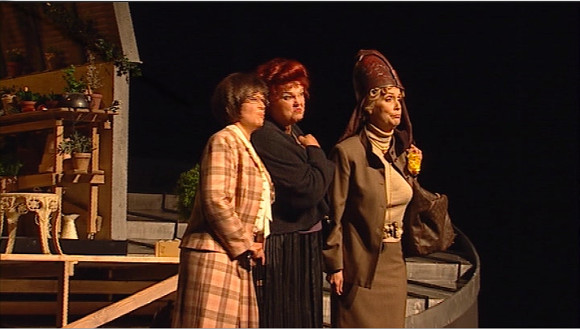
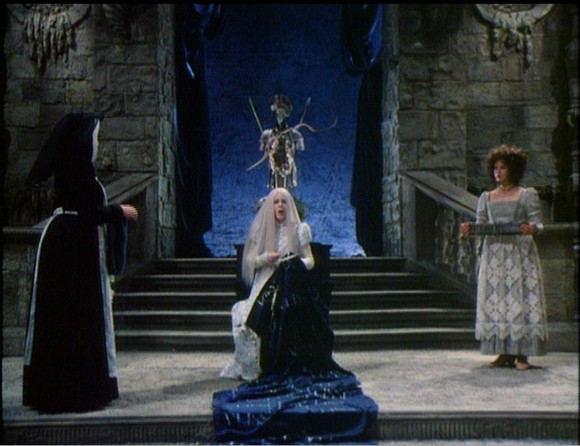
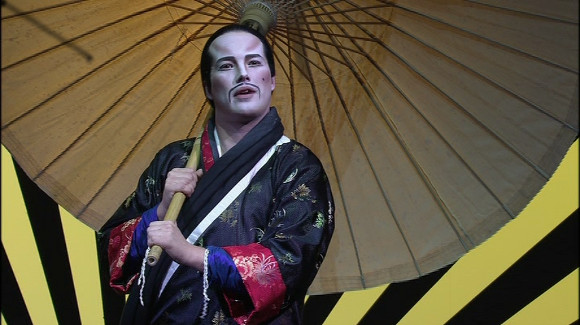
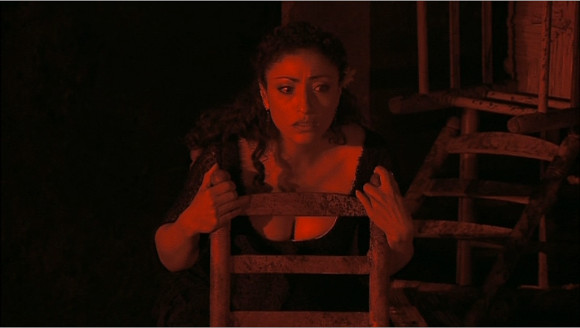
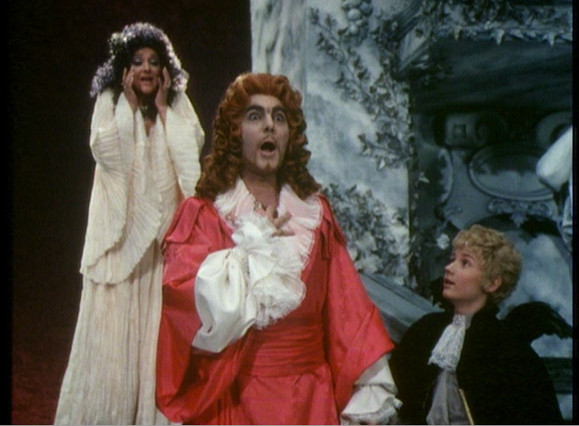
The concluding instalment of Kasper Holten’s Copenhagen Ring really does wrap it up as Brünnhilde’s story. It’s very effective in so doing too. Holten states that the central problem in interpreting the Ring is the ending and he points out that Wagner struggled with it for years before resorting to what Holten sees as a cop out; the tired, patriarchal device of wrapping things up by having the heroine sacrifice herself for her man. Holten rejects this and instead offers us a living Brünnhilde as a symbol of hope and renewal at the end of a century of terrible strife. I wish I were as optimistic.
Tag Archives: dvd
Meyerbeer in the museum
Meyerbeer’s L’Africaine was a huge hit in Paris, London and New York when it premiered in 1865. I’m not sure why. It has all of the things that make Meyerbeer seem very dated and not as much of the good stuff as Les Huguenots, or even Dinorah. It’s ostensibly about Vasco de Gama but that’s just a peg to pin a love triangle and a bunch of exoticism on. Are we actually supposed to believe that the Portugese wanted to find a way around the Cape to find out what was there? It would have been a lot easier to get hold of a copy of Herodotus. It’s also long. Even with cuts it runs well over three hours in the version recorded at San Francisco Opera in 1988.
Ponnelle’s Ulisse
Il ritorno d’Ulisse in Patria is the third of the Ponnelle/Harnoncourt Monteverdi collaborations and perhaps the best. Itseems to stick closer to the original Zürich staging and be less obviously a film though it was recorded in the studio and lip synched. The orchestra and conductor are visible and, in Act 3, Irus descends into the pit throws himself all over Harnoncourt. It’s the conductor too who gives him the knife he kills himself with. Is this the first (of many) times when Harnoncourt has been drawn into the theatrical action?
My darling goat
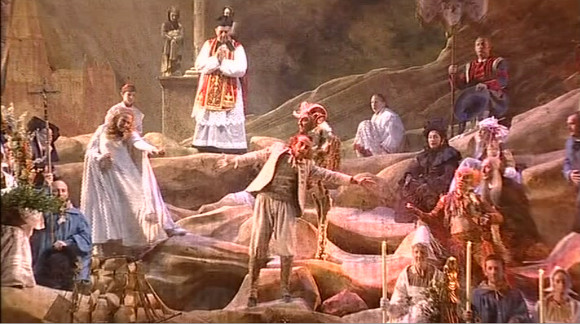
Meyerbeer’s Dinorah ou le Pardon de Ploërmel must be a very strong candidate for the silliest opera ever written. It concerns a young girl, Dinorah, who is deserted on her wedding day by her fiancé Hoël who disappears in search of a cursed treasure. She goes mad. There’s sheep and goat ballet, a lullabye to a goat accompanied on the bagpipes, more sheep and goat ballet and a scene where Dinorah sings a very difficult aria to her own shadow. There’s a “ghastly” enchanted glen scene at the end of which Dinorah, pursuing her pet goat, falls into a river; apparently fatally. Rather than resolve this we then get another half hour of pastoral with a hunter and a reaper and assorted shepherdesses and, inevitably, dancing sheep and goats before Hoël shows up having rescued Dinorah. He persuades her that the last twelve months have all been a bad dream and they get married accompanied by much pious singing.
Armide at Versailles
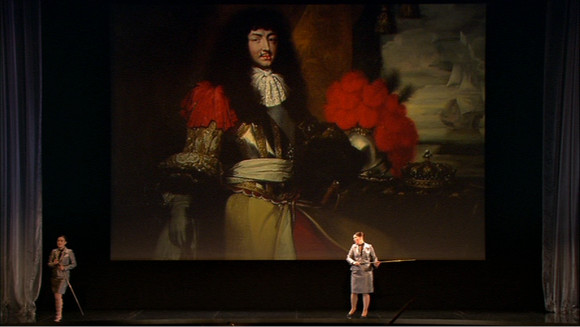
Lully’s Armide is pretty much the archetypal tragédie en musique. It features an allegorical prologue praising Louis XIV’s multiple virtues, delivered as a dialogue by La Gloire and La Sagesse followed by five acts based on the Armida/Rinaldo story from Tasso. There are also, of course, lots of ballet interludes. As such, it isn’t all that easy to stage for a modern audience. Robert Carsen and William Christie’s approach for their 2008 Paris production is to frame the story in the context of Versailles.
Adventure story
Robert Carsen doesn’t seem disposed to treat Handel too reverentially. Although there is some of the trademark Carsen cool minimalism in his 2011 Glyndebourne production of Rinaldo (not to mention symmetrically arranged furniture) there’s also a degree of humour, as there is in his Zürich Semele. I find it very effective and, judging by the audience reaction, so did the people who saw it at Glyndebourne.
Ein Reich, ein Volk, ein König
In many ways Meyerbeer’s Les Huguenots is a typical mid 19th century French grand opéra. It takes a sweeping, epic story; in this case the St. Bartholomew’s Day Massacre, and grafts onto it the elements the paying public demanded; spectacle, ballet, showpiece arias etc. The result is unwieldy and, when applied to such grim subject matter, almost grotesque. The 1991 Deutsche Oper production by John Dew (performed in German as Die Hugenotten) takes these disparate elements and works with them; mixing laugh out loud and extremely grim to create a piece of music theatre that is truly disturbing.
Allons enfants de la Patrie
There can’t be many French Revolutionary propaganda comedies but Cherubini’s Koukourgi is one of them. Written in the crisis year of 1792 and intended for the Théatre Feydeau it never actually made it onto the stage and remained unperformed until it was staged by the Stadttheater Klagenfurt in 2010. By then the dialogues, the overture and the finale had been lost but music director Peter Marschik found a couple of bits from other Cherubini operas to fill the musical gaps and director Josef E. Köpplinger supplied rather arch German dialogue to link the musical numbers (sung in French).
Born to the anvil, not the hammer
Manuel de Falla’s La Vida Breve is often credited with being the first true Spanish opera. It’s certainly one of very few works in that language one might encounter in an opera house. It’s hard to see why it’s not performed more often. It’s a dramatic story about the tragic love affair of a gtpsy girl and a wealthy young man and the music is a blend of verismo and flamenco. The orchestration is quite exciting and the Spanish influenced vocal lines are very easy on the ear. It really ought to have a rather wide appeal.
Campy Poppea
J-P Ponnelle’s 1979 film of Monteverdi’s L’incoronazione di Poppea with Zürich forces conducted by a young Nikolaus Harnoncourt is like his Orfeo only more so. Sets and costumes are that rather odd “ancient baroque” that Ponnelle is so fond of. The acting is stylized and hyperkinetic and so is the camera work with close ups from weird angles all over the place. So far, so Ponnelle.