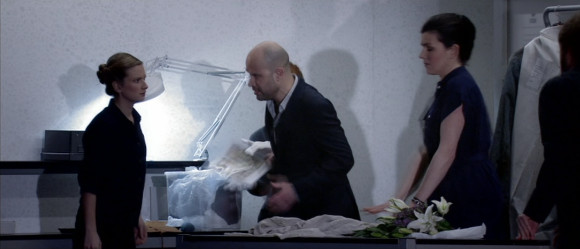
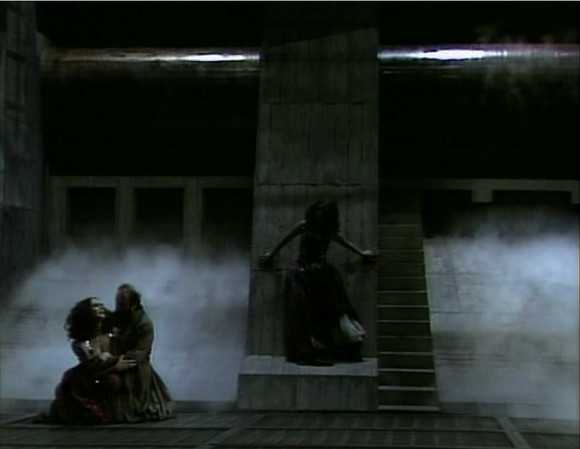
There’s a bit at the end of the first act of Parsifal where Gurnemanz looks at Parsifal and says “you haven’t understood anything have you?” or words to that effect. Watching Romeo Castellucci’s 2011 production for Brussels’ La Monnaie theatre my sympathy was very much with the Pure Fool. This is one of the most incomprehensible productions I have seen. Act 1 is very dark. Most of the time only a tiny fragment of the stage is lit. The first thing we see is a snake in its own tiny patch of light. Then we are in a forest and the Grail Knights appear to be part of the forest. Whether they are just wearing suits of leaves or are actually plants is unclear. Kundry, in a white hoodie, and Parsifal in street clothes are recognisably human. Titurel and his squires wear overalls and hard hats. One of them carries a chain saw. The “swan” appears to be a lit up tree branch though later it appears as a very decomposed skeleton. The Grail Scene is played out with a white curtain, with a small black comma on it, across the entire stage. The curtain is withdrawn and we see fluorescent lights above the greenery, which takes up much less space than one has so far imagined. Is Monsalvat a grow-op and the knights marijuana plants?
Tag Archives: dvd
Make him cry blood
Written on Skin; music by George Benjamin, text by Martin Crimp, was first seen at the Aix en Provence festival in 2012. The following yewar it was given, in the same production by Katie Mitchell and with substantially the same cast, at Covent Garden. Both versions were televised and now the ROH version has been released on DVD and Blu-ray. It’s an unusual, complex and rewarding work. 21st century angels decide, for reasons not entirely clear, to return to the 13th century to create and participate in a human drama. The medieval humans are The Protector; a rich man of mature years utterly confident of his privileged position and his own righteousness, and his wife Agnès; younger, illiterate, downtrodden. Into their world comes The Boy; one of the angels in fact, who will create for The Protector an illuminated book; a precious object celebrating his wealth and worthiness. Inevitably, The Boy and Agnès fall in love and The Protector’s revenge, whipped up by the angels, is quite revoltingly violent. It’s essentially a simple and classic plot but Crimp shapes it skilfully with carefully placed anachronisms and by using the device of having the characters, sometimes, narrate their own actions in the third person. Benjamin’s score is in a modern idiom. He’s not afraid of atonality and he uses a very wide range of colours to create a score that ranges from meditational to almost unbearably violent. Certainly words and music work together here to great effect.
Ciro in Babilonia
Ciro in Babilonia is an early work by Rossini composed for the lenten season when only works on biblical/religious themes were permitted. This doesn’t really fit that description. Sure, the story of Belshazzar and the writing on the wall gets a brief look in but it’s almost interpolated in the story, from Herodotus, of Cyrus’ capture, together with wife and child, by Belshazzar. It’s a tale of arrogant kingship, religious faith and marital devotion. Typical opera seria stuff really. It’s a bit thin plot-wise though which probably explains its relegation to obscurity. This first modern production was created at Caramoor, then translated to the Rossini festival at Pesaro, where it was recorded in 2012.
The way by swan
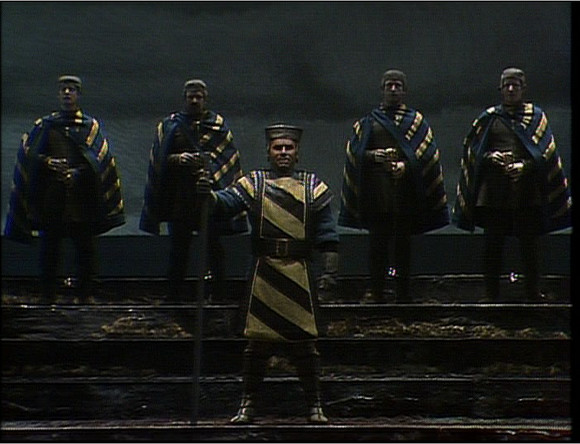
No Madelaines were harmed in reviewing this DVD. It’s a 1992 recording from the Wiener Staatsoper of, of course, Lohengrin and its main claim to fame is that stars Placido Domingo (note no further jokes about water fowl despite the prominent role of Heinrich der Vogler). It’s one of those DVDs from the 80s and 90s that are a bit frustrating. The singing is very good indeed. Domingo is superb and the rest are at least very good plus Abbado conducts with real flair but the production is dull as ditch water and the video quality is awful.
Routine Don Pasquale
Once in a while one comes across an opera DVD that’s so “ordinary” that it’s extremely difficult to write about it. The 2002 Cagliari recording of Donizetti’s Don Pasquale is one such. Stefano Vizioli’s production is set in 1750s Rome and plays the piece about as straight as a madcap comedy can be played. The singing is rather good and, if the acting is a bit Brian Rix farce that’s hardly inappropriate. At the heart of the piece is Alessandro Corbelli who must be close to being the ideal Pasquale. He gets good support from Eva Mei as Norina and Antonino Siragusa as Ernesto. Roberto de Candia is also quite good as Malatesta but he’s not Mariusz Kwiecien. The chorus is a lot livelier than the average Italian chorus and the orchestra, from Bologna, might be a bit thin on string tone but isn’t bad at all and Gérard Korsten’s conducting is perfectly OK.
El Niño
John Adams’ El Niño was conceived as an oratorio but thoughts turned to it being staged early in the creative process. The final result, as staged at Paris’ Châtelet in 2000, defies easy characterization. There are singers and dancers on stage but they don’t represent unique characters. So, for example, at one moment Willard White is Herod and at another Joseph. To further complicate matters video is constantly projected onto a screen above the stage space. It was specially created for the piece being shot on location in Super 8. There’s no clear narrative either. To some extent it tells the Christmas story but it’s at least as much about the feminine experience of giving birth as anything from Isiah or the Gospels. It also uses a very eclectic mix of texts; from the Bible, from the Apocrypha, from female Latin American poets, from Hildegard of Bingen and so on. There are lots off Sellars’ trademarks in the staging too; semaphore and so on. Does it work? I don’t really know as it’s really hard to tell from the video recording (see para 3).
Bard of sex and Eros kinky
The sudden death of Italian opera has always intrigued me. Works, by Italians or to Italian libretti, dominated opera houses, at least in the English speaking world, for centuries. The Metropolitan Opera even commissioned new work in Italian (Puccini’s La Fanciulla del West, 1910). But after Turandot (1924) new works in Italian pretty much dried up. I can’t think of a single one that could be considered a repertory staple and even more recherché pieces like Pizzetti’s Assassinio nella Cattedrale are few and far between. Indeed, since WW2 at least, the dominant language for new operas has been English with German some way behind and the odd work in French or something more obscure. So, I was intrigued to get my hands on a recording of Luca Mosca’s 2007 work Signor Goldoni; a commission for Venice’s La Fenice inspired by the 18th century Venetian playwright and librettist Carlo Osvaldo Goldoni. What’s really surprising is that the libretto (perhaps we should say “book”) by Italian writer Gianluigi Melaga, is in English! Apparently librettist and composer consider that English is better adapted to the kind of word play they were aiming for than Italian.
Chéreau Ring – Götterdämmerung
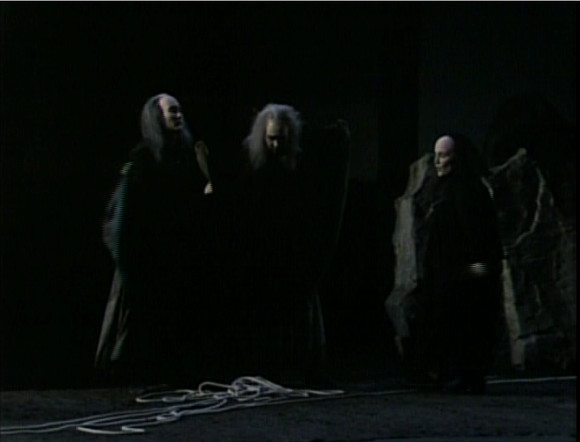
And so, at last to Götterdämmerung. The scene with the Norns is dark, very dark. There’s a rope and not much goes on (at least that is visible) but the singing is good. The “dawn” scene comes off more effectively here than the final scene of Siegfried but it’s still not great. I think the problem is a combination of Manfred Jung’s dry, rather nasal tone and Boulez rather fast tempu. It seems rushed rather than ecstatic and the Rhine Journey doesn’t thrill. I was concerned at this point that I was being unfair to a renowned production so I put on the same scene from Kupfer/Barenboim. It’s much better. Siegfried Jerusalem sounds truly heroic, Anne Evans richer tone blends better than Gwyneth Jones’ (though this could be an artefact of the recording) and, crucially, Barenboim gives the singers room to sing before markedly speeding up for the orchestral music. At least there is no naff attempt to depict a literal Grane in Chéreau’s version. At the conclusion of this scene Brian Large pulls off the first of his artsy effects. During the Rhine music he holds a close up of Brünnhilde for a rather long time before pulling out to a full stage shot which he then shrinks until there is just a tiny square of picture in the middle of a black screen which, when he slowly expands it, has transformed to the Gibichung hall. He does the same thing a couple more times. It seems odd to introduce that kind of thing at such a late stage in the cycle.
Chéreau Ring – Die Walküre
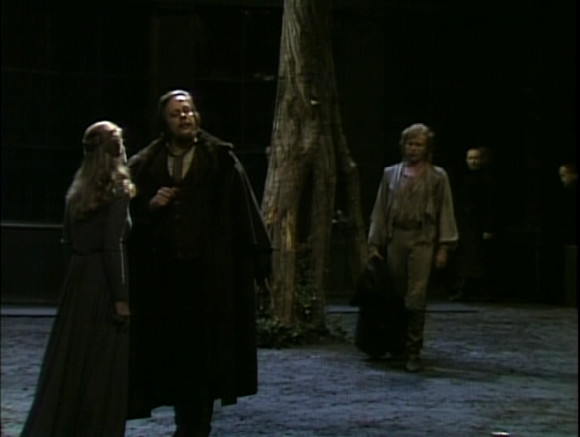
The second instalment of Patrice Chéreau’s 1980 Bayreuth Ring cycle is set, like Das Rheingold, in a sort of industrial bourgeois late 19th century. One would almost say steampunk if that were not an anachronism. Actually the “industrial” side is much less evident than in the earlier work. There’s a sort of astrolabe/pendulum thing in Valhalla but that’s about it. Setting aside, the story telling is very straightforward; so much so that it takes a real effort of the imagination to get into a mindset where this production could ever have been considered controversial. It’s quite literal; Brünnhilde has a helmet and breast and back plates (worn over a rather severe grey dress), Wotan has a spear, Siegmund has a sword. There’s not an assault rifle or light sabre to be seen. It is though dramatically effective.
Chéreau Ring – Das Rheingold
So much has been written about Patrice Chéreau’s centenary production of the Ring cycle at Bayreuth that I approached reviewing it with some trepidation. I have decided to write about it “as is”; i.e. to write about what I see on the DVD and leave the undoubted historical significance, perhaps even revolutionary impact of the production, to others. Also, it’s apparent that what’s on the DVD, filmed in an empty house as was contemporary Bayreuth practice, must differ from what was seen on the Green Hill in certain key ways. This is a review of what;s seen and heard on the DVD.