COC releases some 2013/14 season financial information

eyeshades2013/14 saw the decline in ticket sales and box office revenue at the COC continue, though less precipitously than in the previous couple of years.  Sales were down from 109297 tickets in 2012/13 to 106748 seats sold in 2013/14.  Revenue was also down from $9.9 million to $9.7 million.  A reduction in performances boosted capacity utilisation to 94% but heavy discounting at both ends of the season left the revenue per seat essentially static at just under $91.

Continue reading

Falstaff up close

Falstaff-MC-0417

Photo: Michael Cooper

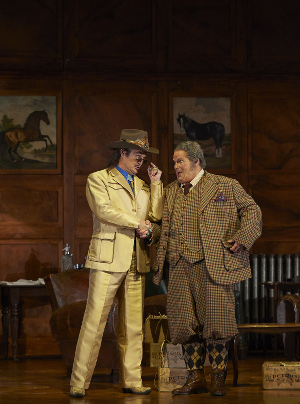
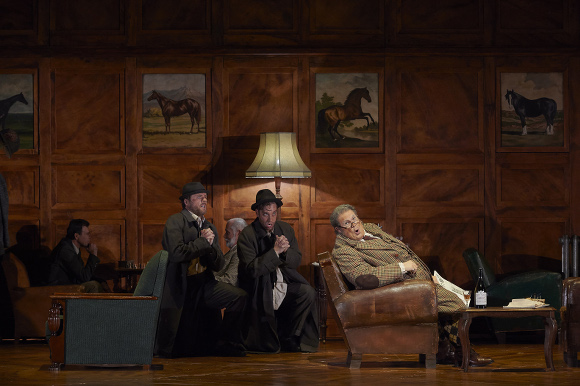
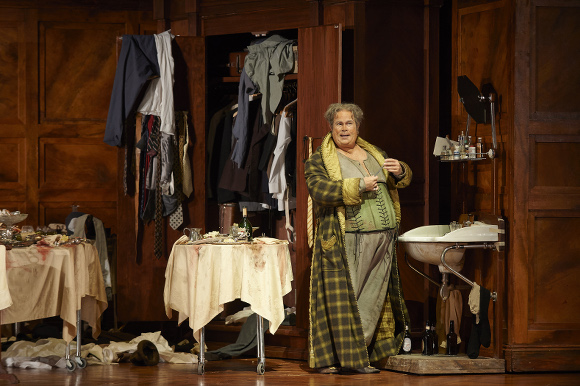
The nice thing about seeing a production for the the third time is that one can focus on what one wants to because the big picture is already known.  After two looks at the COC’s current Falstaff from the Rings I was glad to be able to see it from closer up and this time I also remembered my opera glasses.  The details in the production and the Personenregie are really amazing.  In the scene where Fortuna is offering gifts to Falstaff, the five cases of wine are Pétrus.  In a way that’s doubly funny because although Pétrus is typically the most expensive Bordeaux today it was relatively unknown in the 1950s.  My 1970’s copy of Hugh Johnson’s The Wines of Bordeaux talks of how, if he lived in France, he would certainly cultivate a number of petits fournisseurs in the relatively unknown and undervalued Pomerol appellation!  Anyway, back to Falstaff.  The money in the suitcase of money is clearly US currency.  Nice touch.  The ornaments in Mrs. Ford’s 1960s chic kitchen are hilarious.  I particularly liked the glass elephants.  The antics of Pistola and Bardolfo also came more sharply into focus.  They nick anything that’s not nailed down.  Are we sure Falstaff is from Norfolk not Liverpool?  The handbag snatch in the restaurant scene is especially good.

The other thing I noticed was how much fun the audience was having.  There was none of the “opera is SRS business” vibe going on.  Rather, much unaffected laughter and laid back enjoyment.  We could use more of that.  So when do we get Gerry Finley back?

Kaduce transforms Butterfly

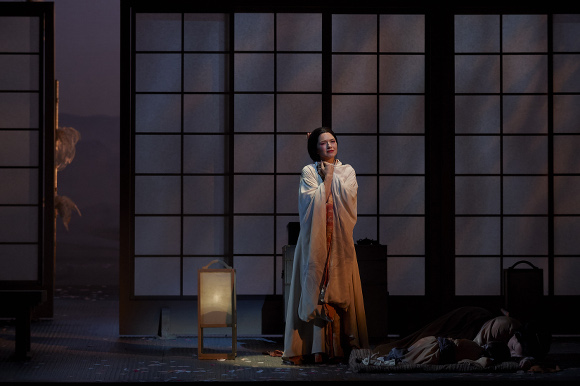
My review of the opening night of the COC’s much revived Brian Macdonald production of Madama Butterfly was as lukewarm as the audience reaction.  In fact, I’ve never seen  an audience in that house so subdued.  Reviews of the alternate cast with Kelly Kaduce in the lead had generally been more encouraging so I was keen to see what she could do.  I saw it yesterday afternoon.  Let’s cut to the chase.  She transforms the production.  It’s like watching a different show and every scene she appears in has an energy that was lacking before.

ButterflyB-MC-2751 Continue reading

Madama Butterfly revived but not revitalised

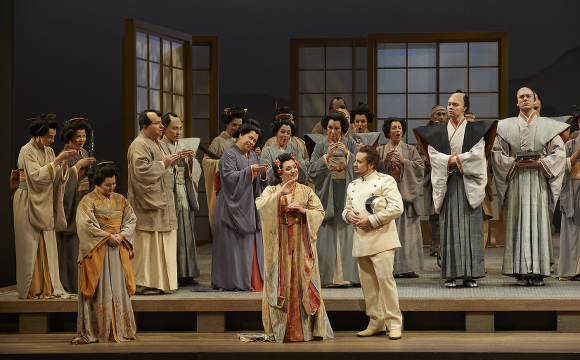
The COC’s production of Madama Butterfly opened last night at the Four Seasons Centre.  I’m not a huge Madama Butterfly fan and it takes a really good production and a really good performance to get me past my instinctive dislike for a libretto based on child rape and sex tourism backed by Puccini soup with an infusion of Mikado.  This production, being revived for the umpty umpth time (It dates back to the Brian Dickie era) just wasn’t that.  Director Brian Macdonald writes in the programme “We both (he and Dickie) had had experience at the Stratford Festival.  That meant wood, simple props, no decoration that wouldn’t bespeak the essence of the play”.  Throw in an Allen key and it would sound like a trip to IKEA.  Which is pretty much what the designs are like; clean, functional and inoffensive.  Throw in costumes and gestures straight from the Mikado and you have it.  Not bad.  Just meh.

Butterfly-MC-0383 Continue reading

Falstaff again

Back to the COC’s production of Falstaff last night for a second look.  I felt I spent so much time last week trying to figure out who was who and what was what in this rather madcap comedy that I was really looking forward to seeing it in a more relaxed way.  I had figured out that there was a lot of detail to unpack that I had missed first time around; partly because I was attention challenged and partly because I had forgotten my opera glasses.  Last night; perched up in Ring 5, I watched a good part of this show through the glasses and saw many things I missed first time around.  I think I want to watch it from close up if I can, even if there’s an acoustical price to pay for that.

Falstaff-MC-1829 Continue reading

A Play of Passion

Colin_Ainsworth_Headshot2Tenor Colin Ainsworth and pianist Stephen Ralls today presented three song cycles written for them by Derek Holman.  The first, The Death of Orpheus (2004) sets two translations of Ovid by Arthur Golding; on the subject of Orpheus in the underworld sandwiching Shakespeare’s Sonnet XVIII.  The parts form an interesting contrast.  In the Ovid, Golding chose to write in rhyming iambic heptameters but Holman’s setting completely ignores that, breaking and reshaping the lines very freely.  The piano line too is spare and more a commentary on the vocal line than a support.  In contrast the Shakespeare is set much more “faithfully”; piano and vocal line both reflecting more closely the metre of the verse.  Holman also rarely repeats a phrase of the text) it happens maybe five times in the eleven songs in today’s programme) which puts quite a burden on the listener given the allusive complexity of Ovid/Golding’s verse. Continue reading

Why productions succeed in one place but not another?

12-13-02-b-MC-D-3024In an age of co-productions many opera productions are seen in multiple houses.  Some of them we get to see in multiple guises.  For example I’ve seen Tcherniakov’s Don Giovanni on DVD and will be seeing it live later this season in Toronto.  Spmething that’s been fermenting in my brain for a while now is why the same production can get a drastically different reception in different places.  The piece that first made me think about this was Chris Alden’s Die Fledermaus.  This was generally well received in Toronto (more perhaps by my friends and acquaintances than the print media but that’s par for the course) but universally panned in London when it played at ENO.  Bryan’s interesting comments about the Carsen Falstaff kicked off the train of thought again and made me want to put some tentative thoughts into writing.

Continue reading

The Revengers’ Comedy

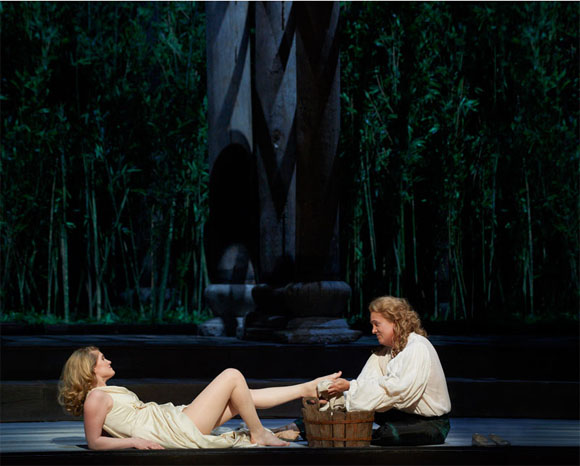
Last night, the COC opened its 2014/15 season with Verdi’s Falstaff; a work I was not familiar with and one that turned out to be a bit of a surprise.  It’s not your usual Verdi.  It’s his last opera, composed when he was 80, and is not at all typical of his earlier work.  There are hardly any “big tunes” or even conventional arias.  The odd chorus harks back to an earlier style but much of the music is quite dark; heavy use in places of the lower pitched instruments, especially for a “comedy”.  Don’t take that as a criticism though.  It’s a musically and dramatically tight, even compact, work that is both incredibly funny and also something more disturbing.  Perhaps it’s as much about mortality as love.

Falstaff-MC-1533 Continue reading

Moving into October

October is the month things usually really get going again in Toronto and this year is no exception.  The calendar for the first third of the month is very busy.  Highlights include three free concerts in the Richard Bradshaw Amphitheatre, the opening of two productions at the Canadian Opera Company and Nuit Blanche events at the Canadian Music Centre and the UoT Music Department.

fall101308_6 Continue reading

That elusive new audience

tumblr_m6l1rgQ65g1ra9bpvo7_1280The other night I was chatting to some folks at a performance by Loose TEA Theatre and a comment was made to the effect that it was companies like Loose TEA and Against the Grain who were creating the future audience for opera.  I didn’t think about it much of the time but it turned into a sort of brainworm that wouldn’t go away.  I don’t think the idea was that somehow innovative “pop up” type companies would replace the likes of the COC; at least not this side of nuclear war or total economic collapse (neither of which seems impossible it has to be said).  So the hypothesis has to be that this sort of endeavour makes a significant contribution to replacing the aging “big house” audience.  As I began to mull that over and further stimulated by yet another fact free piece in The Guardian on “opera snobs” (courtesy of Schmopera) I started to develop a number of lines of enquiry that aren’t exactly tangential to the original hypothesis but rather seem more like a set of eigenvectors defining the problem space.  Which is a mathematician’s way of saying that what follows is kind of all over the place.

Continue reading