
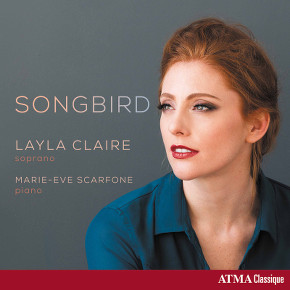
 Layla Claire is one of a handful of young Canadian singers making something of a splash on both sides of the Atlantic with major roles in Glyndebourne, Zürich, Toronto and Salzburg and an upcoming Pamina at the Met. Her debut recital CD Songbird, with pianist Marie-Eve Scarfone, was recently issued on the ATMA Classique label. It’s an interesting and varied collection of songs though never straying very far from familiar recital territory. It’s tilted towards French (Gounod, Chausson, Debussy, Fauré, Bizet) and German (Wolf, Strauss, Brahms, Liszt) repertoire but there’s also Quilter, Barber, Argento and Britten (the comparatively rare Seascape which is, oddly, omitted from the CD liner).
Songbird
Reply
 This review first appeared in the print edition of
  Carl Heinrich Graun isn’t exactly a household name today but he was court composer to the extremely musical Frederick the Great who was fond of both his flute and the opera when he wasn’t too busy being beastly to the Austrians. Anyway, Graun composed a ton of opera and based on the arias on this disk it’s surprising that they are almost completely neglected. The only Graun opera I have seen is
 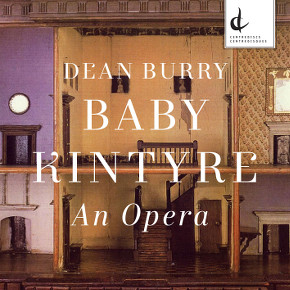 All families, they say, have secrets. Few perhaps are as lurid as what came to light at 29 Kintyre Avenue, Toronto (about 2km from here) in the summer of 2007 when a contractor renovating the house discovered the mummified body of an infant wrapped in a 1925 newspaper. Incredibly, the CBC was able to track down the last surviving member of the household from that era, a 92 year old woman living in a retirement home in up-state New York. Her recollections, which formed the subject of a short two part radio documentary, provided a lot of context and background but few hard facts. Who the baby was and how it came to be under the floorboards remains very much a mystery.
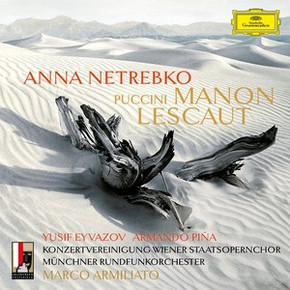 Not too many CDs of new opera recordings, at least of mainstream repertoire, come my way these days. Studio recordings have become rare and the usual medium is a video recording, itself a spin off from a live broadcast; TV, cinema or web, of a live performance. This makes sense to me. Just listening to an opera has always seemed a second best. Anyway, that’s all by way of saying that I was a bit surprised to find myself listening to a CD edition of a live recording of Puccini’s Manon Lescaut from the 2016 Salzburg Festival. How did this recording happen you ask? The answer is on the box, where Anna Netrebko in the title role, gets top billing, even over the composer.
 Renée Fleming’s new CD Distant Light is quite unusual for a “diva disc”. It’s definitely not “Opera’s Greatest Hits” territory. Rather, it’s in three quite contrasting parts though all are linked by the idea of “emotional landscapes”. It starts off with Samuel Barber’s Knoxville: Summer of 1915, follows it with settings of Mark Strand poems by Anders Hillborg and finishes up with arrangements of Björk songs. She’s accompanied throughout by the Royal Stockholm Philharmonic Orchestra with Sakari Oramo conducting.
 This review first appeared in the print edition of
  This review first appeared in the print edition of
  This review first appeared in the print edition of
  This review first appeared in the print edition of
  operaramblings