
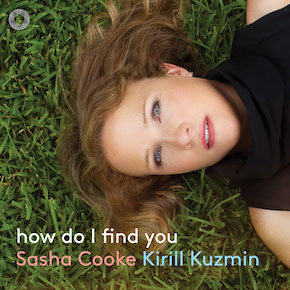
 American mezzo Sasha Cooke’s reaction to the endless cancellations and disappointments of 2020 was to get seventeen pairs of composers and writers to each create a song that encapsulated 2020 for them. She recorded the results with pianist Kirill Kuzmin to create the album how do I find you? As we come to the end of 2021 I find myself reflecting on how we have coped so far and what’s to come. Other people’s experience expressed in music perhaps helps. Continue reading
how do I find you?
Reply
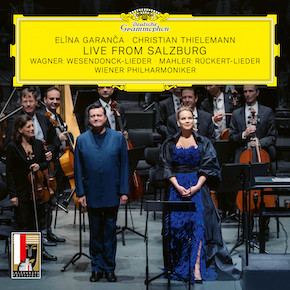 Live from Salzburg is a new CD featuring music recorded live at Salzburg during the pandemic. The performers are Elīna Garanča, The Vienna Philharmonic and Christian Thielemann. There are two sets of songs; Wagner’s Wesendonck Lieder (recorded in 2020) and Mahler’s Rückert Lieder (recorded in 2021). Both recordings were made during live performances in the Großesfestspielhaus.
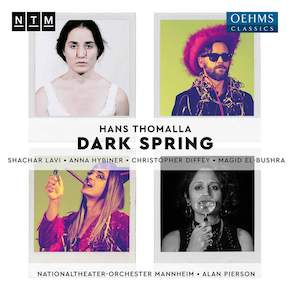 I came across Hans Thomalla’s 2019 opera Dark Spring when the record label Oehms gave me access to a pre-release of the CD version which is to be released in a couple of days time. Listening to a couple of scenes and looking at the photos in the accompanying booklet suggested to me that this was really an opera I needed to see to fully appreciate and, indeed, it turns out that there’s a lot going on that isn’t explicit in the libretto. Fortunately, as it turns out, there’s a full video recording on Vimeo. It’s not the greatest technical quality of all time but it is drawn from the same live performances at the work in Mannheim in the fall of last year as the CDs. The CDs are excellent high quality (48kHz, 24 bit) CD quality. So I think there’s a case for tracking down the video and the CD recording.
 My main reason for getting my hands on a new CD of mainly orchestral music by Sibelius featuring the Bergen Philharmonic and Edward Gardner was to listen to the couple of tracks that feature soprano Lise Davidsen. I first saw her with the TSO in 2019 and I thought
  Cathedral City was the (2010) debut album of Missy Mazzoli’s ensemble Victoire. All the tracks are music composed by Mazzoli and give a pretty good feel for her non-operatic output. It’s been described as a “distinctive blend of post-rock dreamscapes and quirky minimalism” and that seems as good a description as any. Virtuosic instrumental playing is mixed with live vocals, electronics and distorted recorded speech fragments. Often the material is looped and the basic acoustic changed to create a different sound scape. The music is by turns, drivingly energetic, brutal and gently lyrical. It’s like the work of no other composer I know and I find it really compelling.
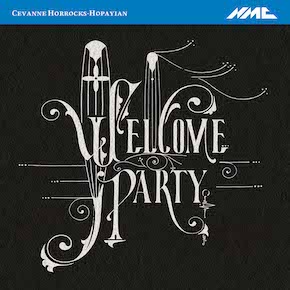 Welcome Party is a new record of music by British-Armenian composer Cevanne Horrocks-Hopayian. Much of it is inspired by her residency with the LSO at 575 Wandsworth Road. That house, now a National Trust property, was the home of Kenyan born polymath and poet Khadambi Asalache, who decorated it with his own wood carvings and murals. Asalache’s poetry provides the texts for several pieces and others are inspired directly by the house and its contents. The house is also a factor in the composer’s visual scores which sometimes use visual elements in the house to shape the music and inspire the improvisatory passages. COVID looms large on the album too; from personal tragedy to the conditions under which many of the recordings were made.
 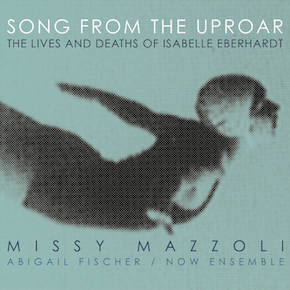 Missy Mazzoli and Royce Vavrek’s opera Song From the Uproar: The Lives and Deaths of Isabelle Eberhardt is based on the journals of Isabelle Eberhardt; a Swiss explorer, mystic and writer who roamed the deserts of North Africa before her untimely death at the age of 27. It was conceived as a multi-media opera and staged as such at The Kitchen in New York in 2012. A studio CD recording was made by the original cast soon after. One can get a s sense for the look and feel of the stage piece from
  Transcendent is a CD from the Asia/America New Music Institute (AANMI). It features works by six American and Asian composers performed by Davóne Tines, Matthew Aucoin and members of the AANMI Ensemble in various combinations.
 Debut albums from young singers usually play it fairly safe but mezzo-soprano Emily D’Angelo’s is anything but. Her new album, enargeia, on the Deutsche Grammophon label is bold indeed. All twelve tracks on the album feature works by contemporary female composers, though with a nod to Hildegard von Bingen. The accompaniments vary from solo cello to orchestra augmented with electric guitar, electric bass and drum kit. Singing style varies from austerely classical to verging on rock opera.
 Listening to Emily D’Angelo’s new CD set me off on a search for more music by Hildur Gu∂nadóttir. This led me to Nortdic Affect; an ensemble who play contemporary music, mostly by female Iceandic composers) on baroque instruments. The older of the two albums is Clockworking, from 2015. It’s rather hypnotic. The music kind of inhabits the space between ambient sound and something more structured. Certainly the range of sounds that the musicians generate is remarkable, even when electronics aren’t involves, as they sometimes are. The
  operaramblings