Conspicuous Consumption

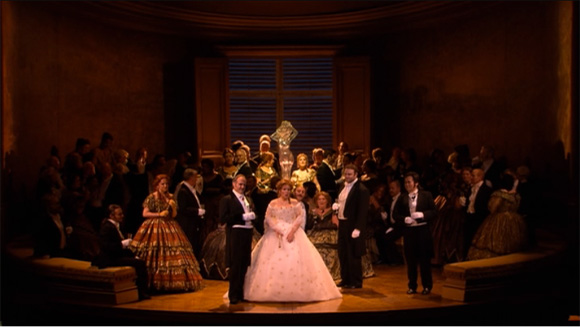
Richard Eyre’s production of La Traviata at the Royal Opera House, filmed in 2009, is a pretty good example of how to do a traditional production.  There’s nothing conceptual or thought provoking to it but the direction is careful and tells the story clearly and well.  The designs are mid 19th century with crinolines and tail coats but with the odd imaginative touch and a welcome refusal to succumb to the “more stuff” syndrome that plagues so many Verdi and Puccini productions.  Backed up by excellent music making it probably makes a near ideal introduction to the piece, even if it won’t entirely displace Willy Decker’s brilliant and disturbing Salzburg production in my affections.

Continue reading

Ballet/Opera Fusion

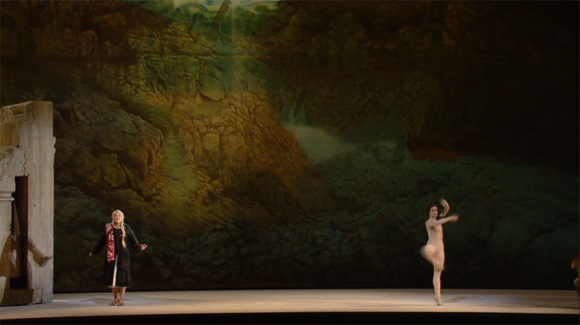
Handel’s Acis and Galatea is a peculiar piece in some ways.  It was written to be performed at Cannon’s, the Edgware residence of the then Earl of Caernavon, presumably for his guests.  Apparently the performance style was to have the singers sing from music stands in front of a painted backdrop.  So, a sort of oratorio with curtains.  It’s not uncommon to stage Handel oratorios as opera these days.  Theodora is done quite often and even Messiah has been staged so it’s no great surprise that Acis and Galatea should be given a similar treatment.  In fact Wayne McGregor’s 2009 Covent Garden production stages it as an opera and a ballet simultaneously combining the resources of the Royal Ballet and the Royal Opera.

Continue reading

Alfano’s Cyrano with Domingo and Radvanovsky

It’s hard to think of a play that would make a better basis for an opera libretto than Edmond Rostand’s Cyrano de Bergerac.  Henri Cain’s adaptation is rather good; somewhat simplifying and tightening up the plot in a similar manner to that later taken by Britten and Pears with A Midsummer Night’s Dream. It’s a shame Franco Alfano’s music doesn’t really rise to the same heights.  It has its moments, especially later in the opera, but much of the time it’s dull and impressionistic; more like a film soundtrack than an opera score.  I guess the lesson is that one just can’t do verismo while trying to avoid vulgarity and excessive melodrama.  It also has to be said that much of the time the music seems to be fighting the natural rhythm of the words rather than supporting it.  What the music does have is Alfano’s trademark torturing of his singers, especially the principal four roles of Cyrano, Roxane, Christian and De Guiche.

Continue reading

A grim and gritty Rusalka

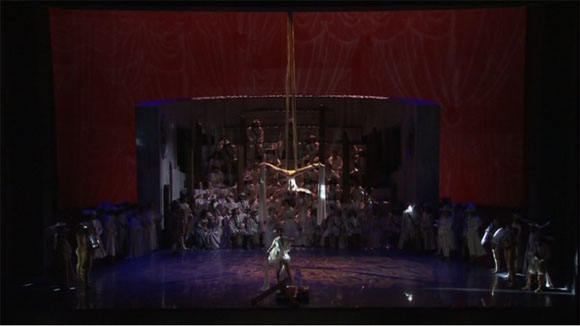
Martin Kušej’s 2010 production of Dvořák’s Rusalka at the Bayerisches Staatsoper is exactly the sort of production traditionalists fume about over their port and cigars.  It’s loosely based on the Fritzl and Kampusch imprisonment/child abuse cases.  The Water Goblin, aided by his wife, Ježibaba, have their children; Rusalka and her sisters, imprisoned in a wet cellar under their house.  The Water Gnome is clearly indulging in sexual abuse of the girls to the total indifference of his wife.  Rusalka dreams of a life among humans and of love.  She begs her mother to make her human/set her free.  This happens and Rusalka, mute and tottering on red heels, is free to pursue her romance with the prince.  Is this literal or all in Rusalka’s imagination?  Does it matter?  Continue reading

But in me life has halted

It’s perhaps odd that somebody like me, who got into Janáček’s music as a teenager, should have taken so long to discover his operas but I’m so glad I did.  The latest discovery is Věk Makropulos in a 2011 recording from the Groβes Festspielhaus in Salzburg with Angela Denoke as the 337 year old diva Emilia Marty.  It’s a strange work dramatically; a sort of fantastic detective story.  Apparently it’s based on a comedy (by Karel Čapek, the guy who coined the modern meaning of “robot”) though how it got from a comedy to the opera is a bit of a mystery.  It’s weird, compelling and creepy but not at all funny.  It also has a terrific score. Continue reading

Claus Guth’s Cosí

In 2009 Claus Guth wrapped up his Da Ponte cycle for Salzburg with Cosí fan tutte.  I really like his Le Nozze di Figaro and after seeing this Così I’ll certainly be seeking out the Don Giovanni too.

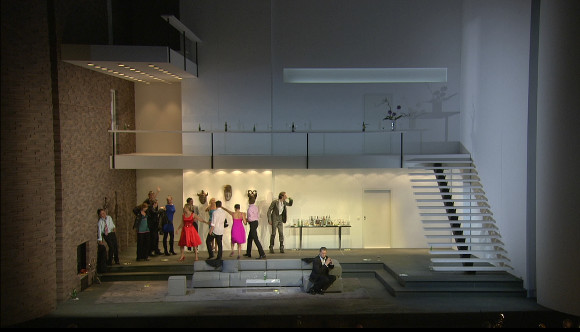
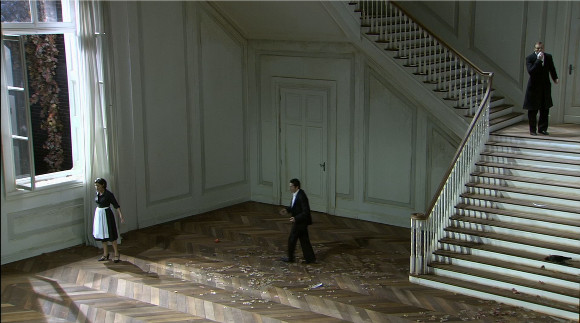
1.apartmentThis production was staged in the Haus für Mozart and uses a single set.  It’s the girls’ apartment; a very expensive looking two level loft with a broad staircase that recalls the Figaro.  The setting is contemporary and it opens on the aftermath of what appears to have been a rather good party.  The men are preparing to leave when Don Alfonso issues his challenge.  It’s the edgiest version of the scene I’ve watched with quite an undertone of violence.  This is clearly not going to be a light comedy.  By Una bella serenata the characteristic feathers of the Figaro have appeared.  The edginess continues throughout the first act with many deft touches, especially a power cut staging of Come Scoglio.  When the “Albanians” appear there is only the most perfunctory effort at disguise.  No slapstick moustaches here. Continue reading

There’s the Moral to Draw

Robert Lepage’s 2007 Brussels production of The Rake’s Progress is fascinating on many levels.  I think all good opera productions start with the music and this is no exception.  Lepage sees a crucial relationship between Stravinsky at the time the work was written (1948) and film and television.  It was an era when insubstantial visual imagery was being supported emotionally by pretty impressive music.  Lepage works with that idea; setting the work in the 40s and incorporating film and film making imagery extensively.  I think this decision also frees up the music.  By taking the piece out of the 18th century it becomes possible to take the 18th century out of the piece.  For instance, there are elements in the libretto that mimic 18th century street ballads but Stravinsky absolutely avoids writing the kind of phrasing one might expect and quite deliberately breaks up the line.  That phrasing is respected here whereas I have often heard a false legato imposed on some of those phrases. In a way, the production is helping the viewer to hear the music differently which is perhaps the highest compliment one can pay an opera production.  There are other intriguing relationships between Lepage’s vision and Stravinsky’s.  Lepage sees Stravinsky as playing with time in a cinematic way i.e. rendering it non-linear.  Lepage seeks to mirror this in the spatial dimension by using some odd perspectives and some cinema devices; notably Anne driving her car in front of a moving backdrop just like a studio movie of the period.  There’s a lot going on and it would be tedious to describe it in detail.

Continue reading

Zambello’s Carmen

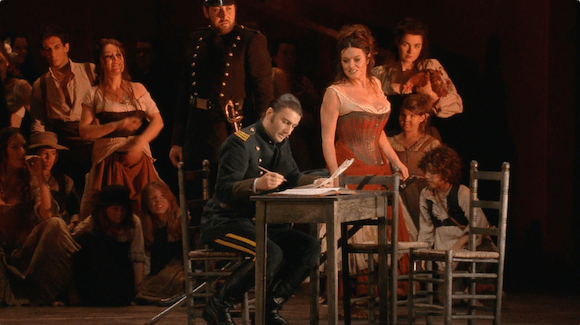
Francesca Zambello’s Carmen for the Royal Opera House has more going for it than is immediately apparent.  On the face of it it’s a very traditional, conservative production; period costumes, literal sets, hordes of kids in Acts 1 and 4, live animals, but a close look reveals rather more.  Zambello reveals her intentions during the overture where we see a manacled, distraught Don José dragged to execution by a masked executioner.  This is going to be Don José’s story rather than one that focuses almost exclusively on the title character.  What we see here is a stark contrast between what Don José really wants; respectability, an obedient wife, conformity with the Church, honour and what key choices, accidents and conflicts drive him to; criminality, liminality, execution and, we may suppose, damnation.  The staging subtly highlights each of the key moments in Don José’s descent; his arrest and demotion in Act1, the fight with Zuniga in Act 2 and the realisation, in Act 3, that Carmen will never be the women he really wants reinforced by Micaëla’s aria that ironically offers him the choice he can no longer make and does so unmistakeably in terms of Catholic eschatology.  There is so much more going on here than a sexy woman and some pretty tunes.

1.carmendonjose

Continue reading

Happy ever after?

I’ve watched the Blu-ray version of the 2006 Salzburg production of Le Nozze di Figaro a few times now but sitting through it with notepad at the ready made me realise how much I hadn’t seen on the previous viewings.  My notes are copious.  I usually take a couple of pages or so.  This time I covered four pages and it could easily have been more.  You have been warned.

1.stairs Continue reading

Orgasm and murder

Martin Kušej’s 2006 production of Shostakovich’s Lady Macbeth of the Mtsensk District for De Nederlandse Opera is occasionally puzzling but mostly brilliant.  The performance, with a strong cast centering on Eva-Maria Westbroek’s Katerina, inspired conducting from Mariss Jansons and consistent excellence from the Royal Concertgebouw Orchestra in the pit and the Chorus of De Nederlandse Opera on stage is unbeatable.  Combine that with decent video direction and superb audio-visual quality and the Opus Arte Blu-ray package becomes very attractive indeed.

1.boriskaterina

Continue reading