The Snow Maiden

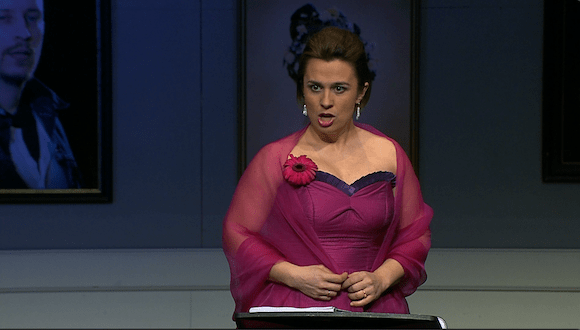
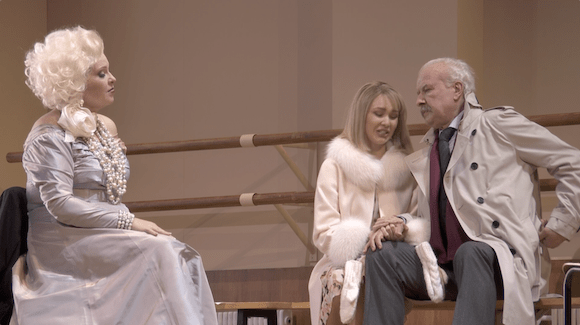
Rimsky-Korsakov’s The Snow Maiden is a rather odd opera.  It’s set in some sort of idyllic pre-Christian Russia where the tsar is approachable, just and benevolent and the people spend most of their time drinking and having sex.  Into this world comes Snow Maiden, the fifteen year old daughter of Winter and Spring.  Her parents have various things to do and so decide to park the girl with the local peasantry.  Various romantic complications ensue involving a rather nasty, rich merchant Mizguir and the mysterious Lel, who may be a shepherd but likely isn’t mortal either.  The mating behaviour of the locals confuses Snow Maiden as she is incapable of falling in love.  Eventually Spring grants her that faculty and she gives herself to Mizguir, while really wanting Lel, but the rays of the sun on the first day of summer melt her. The natives ignore her death and get on with singing and dancing.
1.winterspring

Continue reading

Bartoli in a trouser role

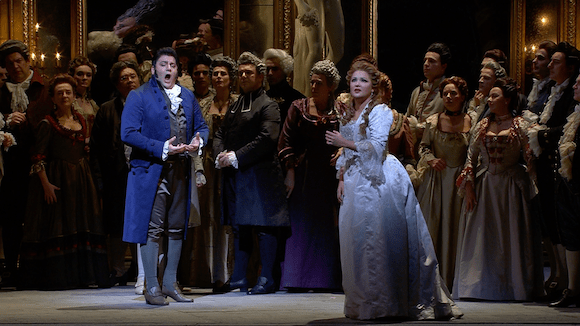
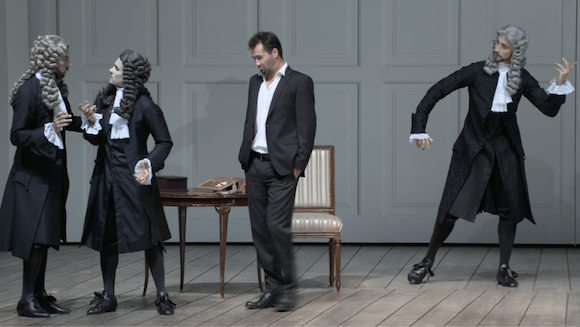
Christof Loy’s production of Handel’s Ariodante premiered at the Salzburg Whitsun Festival in 2017 and was reprised later in the year at the Haus für Mozart where it was filmed. It’s notable for marking Cecilia Bartoli’s first appearance in a breeches role. Loy uses this, and the gender ambiguity that abounds in the source material, in a most interesting way. He’s also very fluid about period; modern and 18th century costumes plus 15th century armour are mixed with gay abandon. Using very spare monochrome sets, often backed by 18th century style genre paintings, he creates a very open space within which the details of the production play out.

1.wigs

Continue reading

The other Bluebeard

I guess many opera goers in the English speaking world will have at least a passing acquaintance with Bartok’s Duke Bluebeard’s Castle but I suspect fewer will have seen Offenbach’s take on Perreault’s rather grim tale.  It will probably come as no great surprise that Offenbach’s Barbe-bleue is a somewhat tongue in cheek version of the story of the notorious serial killer.

1.boulotte

Continue reading

Psychological Elektra

Strauss’ Elektra, for all its “grand” music, is essentially a rather intimate psychological study of the psyches and relationships of three women.  Given this, one might think that the enormous stage of the Felsenreitschule in Salzburg a very odd choice of venue.  Krzysztof Warlikowski’s approach to the challenge is bold but almost impossible to do justice to on video.  Despite that, what does come across on video is a rather compelling version of the work.

1.prologue

Continue reading

Carmen at the Opéra comique

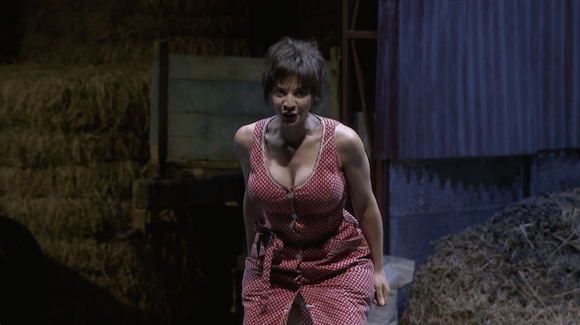
Bizet’s Carmen premiered at the Opéra Comique in Paris in 1875.  In 2009 it was revived there in a production by Adrian Noble.  That production was filmed for TV and has now been released on disk.  Having watched it I’m asking myself whether it’s an attempt in some way to “recreate” something similar to the 1875 experience.  Alas, there’s nothing in the documentation to help with this question either way but two things intrigued me. The Orchestre Révolutionnaire et Romantique is in the pit which suggests an attempt to get a “period sound”.  Secondly, the spoken dialogue is not the version I’m accustomed to and there’s quite a bit more of it.  Is this, perhaps, the original 1875 dialogue?

1.fishtank

Continue reading

“Traditional” La Bohème?

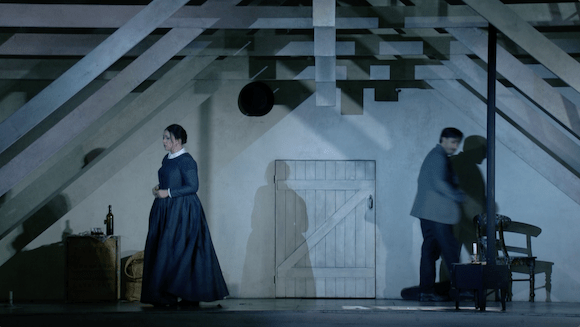
Richard Jones’ production of Puccini’s La Bohème recorded at the Royal Opera House in 2020 is, at first glance, a highly conventional “traditional” La Bohème.  There’s no subtext.  The story unfolds strictly in line with the libretto.  And yet there’s something going on that raises it above the level of the typical canary fanciers’ La Bohème.  Ultimately I think it’s a combination of avoiding sentimentality or glitz or glamour and really focussing on the characters and the relationships between them.  It seems that the revival direction team of Julia Burbach and Simon Iorio and the cast have really worked on this.

1.garret

Continue reading

Harnoncourt 2 – Don Giovanni

Nikolaus Harnoncourt’s 2014 cycle of the Da Ponte operas continues with Don Giovanni.  The recording has much in common with his Le nozze di Figaro, even down to the same essay in the booklet, and I’m not going to repeat what I wrote in that review.  If you haven’t read it, I recommend a look before reading the rest of this.

1.donnaelvira

Continue reading

Distorted mirrors

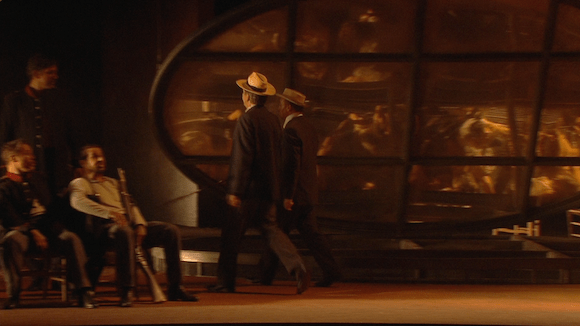
Watching the recently released recording of the 2017 production of Giodarno’s Andrea Chénier from La Scala had me wondering why this piece isn’t done more often.  If it had been written by Puccini, and it might well have been, it would get done as often as Tosca, with which it has many similarities.  In the conscience stricken revolutionary Gérard it has one of the few multi-dimensional characters in verismo opera and the music, for Chénier in particular, has all the qualities that people listen to Puccini for.  I guess perhaps one needs at least a rough understanding of the events of the French revolution to really follow the plot as Giodarno, unlike Puccini, roots his work in actual history but still.  Opera fashion is very odd.(*)

1.ball

Continue reading

Carsen productions of Pagliacci and Cavalleria Rusticana

Robert Carsen’s productions of the classic pairing of Leoncavallo’s Pagliacci and Mascagni’s Cavalleria Rusticana, filmed at Dutch National Opera in 2019, are an attempt to extend the meta-theatricality of the former to the latter. To this end he reverses the normal order which allows the prologue of Pagliacci to apply to both works and elements of the Pagliacci to be extended in Cavalleria Rusticana.

1.clowns

Continue reading

A modern take on Gay’s classic

John Gay’s The Beggar’s Opera has been around since 1728 and is revived with some regularity but has never quite made into the opera canon. The latest incarnation is a version heavily rewritten by Robert Carsen and Ian Burton with a musical concept by William Christie. It first saw light at the Théâtre des Bouffes du Nord in 2018 before touring extensively.

1.peachums

Continue reading