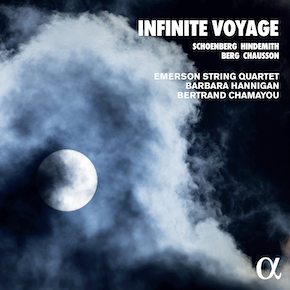
 Infinite Voyage is billed as the final album from the Emerson Quartet capping a long and illustrious career. It’s also a collaboration with Barbara Hannigan so it’s perhaps not surprising that it includes music by Berg, Schoenberg and Hindemith though Chausson’s Chanson perpétuelle belongs to a rather different style.
The disk starts with Hindemith’s Melancholie, Op.13. It’s quite a sparsely scored piece and Hannigan’s treatment of the text is interesting and quite individual. There’s a rhythmic flexibility, almost caressing the words. It’s especially marked in the third stanza “Dunkler Tropfe”. I’m not familiar enough with the piece to judge how unusual Hannigan’s treatment is or isn’t but I think it really works.
Continue reading →


 The new season starts to ramp up in September. My month will start at Factory Theatre on the 7th with Mary Beath Badian’s The Waltz; a coming of age drama set in Saskatchewan. That runs until the 17th. The following night there’s a screening at the Four Seasons Centre of Atom Egoyan’s new film Seven Veils that was created in conjunction with last season’s production of Salome. A young woman is tasked with remounting her former mentor’s production of Salome. It stars Amanda Seyfried, Ambur Braid, Michael Schade and Michael Kupfer-Radecky. It’s a chance to see the film ahead of the official premier at TIFF. More details and tickets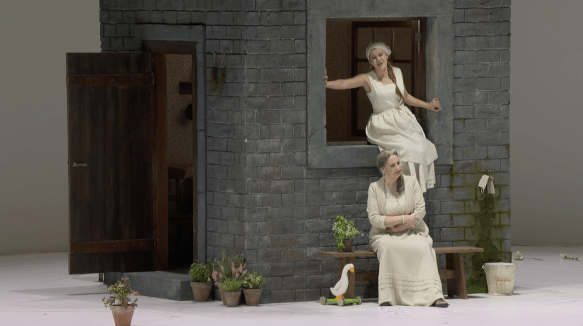

 Seventh Fire, part of the SummerWorks Performance Festival, is an immersive experience currently happening at the Aki Studio. It’s a ceremony/performance in which the participants are invited into a prepared, dark space where they can sit or lie down on cushions or chairs (lying down strongly recommended) and experience 90 minutes or so of a carefully constructed 3D soundscape.
