

Degas – Ballet Scene from ‘Robert le Diable’
The grand opéra, as understood in 19th century France, is a very specific form that played a major role in the evolution of opera but many of the works composed in that form (essentially exclusively for L’Opéra de Paris, though it goes through several name changes in the period which is a bit confusing) are now not well known and rarely performed. I have been rootling around in this territory for a while now and I thought it might be fun to write a sort of general survey with links to reviews of relevant video and audio recordings. Continue reading
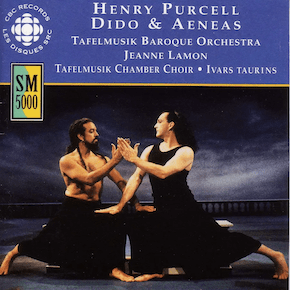 To round out this mini survey of the early discography of Purcell’s Dido and Aeneas I’m going to fast forward a bit to the 1995 recording by Tafelmusik. The most striking thing about this version is the very small instrumental ensemble; two violins, viola, violincello and harpsichord led by Jeanne Lamon. One quickly gets the feel for how they are going to perform with a very fast and rhythmically sprung overture.
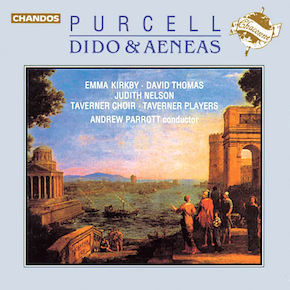 And so we come to the third in our historical sequence of recordings of Purcell’s Dido and Aeneas. We are talking about Andrew Parrott’s recording with the Taverner Players and Choir recorded at Rosslyn Hill Chapel in 1981. It’s a record that I bought when it first came out and has been a point of reference for me ever since.
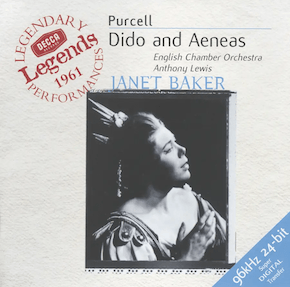 So, to continue our look at the recording history of Purcell’s Dido and Aeneas we turn to the 1961 Decca recording with Janet Baker in the title role. This has won so many awards and featured on so many “best of” lists that it might reasonably be considered to serve as some sort of “gold standard”. It’s certainly very good but I’m more interested in looking at what it says about the evolution of performance practice of Dido and Aeneas than in adding to the praise for Dame Janet’s performance.
 Purcell’s Dido and Aeneas has a long and dense history in the recording studio. The first recording dates back to 1935 and the vast stream of recordings since serve as a kind of barometer of the changes in style in performing 17th century music. I haven’t listened to every recording but I can look at four key moments in the discography and compare them. I’ve also listened or watched a fair number of fairly recent productions. The video review page has six entries for this work; all 1995 or later. There are also five reviews of live productions and reviews of several related shows. But for the purposes of this mini-project I’m going to look at four recordings that take us from the early 1950s to the mid 1990s. The four recordings are:
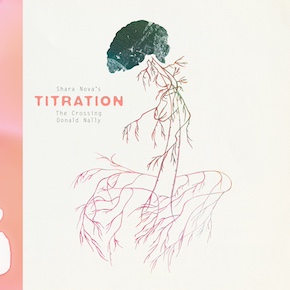 Titration is a song cycle for unaccompanied choir by American composer Shara Nova. On the CD it is performed by The Crossing and their conductor Donald Nally. It’s an interesting and unusual, indeed quite unconventional, piece but it is oddly compelling and has won a fair bit of recognition including a Gramophone “Critics Choice” award this year.
 Here’s a look at the start of 2024 in Toronto.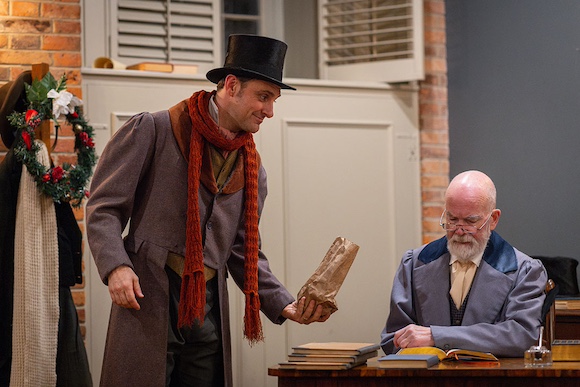
 I have to say that I was unreasonably excited to learn about a new CD from Bryn Terfel called Songs of the Sea. I’ve seen Bryn in recital and, besides being a fantastic singer, he’s a big personality and very good when he steps away from classic art song rep and especially when he sings in Welsh. There were also some interesting collaborators on the disk; Simon Keenleyside, Calan, Sting and Fisherman’s Friends for example. Plus there were some interesting language choices. Besides English and Welsh there are songs in Breton and Norn.
  operaramblings