Heaven only knows why it has taken me so long to discover this resource. COC Radio is awesome. Besides educational materials there are streamable audio recordings of every production from the last two seasons.
Pavarotti and Freni in La Bohème
The audience at this 1988 San Francisco Opera production of La Bohème clearly thought very highly of it. There is even some applause for the scenery. I’m less impressed. Seen as a star vehicle for Pavarotti and Freni it’s quite adequate, though both are decidedly on the mature side for Rodolfo or Mimi. Other than that it’s rather dull, the video direction doesn’t help it any and the technical quality is no more than adequate. Continue reading
CD round up
My “to watch” pile now consists entirely of older productions of 19th century operas (pretty much the dregs of the Toronto Public Library collection) and the COC season doesn’t start for another six weeks or so. I have one other live performance booked before then; a rather peculiar Handel piece performed in various locations at a local hotel. I’ve been listening to some new CDs then at least partly as a form of procrastination.
The first two were part of an ENO “goody bag” that I scored on Twitter. Songs of Muriel Herbert is a most worthwhile project. Herbert, like so many women composers, has never had the recognition she deserves. Not as “romantic” as a drug addled loon like Peter Warlock I guess. The CD contains thirty six songs setting texts ranging from Peter Abelard to James Joyce. I’d say they stand up well against other early twentieth century English art songs and would be well worth mining by anyone looking for some less well known recital repertory. The works are most sympathetically performed by Ailish Tynan, James Gilchrist and David Owen Norris. Continue reading
Banned by the Nazis
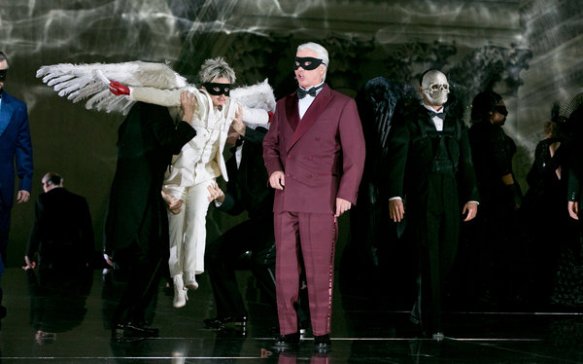
Both Viktor Ullmann and Alexander Zemlinsky were among the group of composers persecuted by the Nazi regime. Ullman would die in Auschwitz, Zemlinsky in exile and obscurity. This 2008 recording from Los Angeles Opera’s “Recovered Voices” series brings together two one act operas; Ullman’s Der zerbrochene Krug and Zemlinsky’s Der Zwerg. in productions directed by Darko Tresnjak and conducted by James Conlon.
Claustrophobic and Intense Don Carlo
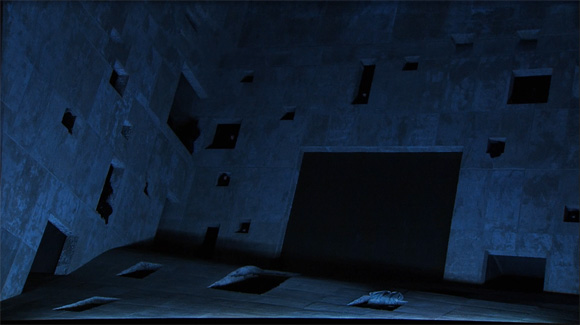
The first time I tried to watch Willy Decker’s 2004 production of Verdi’s Don Carlo at De Nederlandse Opera I failed to get past Rolando Villazón in doublet and hose. To anyone familiar with British TV comedy of a certain era the resemblance is just too close and I couldn’t get beyond the idea of Stephen Fry as Felipe II and Miranda Richardson as Elisabetta. This time around I watched the highly illuminating video introduction and read Wily Decker’s useful essay on his production concept before tackling the piece proper. I’m glad I did that and I’m glad I came back to this recording because it is very fine and it was very useful to have Decker and Chailly’s perspectives on the dramaturgy and the music.
Conspicuous Consumption
Richard Eyre’s production of La Traviata at the Royal Opera House, filmed in 2009, is a pretty good example of how to do a traditional production. There’s nothing conceptual or thought provoking to it but the direction is careful and tells the story clearly and well. The designs are mid 19th century with crinolines and tail coats but with the odd imaginative touch and a welcome refusal to succumb to the “more stuff” syndrome that plagues so many Verdi and Puccini productions. Backed up by excellent music making it probably makes a near ideal introduction to the piece, even if it won’t entirely displace Willy Decker’s brilliant and disturbing Salzburg production in my affections.
Karajan’s Otello
So, another lip synched film from the 1970s. This time it’s Verdi’s Otello starring Jon Vickers and Mirella Freni. What makes this one a bit different is that Herbert von Karajan not only conducts but directs as well. It’s a curious piece with fantastic music making but no real production concept, continuity errors, some very dodgy acting and puzzling cinematography in places. It’s never dull though. Continue reading
Ballet/Opera Fusion
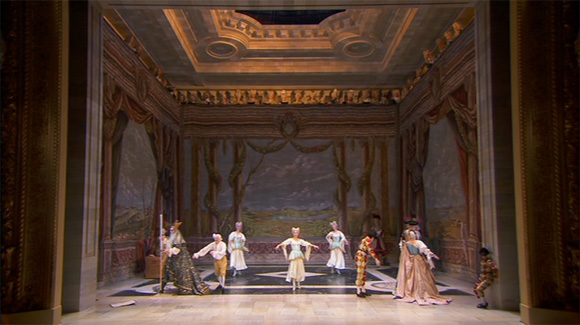
Handel’s Acis and Galatea is a peculiar piece in some ways. It was written to be performed at Cannon’s, the Edgware residence of the then Earl of Caernavon, presumably for his guests. Apparently the performance style was to have the singers sing from music stands in front of a painted backdrop. So, a sort of oratorio with curtains. It’s not uncommon to stage Handel oratorios as opera these days. Theodora is done quite often and even Messiah has been staged so it’s no great surprise that Acis and Galatea should be given a similar treatment. In fact Wayne McGregor’s 2009 Covent Garden production stages it as an opera and a ballet simultaneously combining the resources of the Royal Ballet and the Royal Opera.
Frock Opera
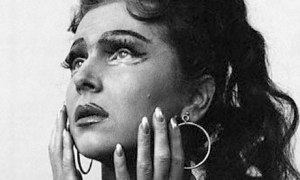
Giordano’s Fedora is a sort of apotheosis of the 19th century Italian opera. It’s a melodramatic love story in an aristocratic Russian setting. There is murder and suicide and plots and a dead mother and brother. The music is dramatic, even bombastic, when the mood suits but finds time to give showpiece arias for the principals. There is not a single idea in libretto or score that could give anyone an uncomfortable thought. The Metropolitan Opera’s 1996 production by Beppe di Tomasi builds on this by playing it dead straight and setting it in a series of suitably opulent settings complete with extravagant frocks. The cherry on the already rather rich cake is casting Placido Domingo as Loris Ipanoff and Mirella Freni as Fedora Romazoff. I imagine it’s many people’s idea of the perfect night at the opera In it’s way it’s the polar opposite of, say, Bieito’s Wozzeck. Continue reading
Portents of Regie
Until very recently one of the few good restaurant options within easy walking distance of the COC offices and the Kitten Kondo (since only a couple of hundred metres separate them) was a pretty decent locavore resto called Veritas. I’ve seen COC General director Alexander Neef in there more than once. Alas Veritas is no more. It has been replaced by what looks to be a hideously trendy and overpriced bar called the Pacific Junction Hotel. What’s a bit disturbing though is that this doubles the number of eateries in the ‘hood with Stiegl on tap (the other being the rather good, but also overly trendy , breakfast/brunch spot Le Petit Dejeuner. Stiegl is, par excellence, the beer of Regie. If beer features in a production by a controversial European director one can pretty much guarantee it will be Stiegl. Is this an omen? The 2012/13 COC season has Atom Egoyan, Peter Sellars, Robert Carsen and the Alden brothers directing 6 of 7 productions (surely enough to induce apoplexy in the National Post‘s Kaptainis). Are the hop leaves predicting a further shift away from the Lotfi Mansouri aesthetic? With this much Stiegl around can Herheim or Bieito be far behind?