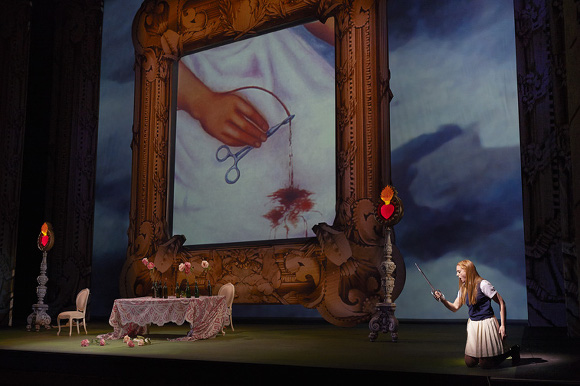
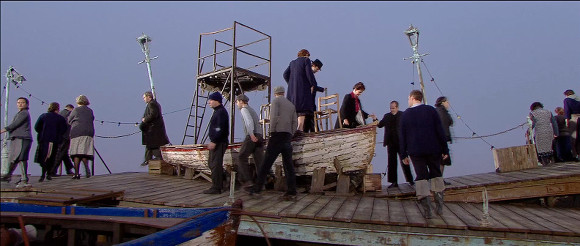
Berndt Alois Zimmermann’s Die Soldaten was something of a sleeper hit at the 2012 Salzburg festival and is now available on DVD and Blu-ray. It’s a peculiar work. It’s very episodic and requires massive forces. There are 16 singing and 10 non-singing roles, a 100 piece orchestra, a jazz band and more. At Salzburg the scale was magnified by staging it in the Felsenreitschule, using the full 40m width and enormous height of the stage. I’ve included some full stage shots in the screen caps to give an idea of how huge this all is. They can be expanded to full size Blu-ray caps (roughly three times the size of the image in the review).
English Song
Yesterday’s free concert in the Richard Bradshaw Amphitheatre featured three members of the Ensemble Studio singing 20th century English language songs. The concert opened and closed with Vaughan Williams. Baritone Clarence Frazer gave us five songs from Songs of Travel (texts by Robert Louis Stevenson) and Cameron McPhail sang three songs from The House of Life (texts by Dante Gabriel Rossetti). These are some of my favourites and I must have almost worn out my CD of Thomas Allen singing them (On the Idle Hill of Summer on Virgin Classics). So, I don’t know whether that made me more or less critical but I thoroughly enjoyed both performances. Clarence sang strongly, straightforwardly and with very fine diction while Cam was more overtly emotional. Both approaches worked.
Earworms
Earworms are funny things. What causes a particular passage of music to stick in one’s mind almost obsessively? I’m thinking about this now because I’ve seen two operas twice in the last couple of weeks and one is filling my waking moments with highly detailed flashbacks. It’s not just tunes. I’m hearing the orchestration and the inflexion of the words. And it’s not the odd tune here and there. It’s great long passages and many of them. The other, although I would recognise most every phrase on hearing it, is not doing that at all. Here’s the odd thing. The one that’s leaving no impression at all is number three world wide in terms of number of performances(1) and is, of course, Puccini’s La Bohème. The one I can’t get out of my head is far down the list at number 88 and it’s Britten’s Peter Grimes (and note that it’s the Britten centenary).
Know I have to ponder whether there is any connection between this and the fact that while all the cheap seats for Peter Grimes seem to sell out, the boxes on fat cat row are half empty.
La Bohème again – Rodolfo III
For my second look at La Bohème at the COC I caught the first night of what is, effectively, the third cast. This is actually the first cast but with Eric Margiore replacing Dmitri Pittas as the third Rodolfo of the run. So, how did it compare to Wednesday night’s effort?
Ensemble Studio competition goes upmarket
The COC’s Ensemble Studio competition; effectively the final auditions for potential new members of the program, gets a makeover this season. Previously it was held in the Richard Bradshaw Amphitheatre with each member performing two arias with piano accompaniment. Now it becomes a gala event styled Centre Stage and held on the main stage of the Four Seasons Centre with accompaniment from the COC orchestra. There’s also a cocktail reception and black tie dinner.
I understand that the format will be that each singer performs an aria of their choice for the judges behind closed doors and a second, of the judges’ choice, for the gala audience. In any event, it’s on November 26th with doors open at 5.30pm. Tickets for the reception and competition are $100 and for the dinner $1500. More details here.
La Bohème at COC is lots of fun
La Bohème has been running at the COC for a couple of weeks now but last night was the first performance for the second cast. There are some new faces; Michael Fabiano comes in as Rodolfo with Simone Osborne as Musetta, Tom Corbeil as Colline and Cameron McPhail as Schaunard. There are also some change ups. Joyce El-Khoury swaps Musetta for Mimi and Phillip Addis swaps Schaunard for Marcello. I’ll be back Friday to see the opening night cast with the exception of Eric Margiore coming in as Rodolfo.
Robert Pomakov with members of the Gryphon Trio
Yesterday’s lunch time concert featured bass Robert Pomakov accompanied by members of the Gryphom Trio. The programme kicked off with two songs by Glinka with Bob accompanied by Roman Borys on cello and Jamie Parker on piano. The first piece was called Lullaby but it’s hard to imagine anyone sleeping through Bob’s powerful rendering. The second piece, Doubt, showcased some lovely playing by Borys.
Simone Osborne on tour
The schedule and programme for the first part of Simone Osborne and Anne Larlee’s Jeunesse Musicale tour have been released. They will perform in the Richard Bradshaw Amphitheatre on November 12th at noon. The other venues are mostly smaller centres in Ontario and Quebec. The programme includes some Richard Strauss and two works by Brian Current including a new commission. Full details are contained in the linked PDF below.
Orlando Paladino
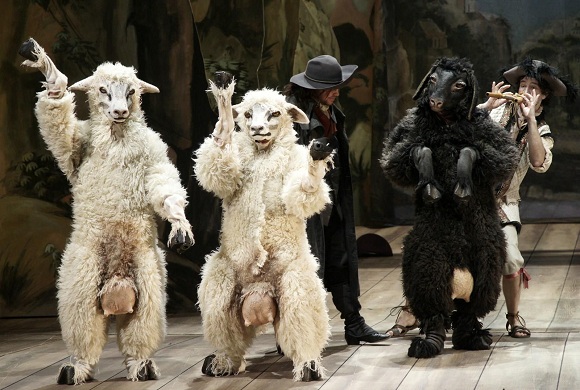
Haydn’s Orlando Paladino is a “heroic comedy” based, of course, on Ariosto. In this version Angelica, queen of Cathay, and her lover Medoro have fled to a remote castle to get away from Orlando who is in love, of course, with Angelica. There’s a shepherd and shepherdess, a sorceress, a squire and Rodomonte, the king of Barbary thrown into the mix and various misadventures ensue until the sorceress, Alcina, dips Orlando into the waters of Lethe causing him to forget being in love with Angelica and it all ends happily. There are also a bunch of non-singing characters who, I think represent the “dangerous” people of this remote country. For reasons I haven’t quite fathomed they include a bishop and a bearded air hostess.
Cunning Little Vixen short on magic
The 2009 Florence recording of Janáček’s The Cunning Little Vixen is bright, colourful, straightforward and fun but it doesn’t quite have the magic of the older Théâtre du Châtelet version. Laurent Pelly’s production is quite straightforward with attractive sets and costumes and interesting choreography from Lionel Hoche.