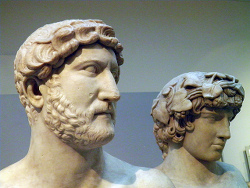
Alexander’s big gay Canadian opera

hadrian_antinousSo today’s Globe and Mail carries the news that the Canadian Opera Company has commissioned its first new work since 1999.  A piece based on the life of the emperor Hadrian will headline the company’s 2018 season.  Now Hadrian may be best known for a chunk of masonry in the north of England but he’s also almost as well known for deifying his lover Antinous.  Since the music and book for the new work are to be by Rufus Wainwright and Daniel McIvor I think we can safely say that that side of things will feature more prominently than fortification construction.  Continue reading

The ceremony of Innocence is drowned

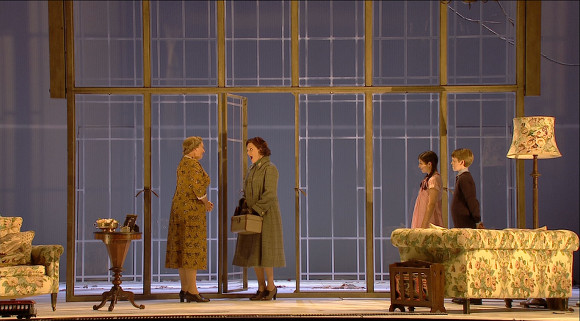
Jonathan Kent sets his 2011 Glyndebourne production of The Turn of the Screw in the 1950s.  It’s effective enough especially when combined with Paul Brown’s beautiful and ingenious set and Mark Henderson’s evocative lighting.  The set centres on a glass panel which appears in different places and different angles but always suggesting a semi-permeable membrane.  Between reality and imagination?  Knowledge and innocence?  Good and evil?  All are hinted at.  A rotating platform allows other set elements to be rapidly and effectively deployed.  There’s also a very clever treatment of the prologue involving 8mm home video.

1.arrival Continue reading

Centre Stage

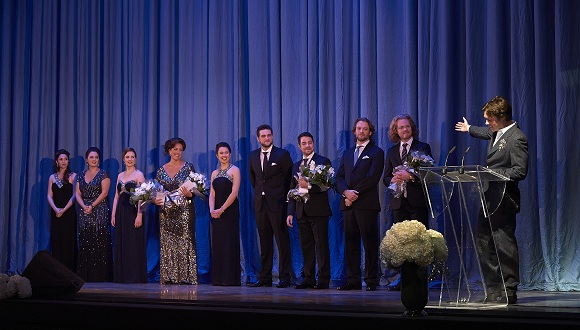
Last night saw the latest evolution of the COC’s Ensemble Studio competition; a competition for cash prizes functioning as well as final auditions for next year’s Ensemble Studio.  This year, for the first time, it was packaged as Centre Stage; a gala event featuring a cocktail reception and black tie dinner as well as the competition itself.  Added to that, the singers got to perform with the COC orchestra under Johannes Debus on the main stage rather than in the RBA with piano accompaniment.

Finalists with Rufus Wainwright

Finalists with Rufus Wainwright

Continue reading

Moby Dick

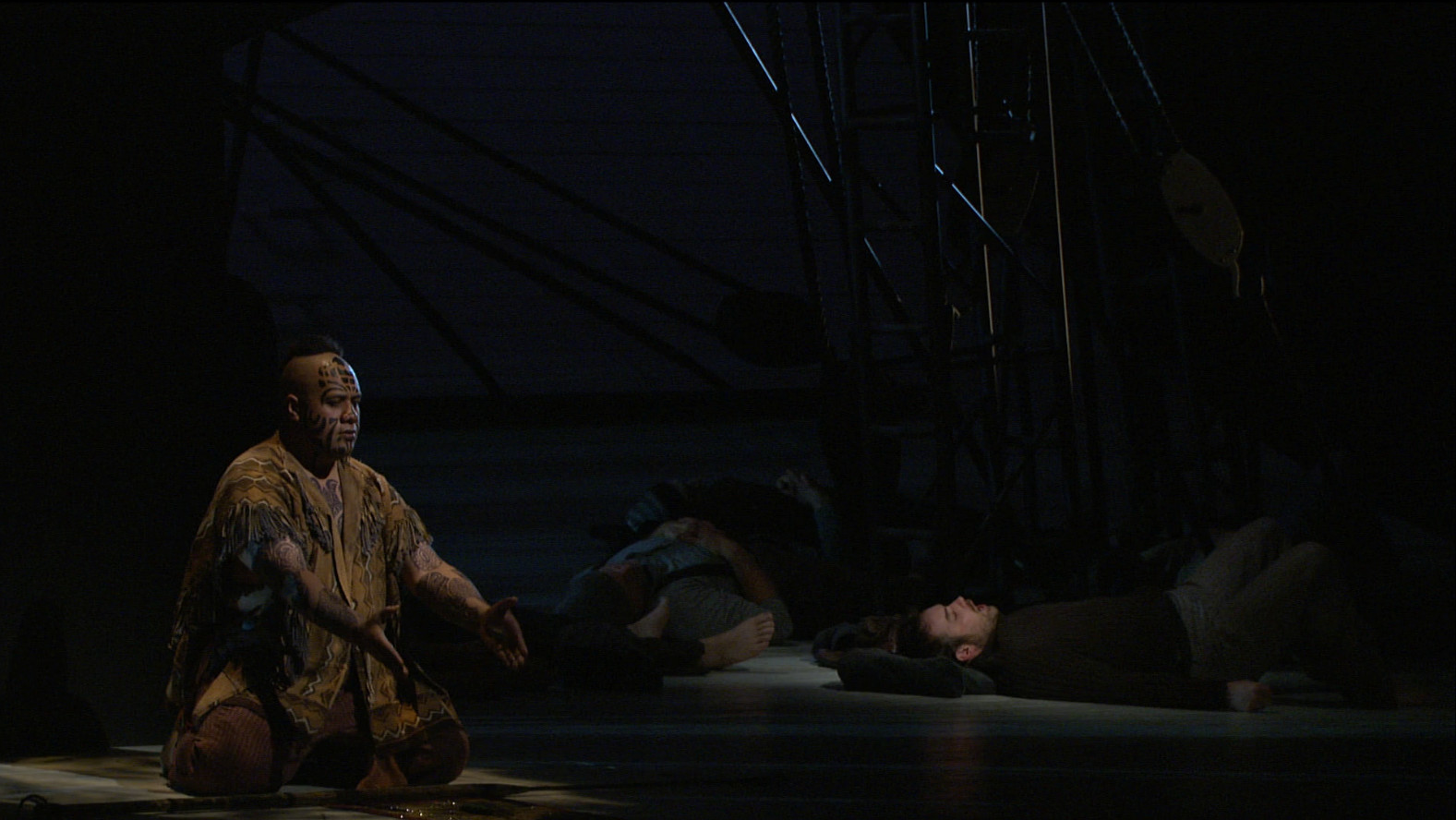
Jake Heggie’s Moby Dick has been successful in a way few contemporary operas are.  Since its Dallas premiere in 2010 it has been given in Adelaide, Calgary, San Diego and, most recently, San Francisco where it was recorded in 2012.  It’s not hard to see why it has been a success.  The subject is dramatic and has been skilfully compressed into a little over two hours by librettist Gene Scheer and the score steers the fine line between accessibility and triviality.  Add to that a visually appealing production and it’s a winning package.

1.queequeg Continue reading

Die Frau ohne Geisterwelt

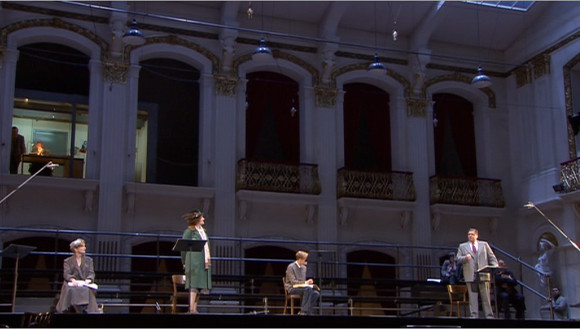
Christoph Loy, in his 2011 Salzburg production of Richard Strauss’ Die Frau ohne Schatten, avoids the problem of how to represent the Spirit World by essentially eliminating it.  Instead we get a Konzept based on Böhm’s first recording of the work in Vienna’s Sofiensalle in 1955.  Vienna is still recovering from the war and the hall is unheated and the singers unpaid.  The Empress is rising star Leonie Rysanek and the Nurse is long time favourite Elisabeth Höngen.  They represent the generations separated by the war.  The Emperor is an American singing in Europe for the first time and, crucially, Barak and his wife are a real life married couple.  Initially we see a lot of recording studio action as singers are moved about by actors in this experiment in early stereo.  Then the action, particularly the Barak/Wife interaction slips more and more off stage.  For the finale, we get a sort of celebratory concert in evening dress.  It’s not a bad concept and this cast handles it very well but I fancy it’s a tough introduction to this far from straightforward opera and it does lose the magic of the Spirit World. (In other words I’m glad I saw the Met production before this one.)

1.studio Continue reading

Innovation

Needing something suitable to celebrate Britten’s 100th birthday I decided to go and see the National Ballet’s new show Innovation which premiered last night and included a piece set to the Four Sea Interludes from Peter Grimes.  A Pergolesi Stabat Mater with Emma Kirkby and Daniel Taylor was a considerable additional attraction.  I’m not a dance expert so take any comments on that subject that follow as the impressions of a complete non-expert.

Continue reading

Intense Dido and Aeneas

Deborah Warner’s entry point to Purcell’s Dido and Aeneas is the, almost certainly apocryphal, story about it premiering in a girls’ boarding school.  At various points in the action we get a chorus of schoolgirls in modernish uniforms commenting silently on the action.  They are on stage during the overture, are seen in dance class during some of the dance music and queue up for the Sailor’s autograph.  It’s quite touching and adds to the pathos of the basic, simple, tragic story.  Warner also adds a prologue (the original is lost).  In Warner’s version Fiona Shaw declaims, and acts out, poems by Ovid/Ted Hughes, TS Eliot and WB Yeats.  These additions aside the piece is presented fairly straightforwardly in a sort of “stage 18th century” aesthetic.  The witch scenes are quite well handled with Hilary Summers as a quite statuesque sorceress backed up by fairly diminutive (and, for witches, quite cute) Céline Ricci and Ana Quintans.  Their first appearance is quite restrained but they go to town quite effectively in their second appearance.

1.entrance Continue reading

On being at the Met for the first time

The Metropolitan Opera looms pretty large in the consciousness of any North American opera goer though, I suspect, is not as big a deal as its management thinks elsewhere. I was very curious then to experience it for myself.  I see most of my opera in the comparatively intimate Four Seasons Centre (2100 seats) or even smaller spaces.  I’m almost used to getting kicked as a character writhes at my feet in a small space production.  I’ve been in larger houses too; neither the Coliseum nor Covent Garden are small.  That said, the first impression of the auditorium and stage at the Met is just how big it is.  We sat in the front row of the Balcony and the combined Balcony and Family Circlre stretched away behind us, apparently the size of a rugby field (probably a Welsh one given the slope).  I had not realized that the Family Circle is not really an additional “ring” but a backwards continuation of the Balcony.

met1 Continue reading

Die Frau ohne Schatten at the Met

We caught Richard Strauss’ Die Frau ohne Schatten at the Met on Wednesday night.  Expectations were high.  It’s Strauss, and rare Strauss at that.  It was our first time at the Met.  The on-line opera world was abuzz with Christine Goerke’s performance as the Dyer’s Wife.  By and large we weren’t disappointed.

frau1 Continue reading