High tech Orfeo marred by artsy video direction

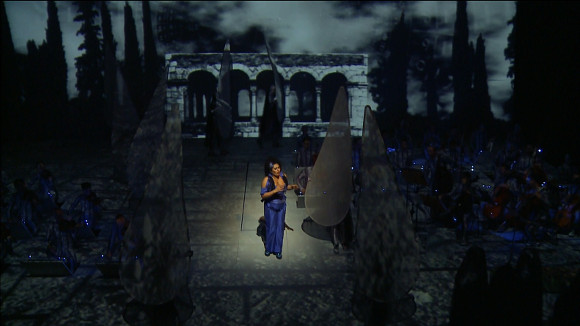
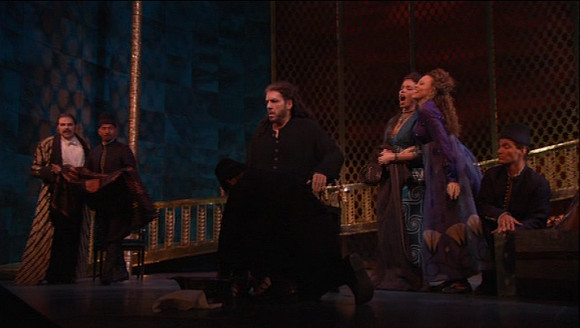
La Fura dels Baus mounted a spectacular production of Gluck’s Orfeo ed Euridice at the Festival Castell de Peralada in 2012.  The concept has the orchestra in costume, on stage and fully involved in the action.  There are lots of video projections and spectacular lighting effects.  In fact at times the whole thing resembles a son et lumière.  There’s also lots of aerial action.  It’s all rather exciting.  Great work from director Carlus Padrissa.

1.orfeo Continue reading

Chestnuts roasting on an open fire

margison090122Well there wasn’t actually an open fire at Koerner Hall last night, though one would have been very welcome on a very cold Toronto evening, but there were plenty of old chestnuts at the Great Songs of Italy concert given by the Ontario Philharmonic Orchestra under Marco Parisotto with tenor soloist Richard Margison.  The concert consisted of a mixture of opera extracts; vocal and instrumental, a couple of Neapolitan songs and Tchaikovsky’s Capriccio Italien.  It was a bit like eating one of those giant Toblerone bars all at once but I don’t suppose anyone really expected it to be any different and the audience for the most part loved it.

Continue reading

Let trumpets blow

A new recording of Britten’s Gloriana is to be welcomed, even when it’s less than perfect.  It’s an unusual work for Britten.  It’s very grand.  The orchestra is large and the music doesn’t seem to be as transparent and detailed as much of his work.  This is especially true in Act 1 where I almost wondered whether Britten was sending up “grand opera”.  It’s also a grand opera sort of plot.  The libretto is based on Lytton Strachey’s Elizabeth and Essex and deals with the late life romance between the queen and the young Robert Devereux, earl of Essex and deputy in Ireland.  It has some fine moments; notably the lute songs in Act 2 and the choral dances in Act 2.  Act 3 is also dramatically quite effective; dealing with Essex’ abortive rebellion and execution.  Curiously, in the final scene, Britten resorts to a lot of spoken dialogue, as he does briefly with Balstrode’s admonition in Peter Grimes.  It’s almost as if he has no musical vocabulary for the highest emotional states; a sort of anti-Puccini.

1.duel Continue reading

Prima Donna

So I got my hands on the DVD documentary about Rufus Wainwright and the genesis of Prima Donna.  There’s not all that much of the music on the disk but there’s enough to get a general impression.  There’s also plenty of material for helping one judge where Wainwright is coming from and how he might approach a second opera.

0.tosca Continue reading

The Rape of Lucretia

Britten’s Rape of Lucretia, which premiered at Glyndebourne in 1946, is an interesting work in a number of ways.  Musically it marks a distinct break from Peter Grimes and anticipates the later operas in a number of significant ways.  It’s written for much lighter forces than Grimes; string quintet, wind quintet plus harp, percussion and piano and there’s no chorus (in the conventional sense).  It’s also not a “numbers” piece.  There are no set pieces here.  The orchestral writing is spare and somewhat dissonant with that absolute clarity that is so characteristic of Britten.  Sometimes this almost distracts from the drama on stage.

1.chorus Continue reading

Christmas at Casa Diva

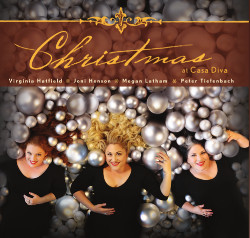
Invitation Dec 3Want a Christmas CD with a difference?  Christmas at Casa Diva may be what you are looking for.  It’s a collaboration between Canadian opera singers lyric soprano Virginia Hatfield, dramatic soprano Joni Henson and mezzo Megan Latham with collaborative pianist Pieter Tiefenbach.  While some of the tracks are fairly traditional sounding versions of standards like White Christmas most are clever, almost cheeky, arrangements or even mash ups.  Born is the King, for example, is a really cool mash up of Lo, How a Rose E’er Blooming, The First Noël and Silent Night that had me grinning like a loon when I heard it at the CD release party (OK the rather good mulled wine probably helped).  Most of the tracks are also quite “modern” sounding.  The arrangements make no concessions to the sort of soupy sentimentality found on so many seasonal offerings.

The music making throughout is unashamedly the work of serious, classically trained musicians (albeit SCTMs with a sense of humour) so it might not be an ideal gift for friends/relatives who are allergic to that kind of thing.  For most readers of this blog though that will hardly be a deterrent.  I have never heard a Christmas record remotely like this and it’s growing on me with each listening.  You can buy the CD at Atelier Gregorian or online at jonihensonsoprano.com

Renée and her frocks

John Cox’s production of Massenet’s Thaïs at the Metropolitan Opera is probably most remembered for the rather extraordinary collection of Christian Lacroix frocks that Met perennial Renée Fleming gets to wear.  It’s rather more than that.  In fact it’s a pretty good example of what the Met does best.  It’s sumptuous and spectacular and has a pretty much ideal cast which, together, go a long way toward making this curious piece rather enjoyable.

1.athaneal Continue reading

A couple of interesting crowd funding projects

The first project is to make a recording of Vincent Ho’s concerto for percussion and orchestra, The Shaman, with percussionist Dame Evelyn Glennie and the Winnipeg Symphony Orchestra conducted by Alexander Mickelthwate.  This piece has been seen in Winnipeg, Toronto and taipei and has received a lot of positive reviews.  Full details are here.

In 1937 La Scala held a contest for a new opera. The winning opera should have been La Serenata al Vento composed by Aldo Finzi, a young, but already successful composer.  It never played during his lifetime.  Finzi was Jewish and the regime wasn’t prepared for a Jew as the heir of Verdi and Puccini.  It wasn’t until 2012 that the work premiered at Bergamo.  Now Croatian director Sanela Bajric wants to make a documentary about Finzi and his music and, of course, needs to raise the necessary.  Full details are here.

A static Tristan

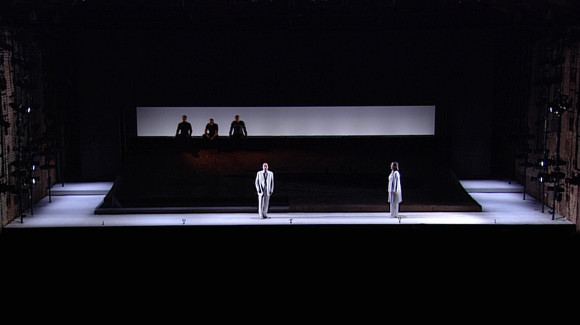
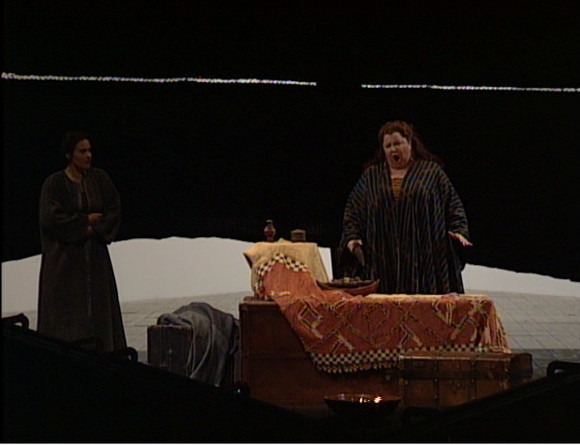
Dieter Dorn’s production of Tristan und Isolde for the Metropolitan Opera is one of the most interesting from a design point of view that I have seen from the Met.  If only the direction of and acting of the principals in this recording (made in either 1999 or 2001; sources differ) was up to the same standard!

1.isolde_brangane Continue reading