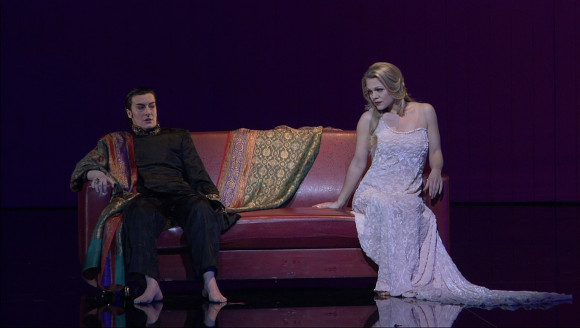
Lehár’s Das Land des Lächelns must have seemed old fashioned even when it opened in 1929 in a Berlin that had already seen Wozzeck and Die Dreigroschenoper. With its waltzes and gentle chinoiserie it looks back rather than forward musically and makes few demands on its listeners. Similarly, the plot; a bittersweet romance between an Austrian aristocrat and a Chinese prince had nothing in it to disturb contemporaries though modern audiences might find the cultural appropriation a bit hard to take. However, if Turandot doesn’t bother you this likely won’t either.
Where’s the Champagne?
It’s really hard to know where to start with Hans Neuenfels’ Die Fledermaus. It’s a prodcuction that enraged the more conventional patrons when it opened at the Salzburg Festival in 2001. It even provoked a “false pretences” lawsuit! There is so much going on that it almost seems to call for a catalogue raisonnée of the various scenes though one fears that would actually be both tedious and unhelpful. Let’s try instead to explore it thematically. Neuenfels takes very considerable liberties with the libretto. A lot of dialogue is cut, a lot is added and numerous non-canonical characters are inserted. That’s just a start.
David Alden’s Poppea
I’m never quite sure what to expect from David Alden. Some things are predictable; striking images, bold colours and a degree of vulgarity, but beyond that it’s hard to be sure. Sometimes he seems to be trying to be deep (his Lucia for example), sometimes more kitschy (Rinaldo) and there’s always a slight undercurrent of him thumbing his nose at the audience. His production of L’incoronazione di Poppea at Barcelona’s Liceu is a curious combination of all these things and I think it works pretty well.
Just for laughs
Canadian tenor Jamie McLennan has a video blog. As he puts it, “It’s just me, my iPhone, a $40 mic and whoever I can grab to work the camera.” Below you can see him at work during rehearsals of Verdi’s Falstaff in Hamilton(*). It’s worth watching just to see Sasha Djihanian twerking.
(*)For non Canadians, Hamilton, ON is a sort of Canadian Scunthorpe or Redcar. Not, perhaps a typical opera venue.
Best of 2013
So what was I most impressed with on the opera and related scene in in 2013?
Big house opera
The COC had a pretty good twelve months. I enjoyed everything I saw except, maybe, Lucia di Lammermoor. Making a choice between Christopher Alden’s probing La Clemenza di Tito, the searing opening night of Peter Sellars’ Tristan und Isolde; the night when I really “got” why people fly across oceans to see this piece, Robert Carsen’s spare and intensely moving Dialogues des Carmélites or Tony Dean Griffey’s intense and lyrical portrayal of the title character in Peter Grimes is beyond me. So, I shall be intensely disloyal to my home company and name as my pick in this category the Metropolitan Opera’s production of Die Frau ohne Schatten. Wernicke’s production is pure magic and Anna Schwanewilms was a revelation.
Quirky Idomeneo
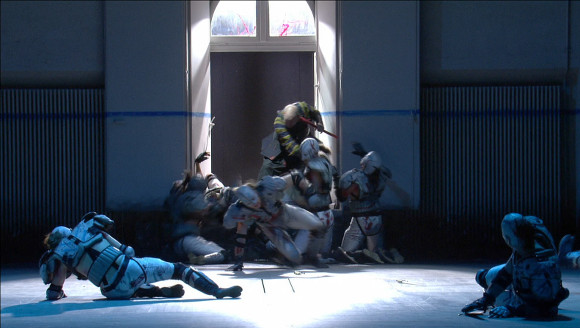
Dieter Dorn’s production of Idomeneo, filmed at the Bayerisches Staatsoper in 2008 has some interesting ideas and some arresting images but ultimately it’s hard to figure out where he is trying to go. There’s a lot to like. He clearly places Elettra as a member of the House of Atreus which makes her more believable. He also creates credible personalities for Ilea, Idamante, idomeneo and Arbace. No mean feat. Some of the images are quite arresting too. There is lots of blood and plenty of stage action. The sets are chaotic piles of stuff. Idamante gets a killer sea monster hunting rig. Then there is the ending. Instead of finishing on the “final chorus” the chorus drape the set with white sheets and for ten minutes the orchestra play what is listed in the booklet as a ballet but there is noone on stage and nothing is happening. Going out on ten minutes of the most boring music in the opera is just bizarre.
Upcoming shows
First up is Toronto Operetta Theatre’s annual holiday offering. This year it’s Lehar’s Land of Smiles and the cast includes Adam Fischer, Curtis Sullivan, Ernesto Ramirez and Lara Ciekiewicz. Guillermo Silva-Marin directs and Derek Bate conducts. There are eight performances between December 27th and January 5th including a gala performance and dinner/dance on New Year’s Eve. Venue is the St. Lawrence Centre for the Arts and tickets are available here.
Die tote Stadt
My acquaintance with Korngold’s Die tote Stadt has been pretty much limited to recital and competition performances of Glück, das mir verlieb, better known as Marietta’s Lied and, apparently, the last opera aria to become a hit single and Fritz’ act 2 piece Mein Sehnen, mein Wähnen. So, I was quite glad to get my hands on a complete recording of this lushly lyrical and rather weird piece. The “dead city” of the title is Brugge and the story concerns a wealthy man, Paul, who has turned his house, and his life, into a shrine to his dead wife Marie. He encounters a dancer, Marietta, who very closely resembles his late wife. What follows is wild and chaotic and is, ultimately, revealed to be a dream. Paul realises that only in the next world can he be reunited with Marie.
Some images from AtG’s Messiah
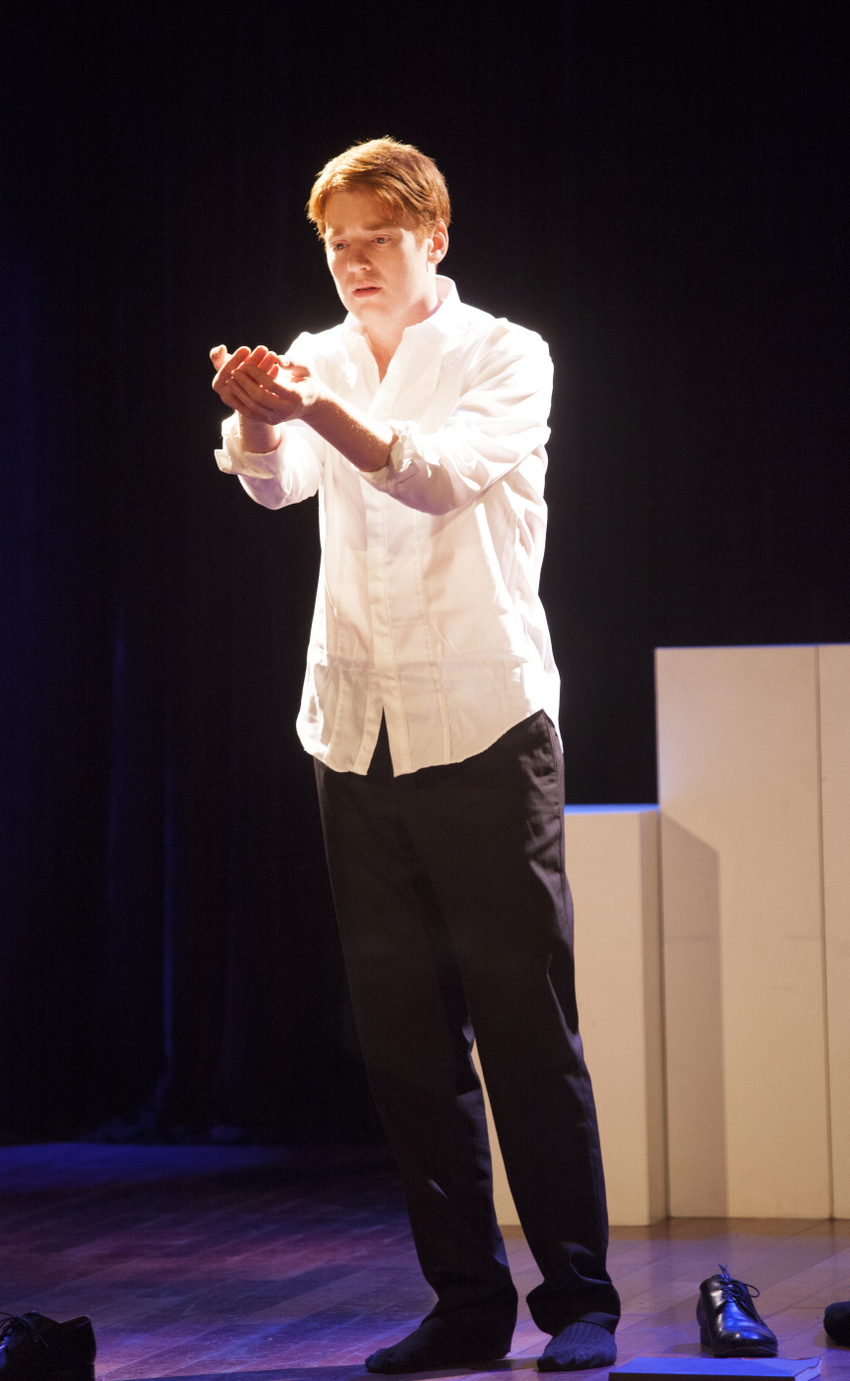
Here are a few images of the Against the Grain Messiah reviewed earlier. They are all from the final dress rehearsal. Photo credits – Darryl Block.
AtG’s Messiah
Expectations could hardly have been higher for last night’s first performance of Against the Grain’s new production of Handel’s Messiah. By and large they were met. It’s become quite the thing to stage Handel’s oratorios and, for the most part, that’s fine. They are really operas in disguise and work well when liberated from the concert setting. Messiah is trickier. Rather than a linear narrative there are a series of Biblical texts selected by librettist Charles Jennens to promote a literal and conservative evangelical Christianity. There is no obvious staging solution. One possibility is to invent a narrative and spin the story around it as Claus Guth did at Theater an der Wien in 2009. AtG’s Joel Ivany’s solution is to stage it as a choreographed performance and use movement to bring depth to the words. Here he is aided and abetted by choreographer Jennifer Nichols who has created a movement language tailored to the abilities and limitations of the singers.