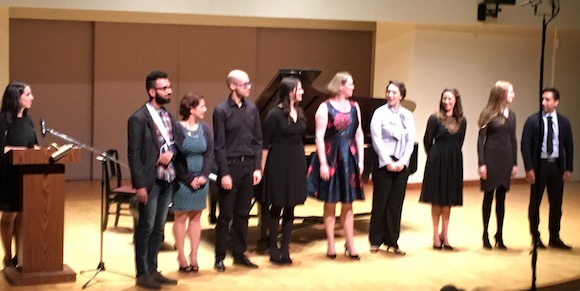
 The contestants for this years Centre Stage; the competition for places in the COC’s Ensemble Studio have been announced. They are bass-baritone Joel Allison (Ottawa); tenor Matthew Dalen (Grande Prairie, Alta.); mezzo-soprano Simona Genga(Woodbridge, Ont.); soprano Natalie Image (Tsawwassen, B.C.); soprano Chelsea Rus (Abbotsford, B.C.); soprano Anna-Sophie Neher (Gatineau, Que.); and baritone Jonah Spungin (Ottawa). I’ve seen a fair bit of Allison, Rus, Dalen and Genga and I am absolutely not surprised at all that they are competing. They are all very promising young singers. I’m looking forward to hearing the others.
This year the judging panel includes regulars Alexander Neef, Roberto Mauro, Liz Upchurch, Wendy Nielsen and Nina Draganić but this year they will be joined by the extraordinary Mary Morrison, whose talent spotting credits include one Barbara Hannigan. Centre Stage is at the Four Seasons Centre on November 1st with the reception at 5.30pm and the competition starting at 6.30pm.

 The Canadian Opera Company released its annual report and accounts for 2016/17 last night. The big news was the extension of General Director Alexander Neef’s tenure to the end of the 2025/26 season. The financial news was basically “same old same old”. Ticket sales once again showed a small decline which was compensated for by record fundraising performance to yield, essentially, a break even.
 And that wasn’t just the weather that went from balmy to barmy round about verse five of Fauré’s Dans le forêt de Septembre as a cold front hit Mazzoleni Hall with, literally, a bang. Meanwhile the sheltered audience was being treated to a skilfully curated program of art song on the theme of the four seasons sung by Erin Wall and Asitha Tennekoon with Rachel Andrist and Robert Kortgaard at the piano. There were French chansons, German lieder and English songs with a decent injection of CanCon, with Derek Holman, John Greer, Jean Coulthard and Matthew Emery all represented.
 Wow! There’s a stack of season and other announcements in my inbox. Apologies for any redundancy from earlier posts but here’s stuff you might want to know. In no particular order…
 And in the week ahead…
 News just in that Tapestry Opera have acquired a 9.5-foot Imperial Bösendorfer 290 Concert Grand Piano, courtesy of a gift from Clarence Byrd and Ida Chen. This beast is valued at $225,000 so it’s quite a gift. One could buy an apartment for that, though in the Distillery it might be smaller than the piano. To inaugurate the instrument and celebrate its public debut, Tapestry Opera will present two concerts on the evening of October 25th to benefit disaster relief efforts around the world, specifically those underway in Puerto Rico, Dominica, Mexico and India. All proceeds will be donated to Medecins san Frontieres (Operaramblings’ charity of choice) and Global Medic, who are working to rescue, support and rebuild the lives of millions affected by recent extreme weather events.