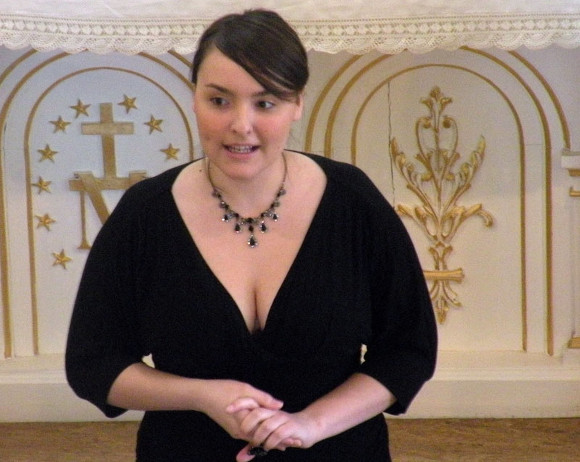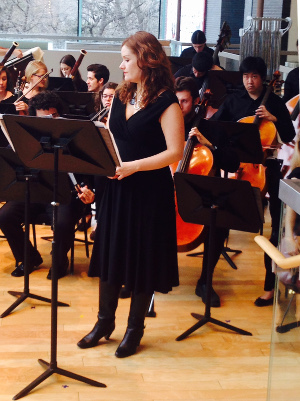
Today saw the annual lunchtime concert in the RBA in which members of the COC Ensemble Studio collaborate with visitors from the Atelier lyrique de l’Opéra de Montréal. There were three singers from each program but rather unusually only one of them was female; soprano France Bellemare. Naturally I was rather focussed on the visiting singers as the three Toronto participants; Gordon Bintner, Clarence Frazer and Andrew Haji are very much known quantities. Of the visitors it was very much Ms. Bellemare who shone. She has a very accurate, lovely rich voice with perhaps still some work to do on the top of her range but very easy to listen to and she’s musically and dramatically convincing too. Her version of Micaëla’s Je dis que rien ne m’épouvante was very competent though I’m not sure it’s ideal rep for her. The Song to the Moon from Rusalka though fitted her like a glove. This was really lovely singing. She also did very well in duet with Clarence Frazer in Lippen schweigen from Die Lustige Witwe or The Merry Widow or La Veuve Joyeuse as all three languages were used! She can waltz too though perhaps not as well as Clarence. Ladies, if you need a dance partner consider Mr. Frazer. She also shone in the final number; the Libiamo from La Traviata. I confess when I saw the program and saw that she would be partnered by Andrew Haji I rather expected her to be sung off the stage. She wasn’t. She held her own with a tenor who will sing this role on the COC’s main stage next season. No mean feat. This young lady is definitely one to watch.
Category Archives: Performance review – RBA
So wondrous sweet and fair!
On a bright, sunny winter’s day there are few more inviting places to be than the Richard Bradshaw Amphitheatre positively glowing in the sunlight. When one’s reason for being there is a recital by Jane Archibald with the redoubtable Liz Upchurch at the piano one feels doubly blessed. It was one of the best performances of the many I have attended in that space.
Continue reading
Quilico Awards 2015
Last night in the Richard Bradshaw Amphitheatre the singers of the COC Ensemble Studio competed for the Quilico awards for the third time in this format. Owen McAusland was off singing in Lucia di Lammermoor in Victoria and Andrew Haji was down with the flu so seven singers actually sang. As usual the standard was very high and it can’t have been easy for the judges. Jean-Philippe Fortier-Lazure and Ian MacNeil had a bit of an off night but that left five singers who I has extremely close on my notes. No permutation of three from five would have particularly surprised me.
Poèmes pour Mi
Yesterday’s lunchtime concert in the Richard Bradshaw Amphitheatre consisted of early works by Olivier Messiaen written for his wife, the violinist and composer Claire Delbos. The first piece was the Theme et variations for violin and piano of 1932. Like much of Messiaen’s music this piece represents two contrasting moods, likely rooted in Messiaen’s Catholicism. It’s either deeply meditative or ecstatic, almost manically so, with not much in between. It’s also very hard to play! Here it was presented with great skill and conviction by violinist Kerry DuWors and pianist Liz Upchurch. Continue reading
A Celebration of Canadian Art Song
This year’s new work from the Canadian Art Song Project, Marjan Mozetich’s Enchantments of Gwendolyn, was premiered yesterday in the Richard Bradshaw Amphitheatre. It’s a setting of four really interesting poems by Gwendolyn MacEwen for mezzo-soprano and piano. The first and last pieces; Sunday Morning Sermon and A Coin for the Ferryman are rather beautifulmeditative pieces and frame the two inner songs nicely. These inner two, for me, was where much of the interest really lay. Waiting for You was a blues inflected number of considerable interest, in some ways recalling Michael Tippett but in others entirely original. The third piece; The Tao of Physics, is a setting of a piece linking sub-atomic physics with the cosmology of The Vedas. That’s not exactly an original idea but it’s always an interesting one to explore and, by accident or design, Mozetich does so in a manner that somewhat recall John Adams’ treatment of the same basic ideas. We get a long, impassioned, vocal line floating over an arpeggiated piano accompaniment. It’s impressive and effective. All four pieces were beautifully performed by Allyson McHardy and Adam Sherkin. McHardy’s warm. dark mezzo seemed perfect for the material and listening was like wallowing in hot chocolate (more lurid similes did suggest themselves but this is a family blog). She can sing the blues too. Who would have thought it.
History’s worst fifty years in song
I guess it’s a good thing when one’s emotional and intellectual reactions to a program threaten to overwhelm one’s ability to listen analytically and evaluate. That’s what art is for isn’t it? Anyway that’s pretty much what happened to me today listening to a program called Songs of Love and War in the Richard Bradshaw Amphitheatre. The songs were all pieces more or less inspired by the catastrophes of the first half of the twentieth century; the wars, the rise of Nazi power, the occupation of France. These are all events that have many layers of meaning for me. I have studied them and the music and literature they generated for decades. I have known, often well, people who played roles in these events. I have deeply held views. You have been warned!
Apparitions
Conductor Brian Current and the Glenn Gould School New Music Ensemble presented three pieces, one of them a world premiere, today in the Richard Bradshaw Amphitheatre. The performances were prefaced by a really rather informative and informal chat by Brian on “how to listen to contemporary music”. It was engaging and totally non-patronising.
And so to the music. The first piece was Marco Stroppo’s 1989 piece élet… fogytigian, dialogo immaginario fra un poeta e un filosofo; a piece evoking an imaginary dialogue between a Hungarian poet and an Italian philosopher who never actually met, or so the composer told us. The first movement was bright and aggressive, very much in the European manner of the 70s and 80s with the second even more explosive before, in the third movement, settling into an exploration of string colour. The composer explained this as being like three walls of a house, painted different colours, slowly rotating. It’s the kind of piece one needs to hear more than once.
Gleadow and Segal go nomadic
Today’s lunchtime concert in the RBA was given by mezzo-soprano Lauren Segal and bass-baritone Robert Gleadow with Sandra Horst at the piano. The programme was titled Gypsy Songs, Travel Songs. First up was Robert, who looks considerable less rakish without a beard, with three songs from Vaughan Williams’ Songs of Travel. All three; The Roadside Fire, Bright is the Ring of Words and Whither Must I Wander are familiar recital fare but sung as well as this are a joy to hear. Gleadow has a big, full sound with quite a range of colour but he can also float very beautiful high notes. It was very impressive.
Lauren came next with Dvorák’s Cigánské melodie. These songs cover a wide range of moods, all vividly captured by Segal. Her voice is dark toned and very mezzo; no soprano 2 here! Onewould think her perfectly suited for gloomy Slavic rep until, as she did later, she cut loose on de Falla’s Siete canciones populares Españolas. Here she was every bit the dark eyed Spaniard singing with fiery passion of love and loss. Both sets ended with fierce, bravura numbers brought off with panache. The lady knows how to work a crowd!
Born out of Wenlock
Ever since they were first published the poems that make up AE Housman’s A Shropshire Lad have exerted a fascination over English composers. Today in the Richard Bradshaw Amphitheatre we heard two first year members of the Ensemble Studio give performances of two settings that take quite different approaches to the texts.
A Play of Passion
Tenor Colin Ainsworth and pianist Stephen Ralls today presented three song cycles written for them by Derek Holman. The first, The Death of Orpheus (2004) sets two translations of Ovid by Arthur Golding; on the subject of Orpheus in the underworld sandwiching Shakespeare’s Sonnet XVIII. The parts form an interesting contrast. In the Ovid, Golding chose to write in rhyming iambic heptameters but Holman’s setting completely ignores that, breaking and reshaping the lines very freely. The piano line too is spare and more a commentary on the vocal line than a support. In contrast the Shakespeare is set much more “faithfully”; piano and vocal line both reflecting more closely the metre of the verse. Holman also rarely repeats a phrase of the text) it happens maybe five times in the eleven songs in today’s programme) which puts quite a burden on the listener given the allusive complexity of Ovid/Golding’s verse. Continue reading