
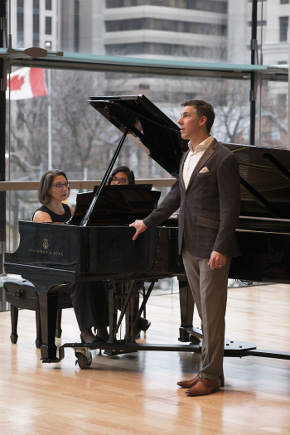
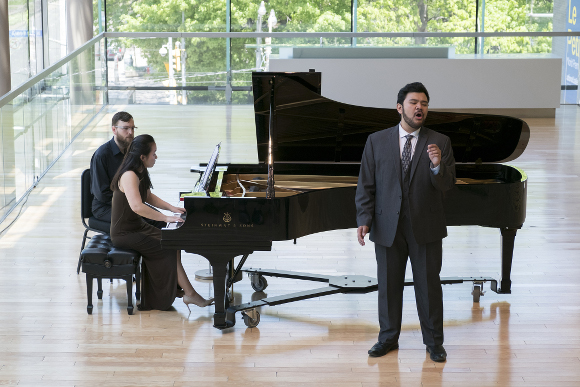
 Phillip Addis, currently one of two Papagenos at the COC, together with pianist Emily Hamper, gave yesterday’s lunchtime recital in the RBA. First up were Ravel’s settings of Jules Rénard’s Histoires Naturelles. These are quirky, fun pieces with sometimes quite complex, impressionistic piano lines. They seemed well suited to Addis’ full, characterful baritone and his obvious zest for comedy. The text twists and turns both linguistically and as narrative calling for acute timing in places, which Addis delivered.
The second set was Waypoints; four songs by Erik Ross to texts by Zachariah Wells (both of whom were present). The first piece, Broken was being given for the first time. The texts are interesting and bear rereading. The settings, often repeating phrases over an over, I found a bit uneven. They are essentially conventional and tonal ranging from the rather fierce setting of the second song, I, to almost Broadwayish in the final number, Waypoints. They are pleasant enough pieces and they got a sympathetic treatment from Addis and Hamper but I’ve heard a lot more interesting Canadian art song.
The performance finished up with an arrangement by Hamper of the lullabye, The Rainbow Connection. Again pleasant but not very substantial. Which, I suppose, was my overall reaction to the concert.
Photo credit: Chris Hutcheson.
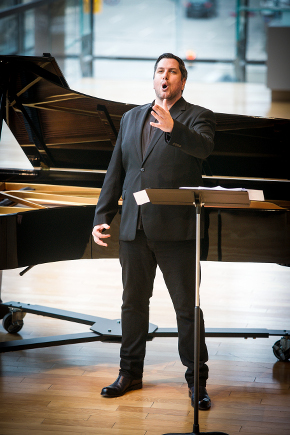 Croatian bass Goran Jurić is currently making his North American debut as Sarastro in the COC’s Magic Flute. Today he gave a lunchtime recital with Anne Larlee in the RBA. It was an all Russian programme; Tchaikovsky, Rachmaninov and Sviridov. I don’t want to do a blow by blow review because I don’t know the rep well enough and it seems a bit pointless. Instead let’s talk about Jurić as an artist, as shown by his performance here (and not surprisingly as Sarastro). He’s a genuine bass, no messing. The low notes are all there and the timbre is rich and dark when he wants it to be. But he’s also extremely lyrical. He can lighten up without ever stopping sounding like a bass. It’s a most pleasant combination. He’s also a terrific storyteller. This seems like an odd thing to say about a recital where not a word was spoken and all the songs were in a language I scarcely understand at all, yet I felt he was communicating the essence of the text with great clarity as a good lieder singer must. Anne was great as an accompanist too. There was quite a lot of range in the piano parts from quite delicate and playful in some of the Sviridov to cranking the pedals up to 11 in some of the Rachmaninov. A very good way to spend one’s lunch break.

 operaramblings