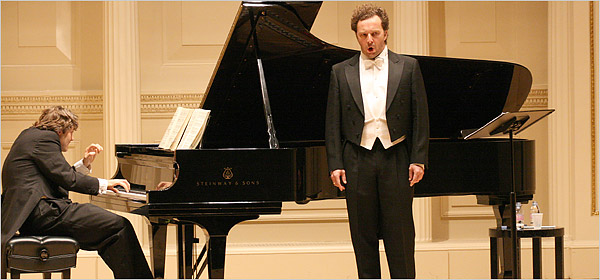
It’s hard to think of a more appropriate work for Toronto this February than A Winter Journey although one could make a good case for A Winter Stay at Home with a Hot Water Bottle and a Bottle of Whisky. Unfortunately Schubert didn’t set the latter so it was Winterreise we got from German baritone and pianist Christian Gerhaher and Gerold Huber at Koerner Hall last night. It was completely classical. Two men in tails walked out and performed the 24 songs of this most demanding cycle. There were no histrionics. There was no interpretive dance. There were no video projections. Indeed so unhistrionic was it that I don’t believe Herr Gerhaher’s right hand left the piano the entire time.
Category Archives: Performance review – miscellaneous
Modern (Family) Opera
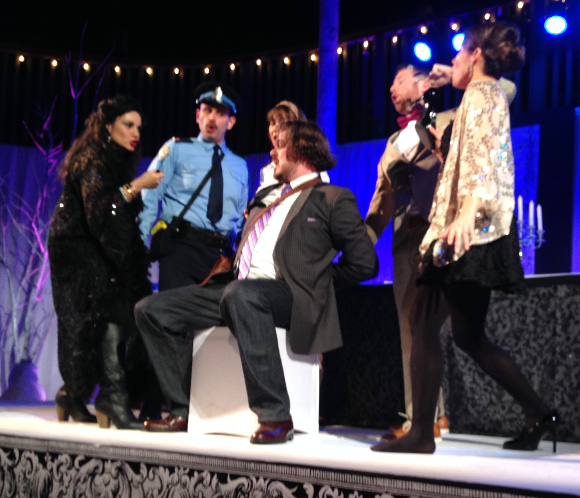
Opera 5’s new show at the Arts and letters Club pairs Wolf-Ferrari’s 1909 comedy Il segreto di Susanna with a new work , Storybook, by Darren Russo inspired by Blake’s Songs of Innocence and Experience. I can’t do a full review as I’m writing it up for Opera Canada but I think I can fairly say that the Wolf-Ferrari is hilarious and the Russo weird, rather wonderful and quite disturbing. It’s a show well worth seeing and you can catch it tonight or tomorrow at 7.30pm. Here are some production photos by Emily Ding. Continue reading
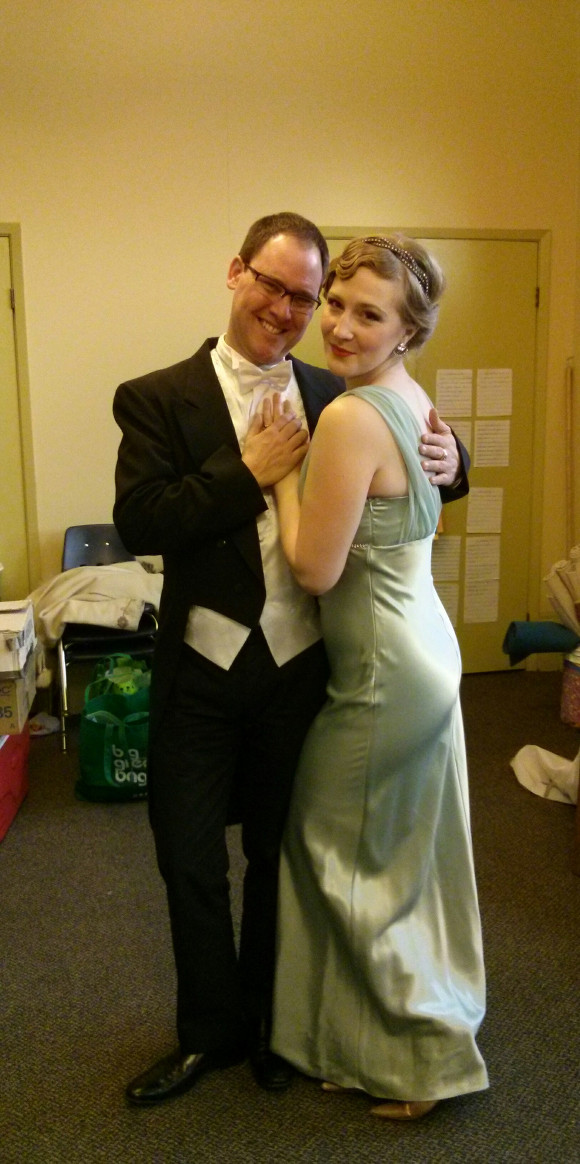
That dress I mentioned…
First we take Manhattan
Yesterday the Talisker Players ventured into new territory for them with a program of Irving Berlin songs entitled Puttin’ on the Ritz. I’m no expert on Broadway in general or Tin Pan Alley in particular but, I suppose like most people, I’ve been exposed to a lot of this music through TV and films. The Talisker presentation was interesting and unusual in that they employed a string quartet and two classically trained singers rather than a dance band or a pianist and voices from a different tradition.
Anne Sofie von Otter and Angela Hewitt at Koerner Hall
I don’t usually give colloborative pianists headline billing but last night’s packed Koerner Hall recital certainly had an element of “They came for Ms. von Otter but stayed for Ms. Hewitt”. Hewitt was phenomenal in a program that interspersed solo piano pieces with sets of songs. In the songs she was simultaneously an individual voice and supportive of her colleague while the solo piano pieces were breathtaking; elegant Scubert and Brahms before the interval, staggeringly virtuosic Chabrier after. She’s also fascinating to watch. Continue reading
Toronto Operetta Theatre’s Mikado
Gilbert and Sullivan operettas are such a stock staple of amateur dramatic societies in the English speaking world that one might think they were easy to stage. They are not. They are a tricky genre; entirely sui generic and strewn with as many pitfalls as the field at Bannockburn. The first and greatest is the primacy of the text and, embedded in that, W.S. Gilbert’s relentless guying of English Victorian society. A director really has to choose to go with that or come up with something really rather different. In Toronto Operetta Theatre’s new production of The Mikado director Guillermo Silva-Marin hasn’t really done either. There’s nothing very new in this production which seems to focus mostly on the visuals; streamer twirling and fancy fan work. One senses the mostly young cast have been left to develop their own characters without a whole lot of help. It’s a big ask and the result is that much of the time, even when the words are fully audible, one senses the players aren’t really aware of what and where the joke is. It’s no surprise then that it’s the veterans of the cast who get closest to the essence of the piece. Both David Ludwig as Pooh-Bah and Giles Tomkins as The Mikado perform with sly wit and excellent diction. The Katisha of Mia Lennox is quite idiomatic too but perhaps lacking a bit of bite.
Cathedrals of Culture
Cathedrals of Culture is a series of six thirty minute films about iconic cultural buildings. I was initially drawn to it because the Berlin Philharmonic and the Oslo Opera House are among the six but, in the end, found much to think about in all six.
Uncle John
Against the Grain Theatre opened their new show last night on the worst day of the winter so far. Over 15cm of snow fell and the TTC was in utter chaos. It’s becoming a habit. Last year’s Messiah opened in weather almost as bad. Uncle John is the latest modern, Toronto based, adaptation of the Mozart/da Ponte trilogy. It follows on from last season’s smash hit Figaro’s Wedding and was created and produced with support from the COC and the Banff Centre. It will be followed by A Little Too Cosy next season. The formula is basically the same. It;s ataged in a non traditional spave; in this case a rock concert venue on Queen West. The libretto is in English and differs in detail from da Ponte while respecting the basic spirit of the original. It’s also very Toronto and a little bit Toronto opera scene insiderish. Much of the recitative is replaced by spoken dialogue. There’s no chorus and accompaniment to the singers is provided by piano and string quartet. It’s a musical solution I like. It adds enough weight and colour that one hardly misses the full orchestra while being, of course, much more affordable. It all works really well and if you can you should see it. I’m putting my more detailed thoughts under the cut because they contain lots of spoilers which you may not want to read if you are going.
Daniel Cabena and Stephen Runge at Hart House
I was at a bit of a loose end yesterday so I made a very last minute decision to catch countertenor Daniel Cabena and pianist Stephen Runge in recital in the Great Hall at Hart House. It was a free concert and I hadn’t seen a program listing so I was pleasantly surprised to find a rather varied mix of early 20th century Canadian and English art song as well as piano pieces by York Bowen. I guess I was expecting baroque and earlier material since that’s what countertenors do!
Guglielmo Tell in concert
The operatic forces of Teatro Reggio di Torino are on a four city tour of North America. Last night, at Roy Thomson Hall, they performed a concert version of Rossini’s Guglielmo Tell. It was strictly concert style without any of the “semi staging” touches that are normal here so just music stands at the front of the stage and concert dress. It’s in some ways a very odd way to experience a piece like this because some of the most dramatic scenes aren’t sung but are accompanied by the orchestra. Take the canonical scene where Tell shoots the arrow off his son’s head. We get the build up and it’s fairly obvious what the hushed orchestra is all about and then we get the chorus announcing basically “Gee by golly, he did it”. Maybe the supertitles could be used as a commentary track at such points? Continue reading