In which the dogs don’t really get let out

Tap:Ex METALLURGY is the second experiment by Tapestry Artistic Director Michael Mori in engineering a collaboration between  opera people and an alien musical form; in this case punk experimentalists Fucked Up.  The program consistec of two pieces.  Metallurgy A was written by Fucked Up’s Jonah Falco to a dense libretto by Mike Haliechuk and David James Brock.  In half an hour it tells the story of a mother and father trying, unsuccessfully, to come to terms with the death of their young daughter.  Dramatically it’s quite clever.  There’s dialogue and then the performers (the musicians are on stage with the singers) leave one by one until only the mother (Krisztina Szabó) and the violinist (Yoobin Ahn), representing the ghost of the daughter, are left on stage to play out a final duet.

fu1 Continue reading

Julie

We are remarkably lucky in Toronto to get as much contemporary opera as we do.  Courtesy of groups like Tapestry and Soundstreams , it seems that two or three new pieces get performed every year.  They tend to be home grown, which is fine but does mean we don’t often get a glimpse into what’s happening with new work in Europe.  In fact, in the last few years, I think the only European contemporary piece I’ve seen in Toronto was Saariaho’s L’Amour de Loin.  So, I was really pleased, courtesy of Soundstreams and CanStage to be able to see Philippe Boesmans’ Julie which opened last night at the Bluma Appel theatre.

Julie, CanStage

Continue reading

Elizabeth Krehm memorial

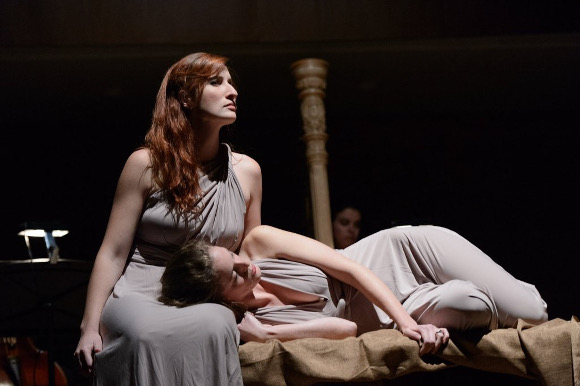
bogdanowiczLast night was the third memorial concert for Elizabeth Krehm in support of the ICU at St. Mike’s.  This year the piece was Mahler’s Symphony No.2 appropriately enough.  It’s a piece I’ve lived with for a very long time and it never fails to move.  It’s a curious contrast with the Fourth which we heard at the symphony last week.  If 4 gives a naive and optimistic view of the afterlife, 2 is much darker, more troubled and less certain.  Even the very beautiful Urlicht is not without its sense of angst and the final movement is majestic, powerful and has the deepest possible sense of yearning.
Continue reading

Kickin’ Puss

Xavier Montsalvatge’s El Gato con Botas, given last night by the Glenn Gould School at Mazzoleni Hall, may not be the most profound thing in the opera canon but it is fun.  The 1948 score is jazzy and accessible and the libretto has fun with the fairy tale of the scheming cat and her gormless monkey servant.  The lighter, even absurdist, elements of the plot were rather played up, and to good effect, in Liza Balkan’s production.  Mazzoleni Hall is not the easiest place to present opera.  There’s no pit and no way to do surtitles.  Not much in the way of wing space or scenery handling either.  Balkan got round this by placing the band on stage and using very simple sets and props that often spilled over into the auditorium even getting Charles Sy, sitting in the front row, to take a selfie of the wedding party at the end.  Given that the Spanish numbers were not surtitled, it was smart to add extra English dialogue, much of it improvised.  I certainly didn’t have any difficulty following the story.  Credit too to lighting designer David Degrow too for making the most of the limited resources of Mazzoleni.

folksongs

Continue reading

The Living Spectacle

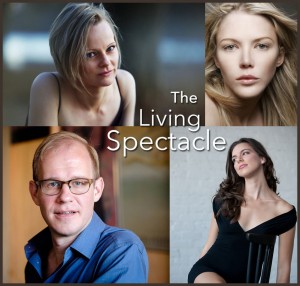
spectacle-300x286The Canadian Art Song Project branched out last night with a ticketed concert at The Extension Room.  The opening number was the latest CASP commission; The Living Spectacle by Erik Ross to words by Baudelaire translated by Roy Campbell.  Like a lot of modern song the three movements were all quite piano forward and hard on the singer.  The second text, The Evil Monk, certainly brought out the darker and more dramatic side of Ambur Braid’s voice while the third, The Death of Artists, was cruelly high even for someone with Ambur’s coloratura chops.  She coped very well and Steven Philcox’ rendering of the piano part was suitably virtuosic.

Continue reading

The Telephone and The Medium

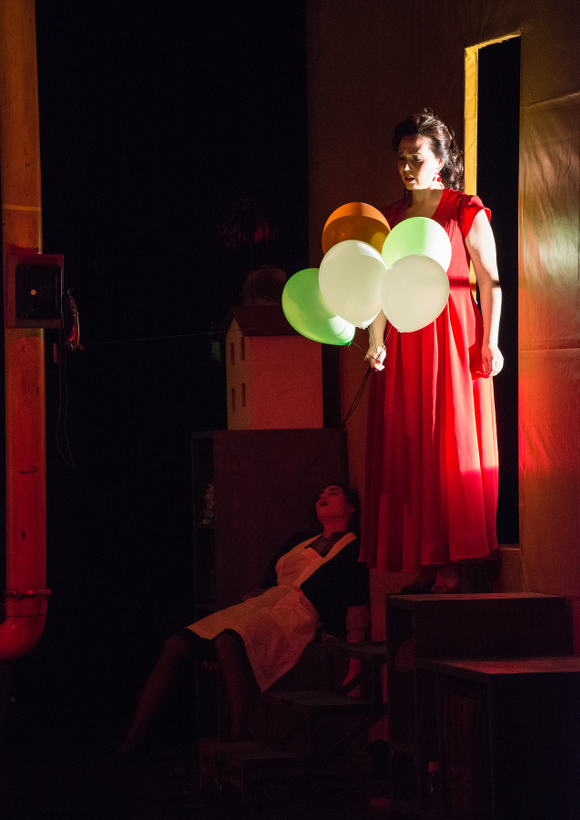
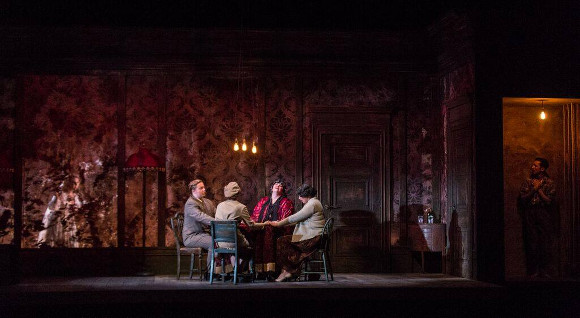
UoT Opera’s fall production opened last night at the MacMillan theatre.  It’s a double bill of Menotti works; The Telephone and The Medium.  The former was cleverly updated by Michael Patrick Albano to reflect the age of the smartphone.  It actually seems more relevant than ever and, slight as it is – an extended joke about a girl who won’t get off the phone long enough for her fiancé to propose – it was wryly amusing. The Medium I’m not so sure about.  It’s a contrived piece written in the 1940’s but set a few years earlier about a fake medium and her deluded clients.  It seems dated, not so much in the sense that seance attendance is pretty unusual today, but in the extent to which the characters are clichéd, cardboard cut outs even.  The medium herself is bad enough but her sidekicks are her rather dippy, if kind, daughter and a boy who is mute (k’ching), Gypsy (k’ching) and “found wandering the streets” (k’ching, k’ching) “of Budapest” (k’ching, k’ching, k’ching).  The first act in which the fake seancery goes on isn’t bad but then the medium gets a shock; a real or imagined cold hand on her throat (probably imagined as she is a raging alcoholic) and decides to go straight.  The second act is pure bathos.  I can see why it was a Broadway hit in the 1940s but I think tastes have moved on.  And who the heck calls their daughter “Doodly”?

medium Continue reading

Songs of Remembrance

monicawhicherSo it’s early November and a recital titled Songs of Remembrance.  One might of expected something like the program Chris Maltman presented just down Philosophers’ Walk last year but no, Monica Whicher and Rachel Andrist’s program was gentler.  Dare we say “more feminine”?  This concert was about remembrance of childhood and love; happy and not so happy.  Framed by Roger Quilter’s settings of Blake we got two “concocted cycles” drawn from very diverse sources; English, French and German texts; art song and popular song; composers from Schubert to Richard Rogers and Hans Eisler. It was effective.

Continue reading

Darknet

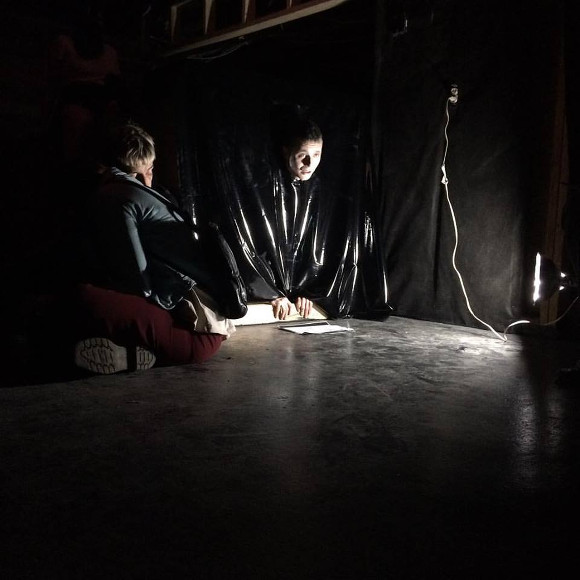
Great idea.  Create a sort of spooky, short opera program in a funky location and use it as a fundraiser for your next major project.  That was Darknet at Mây last night.  Jennifer Krabbe, singing Berlioz, rounded us up in the bar and ushered us downstairs into an installation created by Alessia Naccarato and Noah Grove.  It was dark.  It was eerie.  We were offered masks.  Cairan Ryan sang The Cold Song from Purcell’s King Arthur while writhing on the floor.  Jonathan MacArthur sort of emerged from some sort of primeval goo singing Aria by John Cage and Beth Hagerman gave us one of Lulu’s arias.  Then we were rounded up and ejected into the light again.  Loved it.

jma

Abraham, an oratorio

I really wanted to like David Warrack’s new piece Abraham that premiered last night at the Metropolitan United Church.  It’s described as an oratorio and tells the story of the patriarch Abraham and uses that as a jumping off point for arguing for the breaking down of barriers between Jews, Christians and Muslims based on their shared heritage(*).  Given recent events in Canada and elsewhere that’s obviously a worthy goal and the whole thing was in aid of the Metropolitan United Church Syrian Refugee Fund; reason enough, in itself, to go.

Continue reading

Opera Atelier at 30

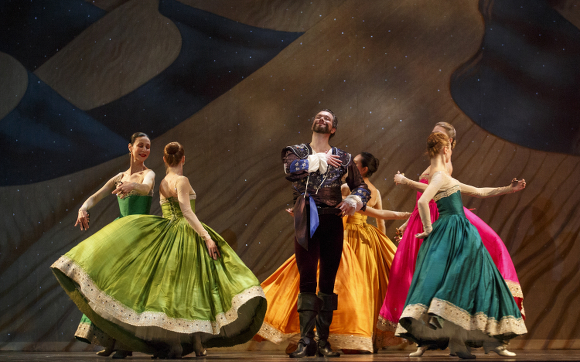
Opera Atelier opened their 30th season last night with Lully’s Armide.  It’s hard to think of a work that better encapsulates what Opera Atelier is and has always aspired to be.  It’s French, it’s 17th century and it’s heavily dependent on ballet, and ballet of an aesthetic that pretty much defines Opera Atelier.  The whole Opera Atelier aesthetic package is there in spades.  Bare chested male dancers in tights that leave little to the imagination, heaving bosoms, ladies twirling prettily in full skirts, castanets and finger cymbals, chorus singing off stage, camp “baroque” acting, tight buttocked homoeroticism, singers cast as much for eye candy value as vocals, a tendency to play for laughs,Tafelmusik.  To be fair, there were a few innovations.  I think I heard a more “realistic” vocal style.  The singers were prepared to make ugly sounds when the emotional context demanded it, rather than an endless flow of prettiness.  The homoeroticism got a BDSM twist in Act 3.  Still, this was very much “by the book” Opera Atelier and if that’s your bag you’ll love it.

151020_53981 Continue reading