Dialogues of the Arkelites

Debussy’s Pelléas et Mélisande is not an opera I’m especially familiar with. It’s a strange piece based on a libretto by Maeterlinck. For much of the time it’s wordy without much action. There is a lot of philosophising. When the action does break out; Golaud’s mad jealousy in Act 3, the killing in Act 4, it gets musically and dramatically quite violent. The music is tonal and mostly quite dreamy. It’s almost mood music. All of this reminds me quite strongly of Poulenc’s Dialogues des Carmélites hence the title of this post. Also it’s French. Actually it’s very French.

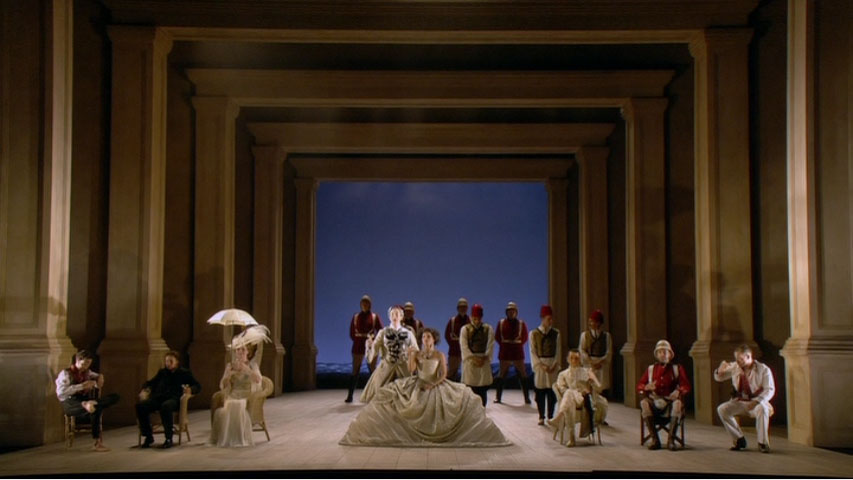
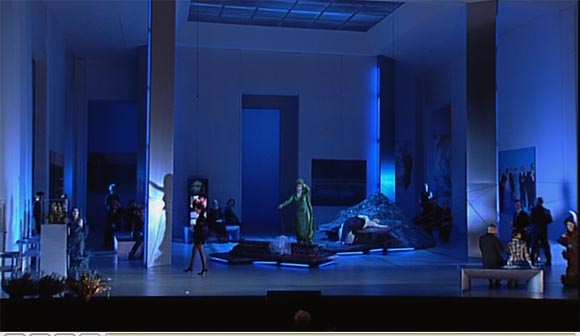
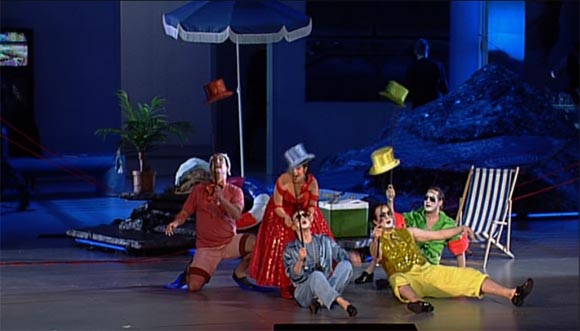
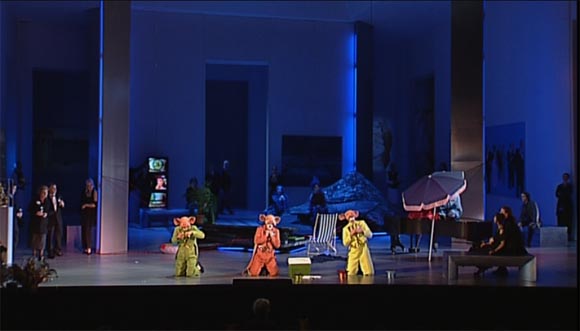
Laurent Pelly’s 2009 production for Theater an der Wien is also very French; French director, French conductor, almost entirely French cast. In an opera where the words and the relationship between the music and the words matter a lot that’s a distinct advantage. The sets are semi-abstract and placed on a rotating turntable so that scenes can follow on with a minimum of interruption. The forest, the tower, the cave are all suggested rather than made entirely explicit. Even Mélisande’s extra long hair is not depicted explicitly. This fits the indirect nature of both the libretto and the music rather well. The costumes suggest somewhere around 1900 and the colour palette doesn’t stray far from “forest floor”. Lighting is quite dark but evocative. The sense of a gloomy castle in a gloomy (Breton?) forest is quite strong.

With the exception of a few outbursts from Mélisande’s husband, Golaud, and one fairly lyrical love scene between Mélisande and Pélleas the singers have few opportunities for vocal pyrotechnics. They do need to sing stylishly and articulate well though and this cast excels in that department. Natalie Dessay as Mélisande does the fragile Natalie thing which works really well in this role. Perhaps she could create more mystery around her character but her interpretation seems quite valid. Stephane Degout as Pélleas is a good physical actor and is lyrical where he needs to be. I’m not sure that there is much depth to be got out of the character anyway. Perhaps the most interesting role is the insanely jealous Golaud, sung here by the admirable Laurent Naouri. He has a fairly major emotional arc to go through and is strong in the scene of crazy jealousy where he gets his young son, Yniold (well sung and acted by Beate Ritter), to spy on the lovers. It’s a fine all around performance. The part of the old king, Arkel, is sung by Philip Ens. He conveys wisdom, sympathy and a kind of philosophical detachment in an extremely dignified but weary way. It’s a fine job of portraying a very old man without the voice sounding past it. Good supporting performances too from Marie-Nicole Lemieux as Geneviève and Tim Mirfin as the doctor.

Bertrand de Billy is in the pit with the ORF Radio-Symphonieorchester Wien. He seems to be thoroughly at home with the score and gets some lovely, transparent, sound out of the orchestra. The chorus, the Arnold Schoenberg Chor, does what little it has to do perfectly adequately.

The video direction, by Landsmann and Landsmann, is pretty sympathetic. A lot of the time not much is happening and they close in on the singer(s) which is fair enough. When there is a stage to be shown they show it. It’s nowhere annoyingly gimmicky. The picture is top DVD quality 16:9 and the DTS 5.0 sound is mellow rather than punchy which seems appropriate. AV quality is pretty much as good as it gets without going to Blu-ray. There are English, French, German, Spanish and Italian subtitles. Despite being split over two disks there are no extras. The documentation too is limited to credits (there’s not even a track listing). It;s quite a major omission for a work like this. An interview or an article about the director’s reading of the piece and his approach would be very useful.

There’s some stiff competition for this release, notably from Zurich and WNO, so I’ll certainly be trying to get my hands on some alternative versions in an attempt to deepen my understanding of the work as much as anything.

And then there were nun

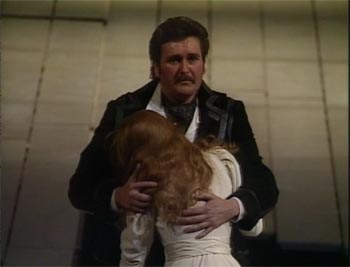
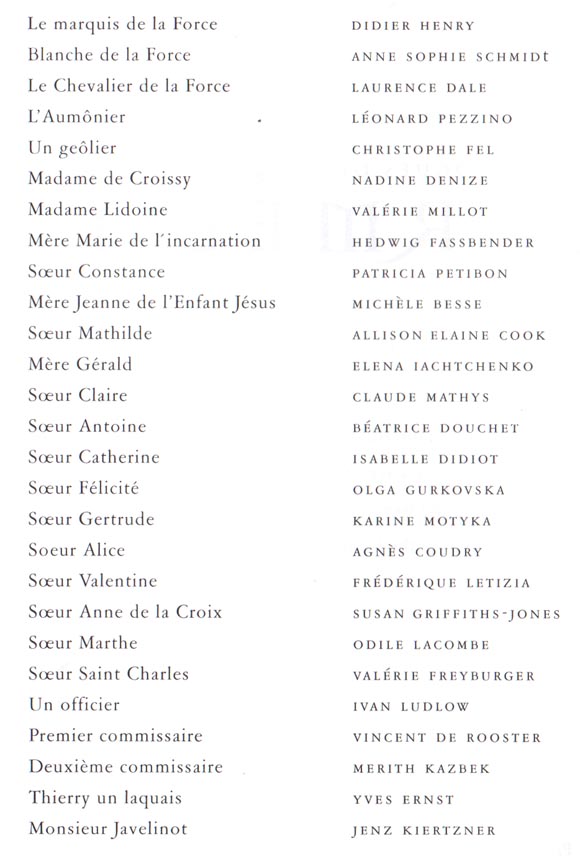
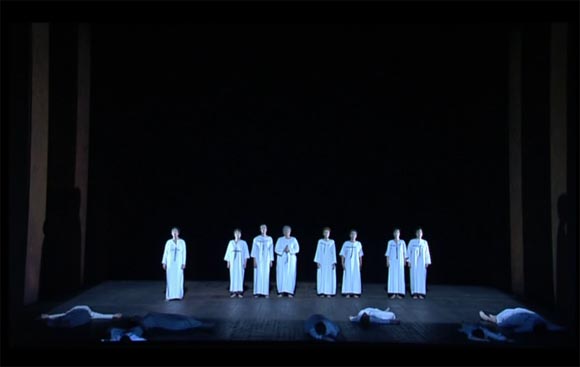
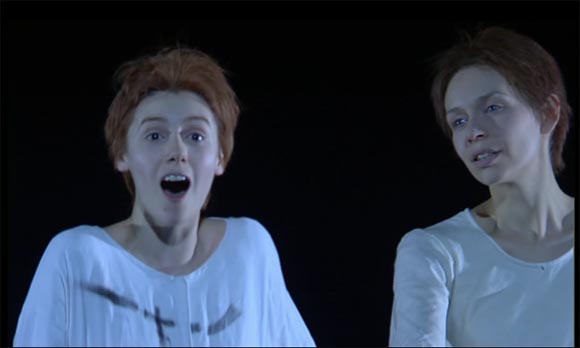
Nest season the Canadian Opera Company is presenting a production of Poulenc’s Dialogues des Carmélites. It’s not a work I’ve had any exposure to and it sounded enough like Catholic snuff porn for me not to have bothered before. However, in the interests of furthering my education I got my paws on the library copy of DVD of a 1999 production from Opéra National du Rhin. I actually ended up quite liking the piece though the libretto might well have been written by Gide in one of his darker moments. The score is so tonal that it could almost have been written a hundred years earlier but it’s pleasant enough in a movie soundtrack sort of way. The production in question, by Marthe Keller, is very restrained. Much of the time it’s quite dark with very little happening. The drama is all in the words and expressions of the singers which must have made it quite hard to appreciate from the cheap seats. It’s also very traditional and period in costume and set design while remaining essentially simple. Given that most of the “action” is a series of dialogues that could have been lifted from a theology text this isn’t a bad set of choices. The final scene is almost impossible to stage literally as it involves the mass guillotining of the nuns. Here it’s handled effectively enough by having the nuns step forward in turn and collapse on stage to the successive sounds of the guillotine falling. The final reconnection of Blanche and Constance is really quite affecting. The cast is huge (full list below) There are a few key roles that have to convince for the piece to work. Foremost among these is Blanche de la Force aka Soeur Blanche de l’Agonie du Christ, here played by Anne Sophie Schmidt. She’s a character of deep religious devotion but also getting on for batshit insane. It’s not an easy role to play. Schmidt is really convincing in what could be a bit of a cardboard cutout role if not handled carefully. She also sings very well though occasionally sounds a bit strained in the upper register. The other young nun is Soeur Constance, a very optimistic young lady, played utterly charmingly by Patricia Petitbon. There are also lots of older nuns. I had to keep looking up who was who because it’s a bit like trying to pick out a suspect in a penguin identity parade. The important one’s are the old prioress (Nadine Denize), who dies in the first act, Blanche’s mentor, Mère Marie (Hedwig Fassbender), and the replacement prioress, also Mère Marie (Valérie Millot). All three ladies play their parts convincingly and sing appropriately for the character. Among the men, the stand out for me was the Aumônier of Léonard Pezzino who has a lovely voice. Really though, Blanche aside, this is an ensemble piece with no real opportunities for vocal fireworks. Here the ensemble worked well and was well supported by Orchestre Philharmonique de Strasbourg under Jan Latham-Koenig. I’m not sure how I feel about Don Kent’s video direction. He starts off with artsy stuff in the title sequence and it’s not entirely clear where the credits end and the piece begins. There is something to be said for showing the conductor going to the pit and starting the show. He stays very close in on the singers most of the time which normally drives me nuts but here seems unavoidable and, to be fair, when there is a stage tableau to be seen we see it. There are also grainy black and white images used during some of the orchestral interludes. It’s not entirely clear whether they are projections in the house or inserts in the video. I think the latter but I can’t be sure. It’s perhaps best to enjoy this as a video and not worry too much about how well it reflects what is going on on stage. Technically this isn’t a bad DVD. The 16:9 picture is quite decent and the LPCM Stereo sound is OK though not in the class of the best recent releases. The only subtitle options are English and Chinese. There is a trilingual (English, French, German) booklet with track listing, synopsis and a brief historical essay. The only real competition for this work on DVD is a much starrier La Scala cast in the Robert Carsen production that will be seen in Toronto so this Strasbourg version is probably worth a look for anyone with a serious interest in the work. There’s also an old (1984) Opera Australia version sung in English still in the catalogue.
I came, I saw, I picnicked

The DVD of the 2005 Glyndebourne Festival production of Handel’s Giulio Cesare in Egitto is one of the most satisfying that I have ever got my hands on. David McVicar’s production is a delight. The cast is consistently excellent with stand out performances from Sarah Connolly as Caesar and Danni de Niese as Cleopatra. William Christie gets wonderful playing from the Orchestra of the Age of Enlightenment. The production for DVD/Blu-ray is exceptional in every way. There’s even over an hour of worthwhile extras giving a total of over five hours of material.

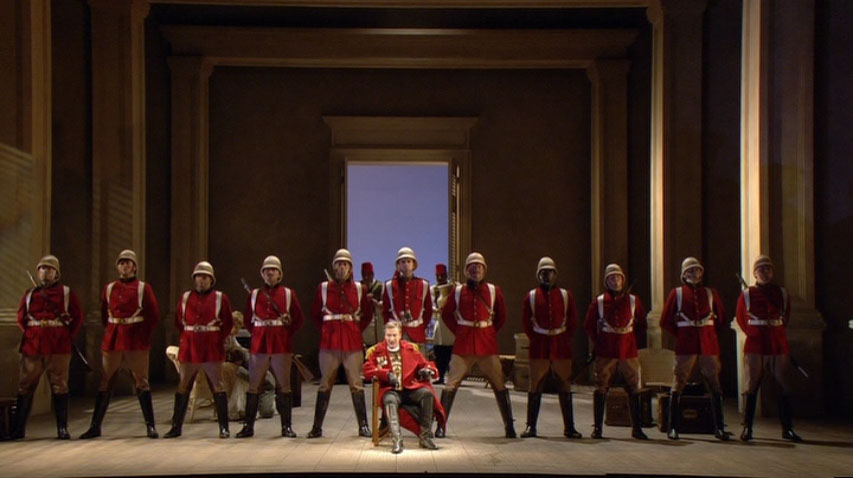
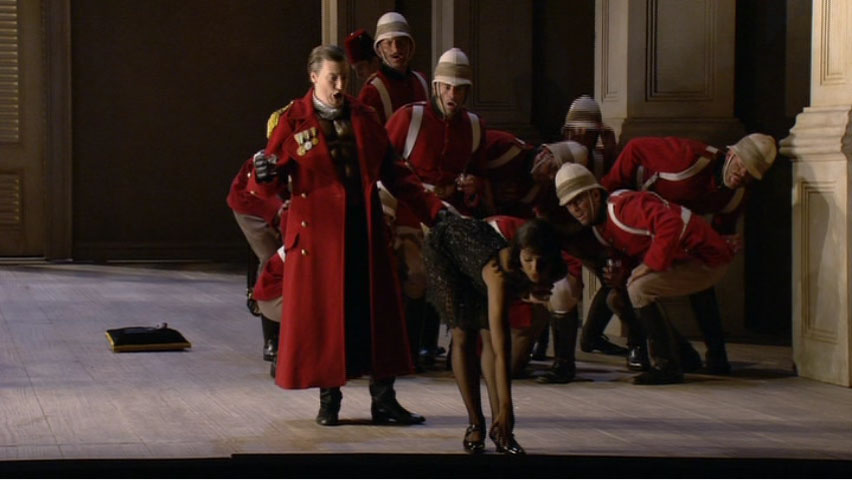
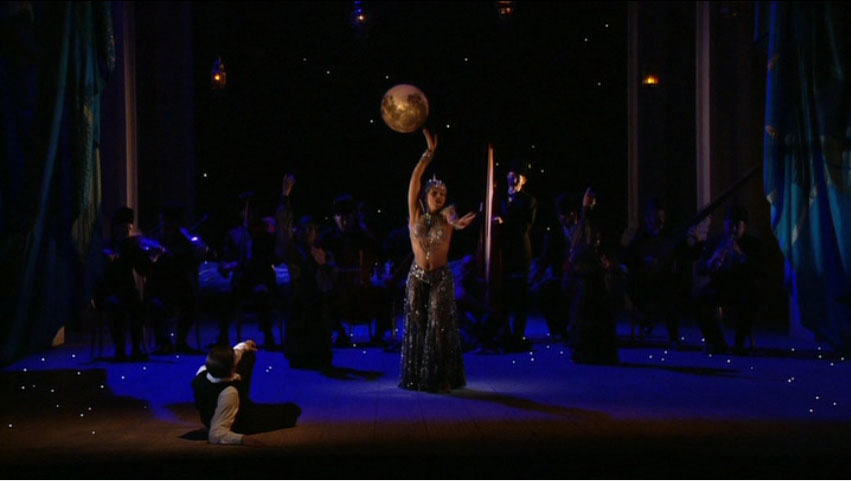
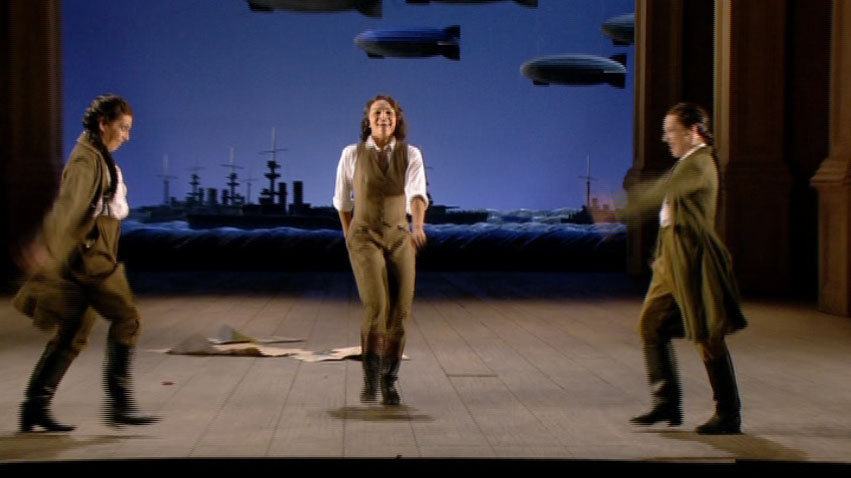
Let’s start with the production. McVicar and his design team have placed the action firmly in Egypt but moved the time period to the late 19th century with the Romans being portrayed in the manner of the British who effectively ruled Egypt at the time. There are a number of elements taken from Bollywood musicals which seems to have led some reviewers to dismiss it as not being “serious” enough to be a proper Handel production. I think this is misguided. The Bollywood elements are well integrated dramatically and musically and serve a dramatic purpose. They point up the cultural rift between the Romans and the Egyptians without getting into a crude and heavy critique of colonialism. There are a few places where Andrew George’s choreography is a bit over the top but mostly it works and, if nothing else, it’s tremendous fun. McVicar has obviously worked really hard on the and all the main characters and their interactions are clearly defined. The gulf between Romans and Egyptians emerges through these relationships though perhaps the rather overwrought Sesto of Angelika Kirchschlager somewhat undermines the chilly memsahib Cornelia of Patricia Bardon. Throughout there are neat little touches like Cleopatra ditching her cigarette in the urn containing Pompey’s ashes or the Roman/British warships sailing into Alexandria harbour with airship cover during Da tempeste il legno infranto. At the very end, Achilla and Tolomeo, blood soaked, (both are dead at this point) reappear and flank the line of seated dignitaries sipping champagne. It’s weird but works. Notably the production team got one of the biggest ovations of the night when they appeared for a curtain call.

The individual performances range from very good indeed to spectacular. Musically the star is Sarah Connolly. She’s utterly brilliant with completely secure coloratura and ornaments that are far more than just decorative.  Right from Empio, dirò, tu sei where she manages to spit out her disgust while maintaining 100% musicality, to the very end she’s note perfect. Her acting is also really good. She covers a wide range of emotions and her physical acting is genuinely masculine. She really does not look or move like a woman in drag. Then there’s Danielle de Niese! Musically there may be subtler or more refined exponents of the art of Handelian singing but I doubt whether there are any who could handle the role Danni is handed here. (Jane Archibald maybe, just maybe). She sings very well in fact. Some of her big numbers are very well done indeed and Piangerò la sorte mia is very fine and she’s very clever vocally in Da tempeste il legno infranto here she works some ornamentation in to accompany miming firing a sub-machine gun. But singing is only a fraction of the work she gets through. She has a lot of physical acting and several major dance numbers. She’s a very good dancer and, of course, she really looks the part. It’s really quite a performance!

Patricia Bardon acts well in a chilly way and sings beautifully. Priva son d’ogni confortois a real tear jerker. Kirchschlager sings very well but is a bit overwrought in the acting department and doesn’t really come across as a young man set on revenge. Rachid Ben Abdeslam is wonderful as Nireno. He gets the basically scaredy cat (and somewhat effeminate) functionary spot on. Chris Maltman is an appropriately brutal and coarse Achilla without letting the coarseness affect his singing. Alexander Ashworth in a kilt, is a solid, if unexciting, Curio but that’s the role. Christophe Dumaux is brilliant as Tolomeo. He looks like Captain Darling from Blackadder Goes Forth and is similarly petty and petulant. He’s also a vicious, spoiled bully and narcissist. Dumaux brings out all these aspects while singing at the highest level. It’s almost up there with de Niese and Connolly. The musical direction and orchestral playing is of the highest order.

Glyndebourne has been really well treated on video in recent years and this Opus Arte release is no exception.  The production for DVD is both excellent and opulent. The DVD version is spread across three disks (the Blu-ray gets two which is remarkable!). The video direction, by Robin Lough, is sympathetic and unobtrusive. The production was filmed in 1080i (which is what one gets on the Blu-ray) and the DVD rendering of the picture is about as good as DVD gets. The audio choices on DVD are LPCM stereo and DTS 5.0 with the latter being superior. In fact it’s superb; maybe the best sound I’ve come across on DVD. The fidelity with which the brass and woodwinds are captured is exceptional. The Sinfonia just before the final scene is thrilling to listen to. I’d really like to hear what the PCM 5.0 track on the Blu-ray sounds like. There are English, French, German, Italian and Spanish subtitles. Besides a synopsis and cast gallery there are two documentaries incluced. There’s a “making of” called, appropriately “Entertainment is not a dirty word” and a feature on “Danielle de Niese and the Glyndebourne experience”. It’s rather touching as Danni gushes over what an amazing place Glyndebourne is and interviews Gus Christie about what it’s like to live there. I’d like to see the follow up with Mrs Gus Christie, chatelaine!

This really should be watched by anyone who thinks baroque opera is difficult and boring and needs to be dumbed down for the average audience. But I don’t suppose he’s listening.

Barbarella, Prinzessin von Judea

Götz Friedrich’s 1974 film of Strauss’ Salome is a bit of an oddity. It’s a studio film rather than a video recording of a live performance. This allows the casting of singers who might not be able to manage the role in the opera house. In this case, crucially, the light lyric soprano Teresa Stratas sings the title role which she most certainly never did on stage. Continue reading

Lady Macbeth in Florence

Shostakovich’s The Lady Macbeth of the Mtsensk District is becoming quite a staple of the opera repertoire. Even so, I’m still a bit surprised to see a production from the Teatro del Maggio Musicale di Fiorentino making it onto DVD and Blu-ray. It’s a 2008 recording with James Conlon conducting and Lev Dodin directing a mostly Russian cast though with Jeanne-Michèle Charbonnet in the title role.

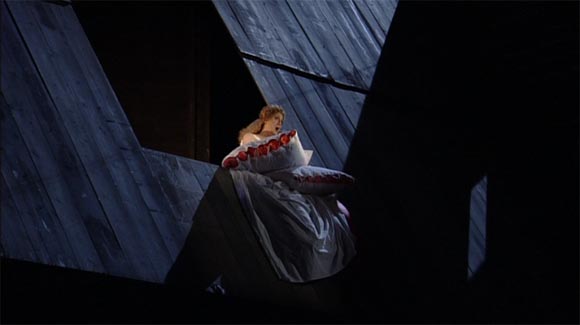
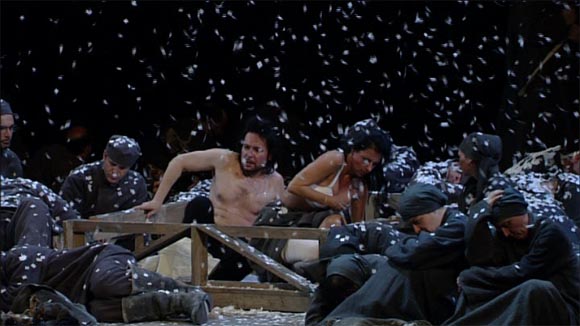
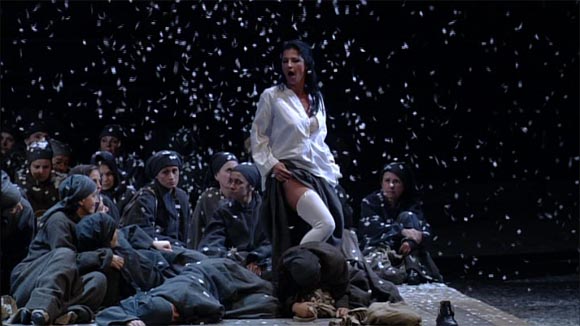
The production is fairly conventional. A wooden set serves variously as the interior of the Izmailov’s warehouse, the police station, some external scenes and, with minor changes, the convict’s camp. There are various galleries and a sort of eyrie that serves as Katerina’s bedroom. The production is not particularly exciting. The seduction/rape in Act 1 is depicted by Katerina’s bedroom light swaying increasingly wildly while a minor character clowns across the stage. It really stays in much the same key until Act 4 where everything goes blue and white and “snow” pours down continuously onto the stage. Sergei and Sonyetka get it on under a big white sheet while the rest of the convicts look on. The push/jump into the river happens so suddenly and unobtrusively that if one didn’t know the plot one might miss it.

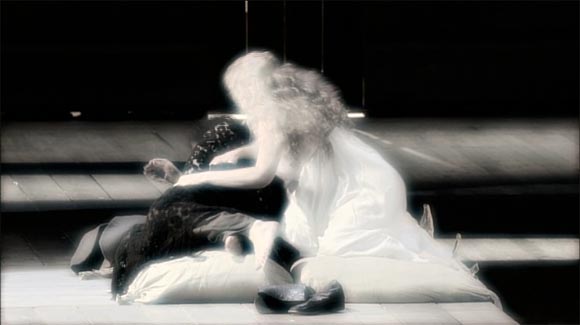
Maybe it’s the essential dullness of the production that causes video director Andrea Bevilacqua to take the approach he does, which is highly interventionist. Sometimes we get to see the action more or less as the theatre audience does but often we get extreme closeups or weird angles; backstage, side stage, from the pit, the works. He also indulges in some video trickery. At least I think that’s what’s happening in the scene with Boris’ ghost which is very white and somewhat out of focus. I don’t think the effect could be produced with stage lighting. In Act 4 Bevilacqua also pulls out the fades, dissolves and superpositioned shots. As a video in its own right it is quite interesting. As a record of a stage production it largely fails so whether one likes it or not becomes largely a question of point of view on what a video recording of a live opera performance should be. The disk includes an introductory credits sequence which involves what appear to be black and white portraits of the cast put through Photoshop’s oil painting filter. It really is a taste of things to come.

Musically this is a mixed bag. James Conlon takes an unusually lyrical view of the score and at times his Florentine orchestra sounds almost more like Verdi than Shostakovich. I was sufficiently surprised by his reading of the first act, especially the scene at the end between Sergei and Katarina that I put on the Amsterdam production (Mariss Jansons conducting the Concertgebouw) for a comparison. It’s night and day. Conlon shapes long legato phrases and the percussion is quite restrained. Jansons is strident and staccato with incisive percussion and blaring brass. Jansons sounds much more like the music I fell in love with as a teenager! Conlon is not quite as extreme in the remaining acts but it’s still very restrained Shostakovich. The singing is generally pretty good. The stand out is Vladimir Vaneev as the brutally lecherous father in law. Sergei Kunaev is an adequate Sergei but he’s not terribly charismatic and the chemistry between him and Charbonnet never really gets going. She’s OK too but her vibrato increases with volume and is really quite obtrusive when she’s singing loud.

Technically the DVD production is pretty good. It was filmed in 1080i and is generously spread across two DVD9 disks. The picture is comparable with DVD releases from the MetHD series. Sound options are LPCM stereo, Dolby 5.1 and DTS 5.1. As to be expected the DTS track is the best bet. It’s clear, spacious and detailed. The dynamic range seems a bit limited but I think that’s probably the orchestra and the house acoustics rather than a fault in the recording. There are Russian, English, Italian, German, French and Spanish subtitles. There are no extras but the booklet includes casting, a full track listing, a historical essay and a plot synopsis.

People who find the dramatic liberties that Martin Kusej takes with his Amsterdam production really irritating may prefer this. Most people, I suspect, will prefer that version. So I guess I’d better do a full review sometime.

Ariadne auf Dresden

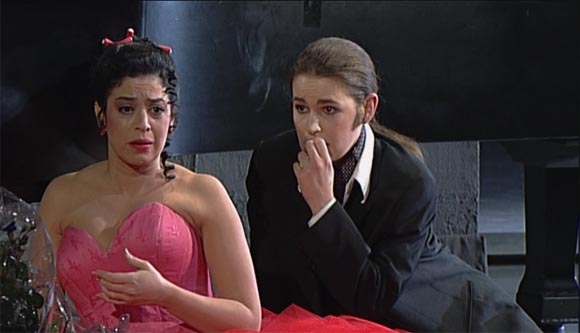
Marco Arturo Marelli’s 2000 production of Richard Strauss’ Ariadne auf Naxos is fascinating and compelling. He sets the work in the present at a very posh, arty party. Throughout there are extras playing party guests all over the place. The “opera” itself takes place in the middle of the main salon where the party is taking place. There are many interesting touches. For example, the Komponist features extensively in Act 2. Obviously smitten with Zerbinetta, he appears to accompany her on piano at the beginning of Groß mächtige Prinzessin and frequently watches from the side of the room as she is drooled over by various male party guests. Only at the end does the staging shift from the party to something that suggests some sort of reality in the relationship between Bacchus and Ariadne before dropping us right back into the party where the guests have completely ignored this piece of transcendence to go and watch the fireworks in the garden. The directorial take on Zerbinetta is interesting too. No flighty airhead here but rather a somewhat cynical and worldly young woman. It works rather well.

The performances are a bit mixed. The Act 1/Prologue is uniformly strong. Sophie Koch is an excellent Komponist. She sings well and acts very well indeed. Her, non singing, portrayal of the character in the second act as a gauche and geeky young man socially and emotionally out of his depth is really quite funny and touching. Friedrich-Wilhelm Junge is excellent as the Major-Domo. He has just the right touch of disdain. Moving on to the main action it’s a bit of a mixed bag. Iride Martinez’ Zerbinetta is a tour de force. She is completely consistent in her portrayal of the character to the extent of, at times, somewhat suppressing the beauty of the music in favour of dramatic verisimilitude. That’s not to say she sings badly. She sings very well but to a particular purpose. Susan Anthony’s Ariadne didn’t really convince me as much. She’s OK but “OK” isn’t a description I want to use about someone singing Es gibt ein Reich. It should make the hair stand up on the back of one’s neck and Anthony’s doesn’t. To be fair she’s not helped by the recording (see below). Jon Villars’ Bacchus is pretty good and the supporting nymphs and players are more than adequate. The players in particular have a lot of business and they handle it with considerable comic flair. Surprisingly, Sir Colin Davis’ reading of the score seems a bit bland. He doesn’t point the rhythms nearly as incisively as Levine on the Met recording or, even better, as Andrew Davies did in Toronto last year. The orchestra sounds a bit undercooked too. The recording may be a significant part of the problem here too.

Technically this isn’t too, too bad for a budget Kultur effort. The video direction by Felix Breisach is very good. He shows us the whole stage often enough to appreciate the complexity of the director’s concept and its execution and his close ups aren’t excessively close. It’s a good balance. It’s a pity he’s not better served by the picture quality. It’s fairly good 16:9 (not 4:3 as the box and most on-line references suggest). It works pretty well on close ups but the lack of definition is a bit annoying on the longer shots.  This production would definitely have benefitted from being shot in HD. The sound is Dolby 2.0 and it’s at best OK. There’s no real sense of space and it’s a bit dry. It certainly doesn’t do Susan Anthony or the orchestra any favours. Subtitles are English only and documentation is limited to a track listing.

There aren’t a lot of versions of Ariadne on DVD. There’s a recent Guth production with Emily Magee, which is said to be quite good, an ancient film with Karl Böhm and a 1988 Met version. The Met version is musically far superior to the Dresden offering but features a deadly dull production that looks like it was first given half a century before Ariadne was written. Given that, I think this Dresden version is well worth a look.

Hunger and starvation is increasing everyday

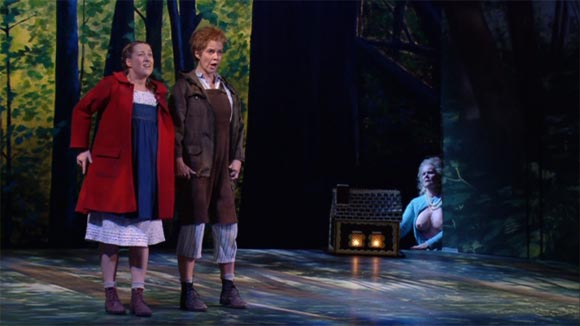
The Royal Opera House’s 2008 production of Humperdinck’s Hänsel und Gretel makes no concessions to the idea that this is a sort of operatic Nutcracker to be staged for the kiddies at Christmas. Patrice Caurier and Moshe Leiser’s production is firmly in the grim, and Grimm, tradition of central European folk tales and it’s sung in German.

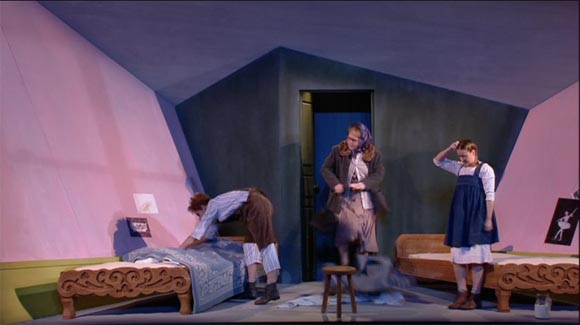
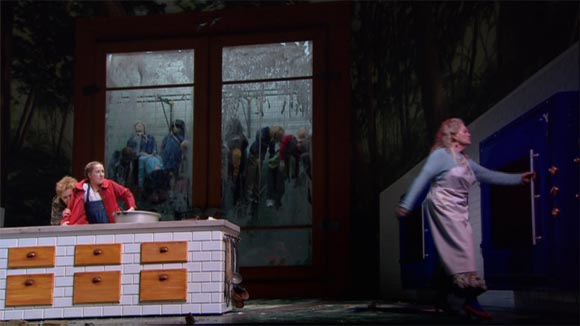
For Act 1, designer Christian Fernouillet has created a claustrophobic bedroom with surfaces at odd angles in which the children (Angelika Kirschlager and Diana Damrau) play out their hunger displacement games until their angry mother (Elizabeth Connell) sends them off to forest to gather berries. The father (Thomas Allen) returns with food and this relief from hunger is played out in a scene heavy with sexual innuendo between mother and father. It’s quite creepy. Finally they realise that the children are missing and set off in search.

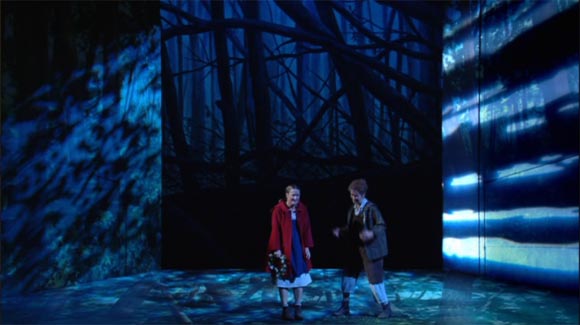
Act 2 starts in a classic fairy tale forest which rapidly darkens into a place of real menace. The sandman (Pumeza Matshikiza) is a strange distorted creature who puts the children to sleep. In the dream sequence the fourteen guardian angels, with animal heads, carry in a bunch of furniture, including a fireplace, to create a fireside scene of bourgeois domesticity. Two of the animal angels reveal themselves as the mother and father and give the children gifts. Inside each elaborate package is a single sandwich which is devoured with rapt concentration.

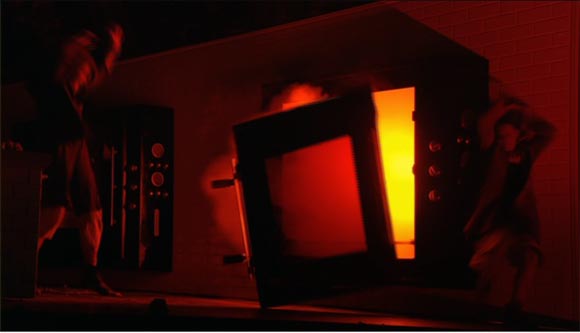
Act 3 opens with the Dew Fairy, here a pink confection played by Anita Watson, waking the children. The witch (Anja Silja), a vicious looking old woman with comedy breasts and a Zimmer frame, leaves a miniature gingerbread house for the children to explore. This transforms to the full size version with dead children hanging in a glass fronted cupboard and industrial scale ovens for the witch’s child based confectionery experiments. There is no concession whatever to comedy. The witch is scary as all hell and the scene in which she is shoved in the oven involves some serious pyrotechnics. The conventional happy ending descends into an orgy of face stuffing as the revived children fall on the cake/corpse of the witch. The production is consistent in its essential seriousness and is supported by fine acting across the board. In line with the concept nobody camps up their part. It’s all in earnest.

Musically it’s a really strong performance. Both Kirschlager and Damrau are quite excellent and work really well together. Kirschlager has quite a rich tone which blends nicely with Damrau’s cleaner sound. Thomas Allen is also really good. He’s quite chilling in the Hexenritt for example. Anja Silja’s Witch is a tour de force. She is every inch the witch/hag of nightmares without descending into cheap vocal trickery. Matshikiza sings very sweetly. Connell and Watson are quite good too but didn’t really register strongly with me. Colin Davis gets a suitably Wagnerian sound out of the orchestra and seems to balance drama and beauty very nicely. He’s well supported by the ROH orchestra, especially the brass and woodwinds, and the Tiffin Boys’ Choir and Children’s Chorus. The sheer beauty of the piece really comes out in the finale with Erlöst, befreit, für alle Zeit which manages to be gorgeous while avoiding dipping into excessive sentimentality.

The video direction of Sue Judd is good. She isn’t fixated with close ups though, since this isn’t a terribly busy production, she brings the camera in when there’s not much else to watch. There aren’t any gimmicks and it’s a good approximation to how one would watch from a decent seat which is what video directors ought to give us. The sound and picture quality are very good. It was shot in 1080i and the DVD picture is generally crisp and clear. The DTS 5.1 soundtrack is absolutely first class; vivid and with spatial depth and everything clearly located. This is also available on Blu-ray.  Audio choices there are LPCM 2.0 and 5.1. Subtitle options are English, French, German, Spanish and Italian. There’s a useful “Making of” documentary, an interview with Colin Davis plus cast and synopsis material on the disks. The package includes an unusually lavish tri-lingual leaflet.

ETA 23 May 2019: I have now had a look at the Blu-ray.  It is, as expected, even better from an AV point of view.  The LPCM 5.1 sound track is especially good with real depth and sense of spaciousness.  The stereo is not bad either but switching it to it from surround the reduction in the width and depth of the sound field is tangible.  Also note that at time of writing this recording is available as part of a three disk set called Fairytale Operas that also contains the Glyndebourne Cunning Little Vixen and Jonathan Dove’s The Adventures of Pinocchio.

I hesitate to compare this Hansel und Gretel with the roughly contemporary Metropolitan Opera version. They are very different but both worthwhile in their own way.

Être ou ne pas être

Ambroise Thomas’ Hamlet is a very grand French opera based loosely on various (loose) French adaptations of the play by Shakespeare. If one discards any notion that one is going to see Shakespeare with music and takes the piece on its own terms it’s really pretty good. In recent years it’s been doing the international opera circuit in a production by Patrice Caurier and Moshe Leiser that originated in Geneva in 1996 and was, for example, seen in the Met HD series a year or two ago. Most productions have featured Simon Keenleyside as Hamlet and Natalie Dessay as Ophélie. The available DVD version, recorded at the Liceu in Barcelona in 2003 features both of them.

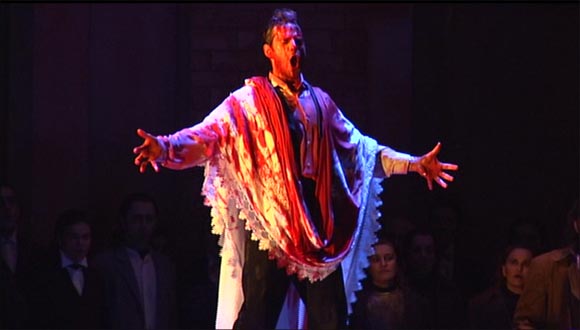
Really all this opera needs to work is a baritone with exemplary French who can sing with power and lyricism for three hours and really, really act. That, I guess, is why Keenleyside owns the role. He’s superb. He probably peaks in the really quite amazing second act where he does a sort of mad scene as the “play within a play” misfires but he’s superb throughout. The second requirement is someone who can do a compelling mad scene with lots of blood and coloratura. Natalie Dessay seems to have trouble cutting her wrists but is otherwise brilliant and is rewarded with what is probably the longest applause for a single aria ever committed to DVD.

The rest of the cast is mostly very good. Alain Vernhes’ Claudius is very strong, vocally and dramatically; certainly much better than James Morris at the Met. Béatrice Uria-Monzon is occasionally a bit squally as Gertrude but acts really well, especially in the confrontation with Hamlet in Act 3. I didn’t care much for Daniil Shtoda’s Laërte. he sounded too “Italian” and not at all idiomatic. Overall though really great singing backed up by a very crisp performance from the orchestra under Bertrand de Billy. They sounded more lyrical and less bombastic than in the Met version.

The production is not especially exciting. It’s very plain with just a few moving “faux marble” walls. Most of the scenic effects are left to the lighting plot which is effective though hard to film (see below). Costumes are a sort of generic late 19th century with breastplates thrown in in odd places for some reason. It all provides an effective enough backdrop for some carefully directed and well executed acting. There’s no high concept here but the story gets told.

The video direction by Toni Bergallo is pretty good. It’s a tough ask. Often the light levels are low with a really brutal lighting focus on a single character. The Act 2 scene between Hamlet and the ghost is a great example. It’s very hard to make something like that look good on video. The cameras start to lose definition with the low light levels and then the high local contrast sort of blurs out. I found myself watching from quite close up even on a sixty inch screen! The DTS 5.1 sound track is OK but not demonstration quality. There’s not a lot of spatial depth and sometimes the singers sound as if they have been miked too close. The Dolby surround and LPCM stereo mixes aren’t any better. It’s not bad overall technically but it’s not up with the latest from a label like Opus Arte. There are subtitles in English, French, German, Italian, Castilian and Catalan. The only extra is EMI’s standard teaser reel.

Overall, this is well worth seeing. It’s a pretty good little known work, Keenleyside is exceptional and the production for DVD is pretty decent.

Mozart’s Mitridate – ROH 1993

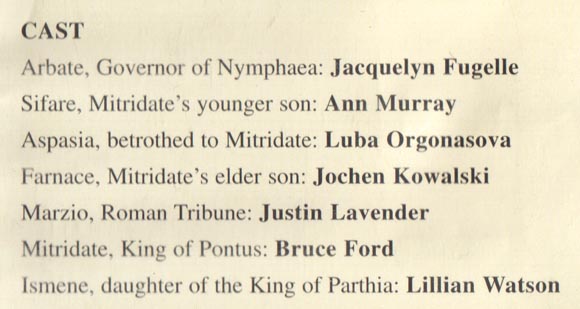
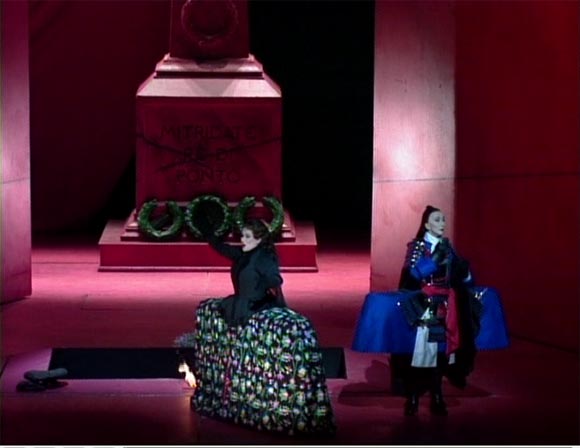
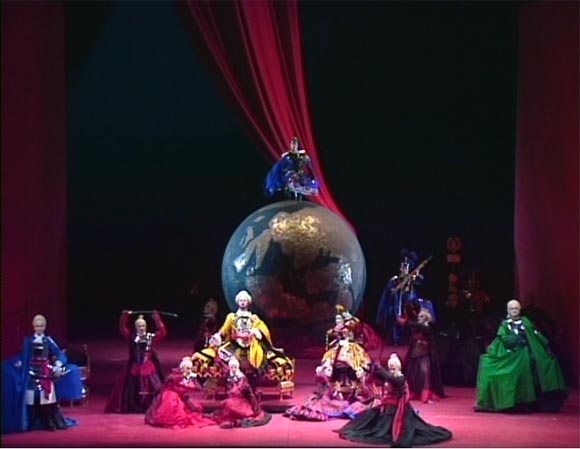
Mitridate, rè di Ponto is a three act opera seria by a fourteen year old kid called Mozart with a libretto based on Racine. Like most operas with a libretto based on Racine, and there are many, it isn’t exactly a barrel load of laughs. While it’s fair to say that the music may well be the best ever composed by a fourteen year old and it is recognisably Mozart it’s still not really quite enough to carry three hours of recitative and da capo arias about the troubled love life and familial relations of a first century BC King of Pontus and his fractious sons. In short, it gets a bit tedious. For a modern audience it’s not improved by the fact that all the male voices are high. Originally the score called for three castrati and two tenors. In the 1993 Royal Opera House production two of the three castrato roles were taken by mezzos and the third, inevitably the baddy, by a countertenor. For the record, here’s the full cast:

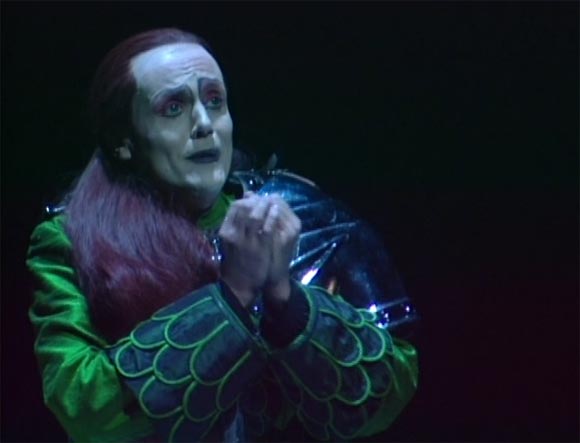
The director – Graham Vick, designer – Paul Brown and choreographer – Ron Howell do a pretty good job of injecting some life into the production with fairly extreme use of colour in the costume design, sets and makeup. The choreography and blocking is also quite striking at times but it still ends up being rather a wash of coloratura. The singers too do a worthy job but after a while it all starts to sound the same. Good work too from conductor, Paul Daniel, and the ROH orchestra but ultimately a bit blah.

Video director Derek Bailey does a pretty good job for the period. It’s hard to object to closing in on the singer during a da capo aria and he does pull out when there is stage wide action. He’s not helped by pretty average picture quality that lacks the definition needed to make long shots fully effective. Technically it’s a typical Kultur release of the period. The less than brilliant picture is coupled with so-so Dolby 2.0 sound, hard coded English sub-titles and minimum documentation. It’s also a bit quirky in that the overture comes on, with lead in credits, as soon as the disc is inserted. There’s no “set-up” menu.

One for the Mozart completist.

Joan Sutherland in Toronto

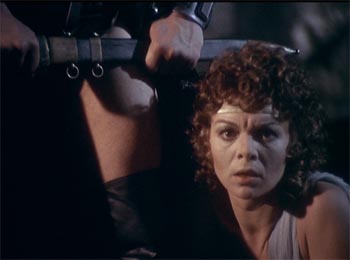
It’s a pet peeve of mine that, alone among state funded TV broadcasters in the industrialised world, CBC doesn’t broadcast opera on TV. There are many other reasons why the CBC is a national embarrassment but this one rankles. That said, there have been a couple of CBC broadcasts over the years and they did make it to DVD. These include a 1981 Canadian Opera Company performance of Bellini’s Norma with Joan Sutherland. It’s a great big pile of steaming whale dreck. The production, by Lotfi Mansouri, looks more like it was done in 1881. The Gauls have helmets with horns on. Sutherland seems to be dressed as the Statue of Liberty and the tenor playing Pollione (Francisco Ortiz) looks like Stephen Fry as the Roman centurion in Black Adder Back and Forth. Add to that it’s pretty much park and bark as far as blocking goes.

Sutherland is on poor form. She has no lower register to speak of and she gets about as much drama out of the music as a doorpost. Whether her powers were in serious decline at this point or she was just having an off night I can’t tell but it’s pretty sad. Ortiz is dreadful. He’s often below the note and seems to be using every trick in the tenor playbook to approximate his music. Bonynge’s conducting is deadly dull. The only part of the music making worthy of note is Tatiana Troyanos as Adalgisa. She’s very good indeed.

Technically the DVD is at least as bad as the performance. It’s recorded in mono (mono, in 1981!) and the sound is muddy and badly balanced. At some points the chorus is completely inaudible. Of course, some of this maybe the lousy O’Keefe Centre acoustics but I think it’s mostly just bad engineering. The picture is very poor quality too. There are hard coded English subtitles. This is one to avoid.

“Thanks” to Lydia at Definitely the Opera for drawing this to my attention!