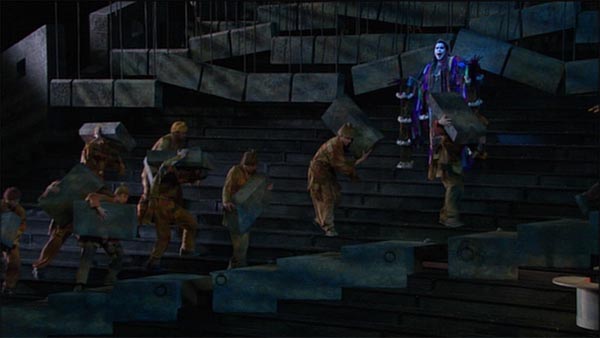
The Turn of the Screw – Perth 1991

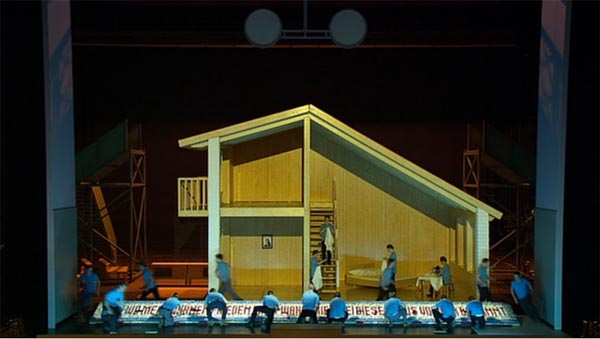
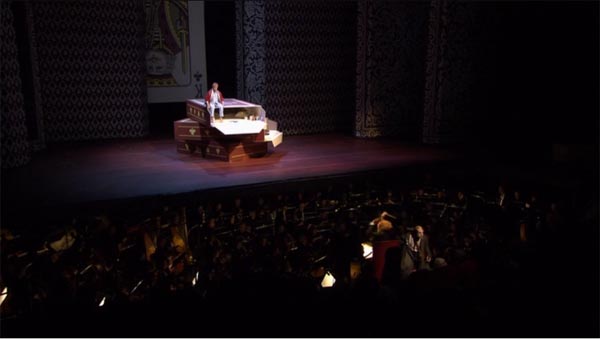
The DVD of Opera Australia’s production of Britten’s The Turn of the Screw is a train wreck. I’m not sure how much of the problem is due to the stage production and how much to the treatment for DVD but the end result is horrible. It’s almost impossible to comment on Neil Armfield’s production because one can’t tell when one is seeing it and when it’s being overlaid or perhaps even replaced by some conceit of the video director. The overall effect is completely incoherent. The barely TV quality picture doesn’t help things.

Musically it’s not good either. The singing is, at best, patchy. The children (Lanneke Jones as Flora and Patrick Littlemore as Miles) do fine and the ghostly pair; Anson Austin and Wendy Dixon, are adequate without being terribly otherworldly. The real problem lies with the Governess of Eilene Hannan and the Mrs. Grose of Margaret Haggart. Both are squally when loud and tending to drop into speech when quieter. Their duets are really hard on the ears. David Stanhope conducts the West Australian Symphony Orchestra. It’s not pretty. This score is hugely rhythmically inventive and the rhythm should drive the thing along. This reading is rhythmic mush. Again, nobody is helped by the recording. The quality of the Dolby 2.0 soundtrack is poor. It’s unfocussed and muddy adding to the overall lack of definition.

If you’ve got this far you probably won’t care that there are no subtitles and the only documentation is a chapter listing. There isn’t even a cast list.

Four decades of Peter Grimes

Having now had a chance to watch and review all seven currently available (as of June 2025 only the Oke and Graham-Hall performances seem to be available) video recordings of Peter Grimes I thought I might do a summary of the strengths and weaknesses of each. All of them have some merit and I doubt that there would be consensus on a “winner”. Anyway, here goes…

BBC film 1969
Grimes – Peter Pears
Conductor – Benjamin Britten
Director – Joan Cross & Brian Large

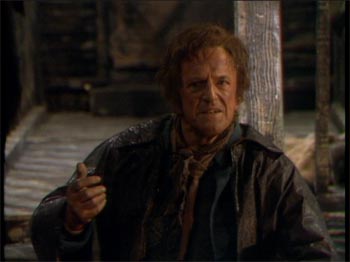
This is an essential historical document with both composer and the creator of the role involved. The production is straightforward and naturalistic. The sound and video quality is surprisingly good for the period. It does, though, leave one with the feeling that there is more to the role of Grimes than Pears finds.

Royal Opera House 1981
Grimes – Jon Vickers
Conductor – Colin Davis
Director – Elijah Moshinsky

Also a historical landmark being the first major production where Grimes wasn’t sung by Peter Pears. It has the excellent Heather Harper as Ellen Orford. The production is quite dull and very dimly lit. Vickers’ Grimes is controversial. In places he sounds fantastic and in others sorely taxed. His acting is oddly stilted. Norman Bailey fails to convince as Balstrode.  Sound and picture quality are OK.

English National Opera 1994
Grimes – Philip Langridge
Conductor – David Atherton
Director – Tim Albery

This is the production with most sense of the sea as a character brought out through innovative use of video projection. Langridge’s Grimes is intense, convincing and beautifully sung. Alan Opie is a very strong Balstrode. Unfortunately the orchestra and chorus aren’t up to rival versions and all aspects of the DVD; video direction, sound quality and picture quality are rather poor.  This recording was rebroadcast on June 1st 2025 by the BBC with dramatically better sound.  See my thoughts here.

Opernhaus Zürich 2005
Grimes – Christopher Ventris
Conductor – Franz Welser-Möst
Director – David Pountney

This is a very fine and thought provoking production with any number of magical moments. Ventris is a first class Grimes combining power and sensitivity and the supporting performances all have merit, save perhaps for Alfred Muff’s sub-par Balstrode. The orchestra and chorus are quite superb. The performance gets a thoroughly sympathetic treatment on DVD with good video directing backed up by quite excellent sound and picture quality.

Metropolitan Opera 2008
Grimes – Anthony Dean Griffey
Conductor – Donald Runnicles
Director – John Doyle

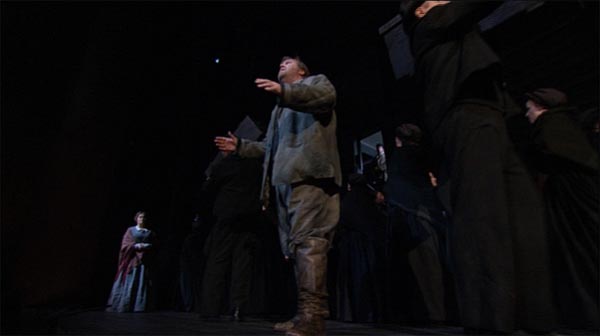
This is a rather dull and dark production given a very eccentric treatment by the video director. Dean Griffey is a lyrical and sympathetic Grimes well backed up by the supporting cast, especially Anthony Michaels-Moore as Balstrode and Teddy Tahu-Rhodes as Ned Keene. The orchestra and chorus are excellent and Runnicles is fairly convincing though the first act drags a bit. The sound and picture quality is excellent.

La Scala, 2012
2.theboarGrimes: John Graham-Hall
Conductor: Robin Ticciati
Director: Richard Jones

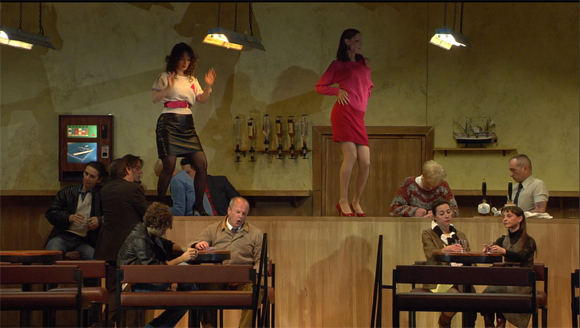
Richard Jones’ production, updated to the 1980s, is quirky. John Graham-Hall is quite lyrical as Grimes but slips into pseudo speech a lot. Susan Gritton fails to convince as Ellen Orford. The supporting cast, the orchestra and the conducting are first rate but the chorus is decidedly sub-par. The Blu-ray sound and picture outclasses all previous versions but, overall, this recording fails to convince.

Peter Grimes on Aldeburgh Beach, 2013
1.prologueGrimes: Allan Oke
Conductor: Steuart Bedford
Director: Tim Albery/Margaret Williams

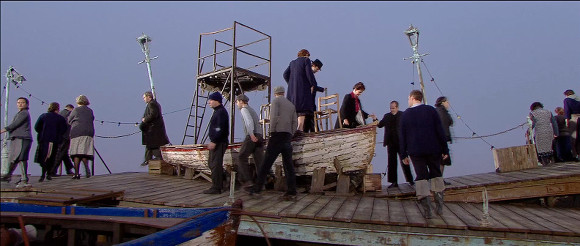
This film is a record of the unique production staged on Aldeburgh beach by Tim Albery and filmed by Margaret Williams. It’s highly atmospheric and features a brilliant performance by Alan Oke but conditions were not ideal for the singers and musically this cannot match the best available recordings from the theatre.

Grimes goes to Zürich

I guess it’s a sign that work has attained a certain maturity when it is performed outside it’s own “cultural zone”. Peter Grimes has surely reached that point. A quick look at Operabase suggests fifteen productions worldwide in 2010-12 with only two of those in English speaking countries. That said, four of the five video recordings in the catalogue were recorded in Britain or the United States. The fifth, from Opernhaus Zürich is the subject of this review.
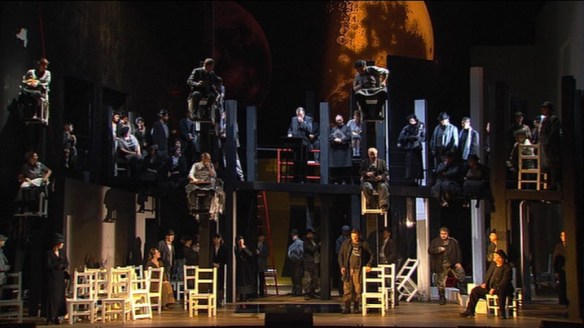
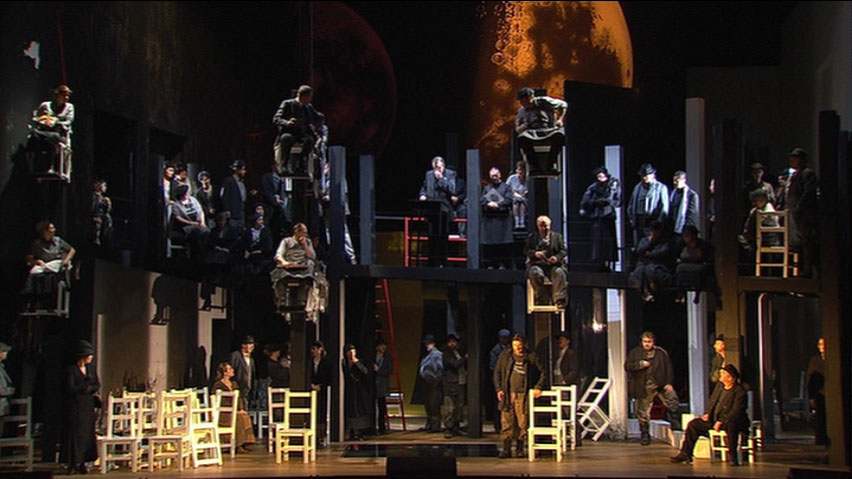
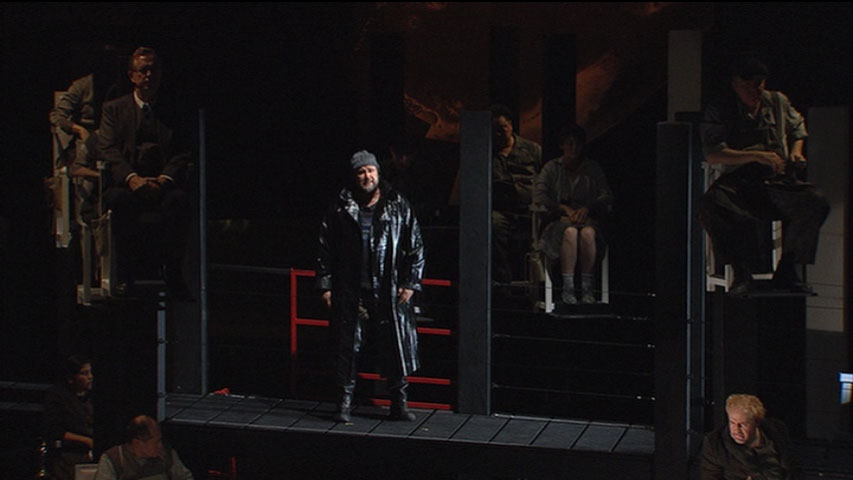
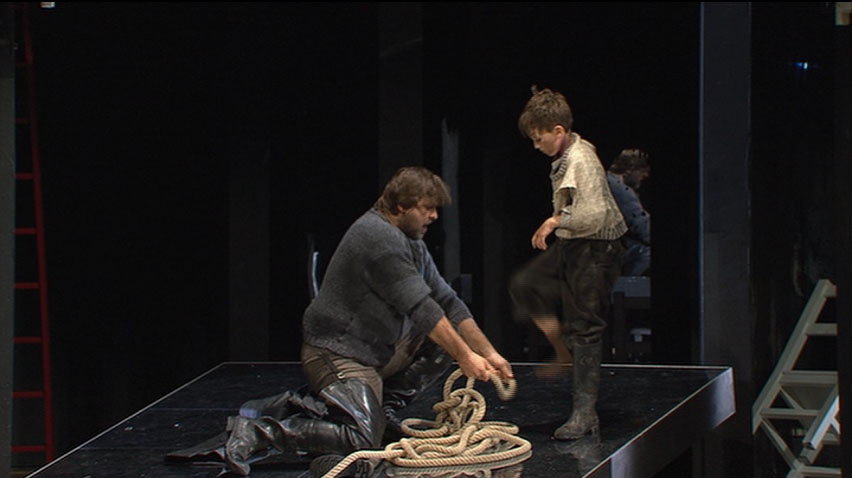
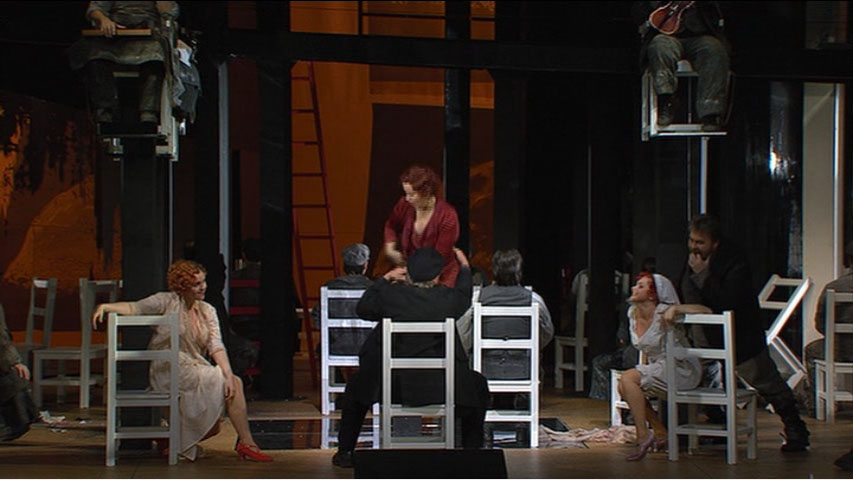
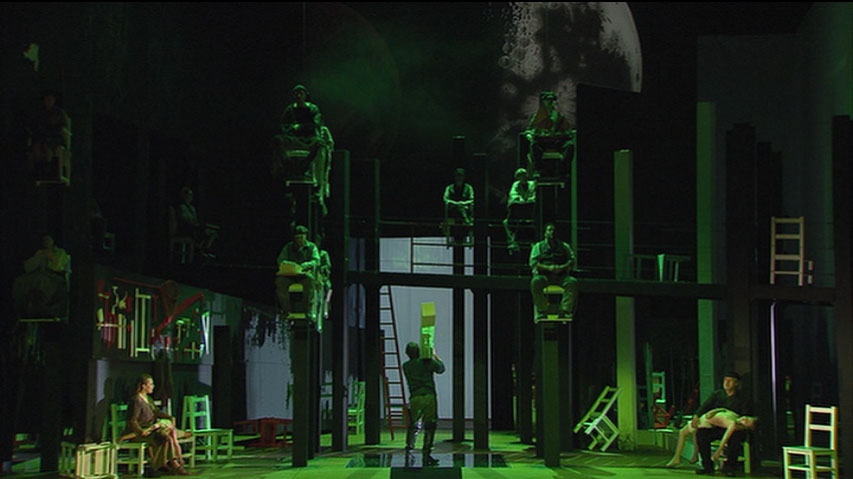
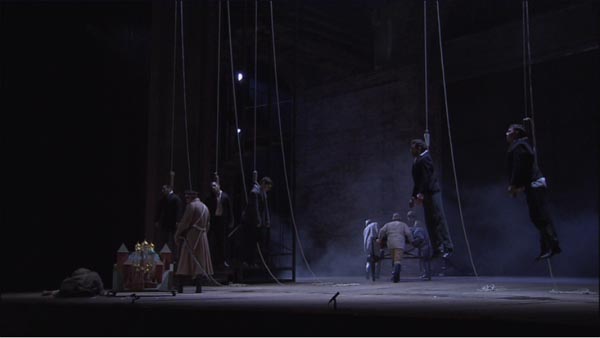
David Pountney’s 2005 production uses a single set, designed by Robert Israel, with gantries at different levels and members of the Borough suspended in chairs above the action. In some ways the concept is similar to the “wall” at the Met but it’s less compartmentalised and not as bleak to look at. It provides a flexible, abstract space which Pountney uses with minor detailing to great effect. Some aspects seem almost Brechtian. The pub scene could be straight out of Mahagonny while “Now is gossip put on trial” takes on quite a militaristic aspect. The set realises it’s potential to greatest impact in the closing scene. Grimes staggers on stage carrying the mast of his boat which he plants on a rocking platform at centre stage. On either side of the stage sit Ellen and Balstrode, each with a dead boy in their lap. As Peter departs to his death, he unships the cruciform mast, shoulders it and walks slowly upstage. It’s stark, beautifully composed and breathtakingly moving.
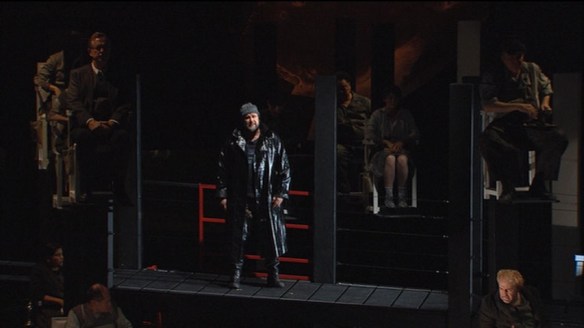
Pountney is also very careful in his direction of the interpersonal relationships though the Grimes/Balstrode chemistry doesn’t come off as well as in some productions. The Grimes/Ellen relationship is very well delineated. This Ellen is a tough cookie. She stands up to Grimes in the Sunday morning scene and while peter appears desperate and hopeful by turns throughout Act 2 there’s a real finality about Ellen’s “We’ve failed” and it’s followed by a very effective scene with Ellen, Auntie and the Nieces which strongly conveys both “sisters under the skin” and the sense that they, with Grimes, stand outside the tight knit community of the Borough. There are many other deft touches.
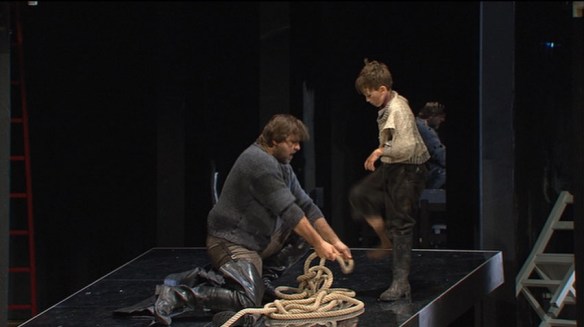
The performances are generally strong. Christopher Ventris’ Grimes is wonderful. He’s a full on Heldentenor who can sing a simply gorgeous pianissimo and he can act. It’s a more subtle performance than Vickers and less ethereal than Pears. He’s a Grimes who just doesn’t really get why the Borough hates him. Even when the lynch mob is heading for his hut at the end of Act 2 he’s more puzzled than angry. We never see him maltreat the boy and he doesn’t really hit Ellen either. He’s magnificent in the final scene. Arguably his is the best Grimes currently available on video.
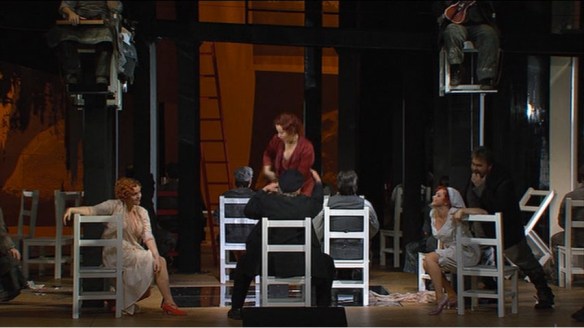
Emily Magee’s Ellen is interesting too. Hers is a more obviously dramatic voice than, say, Heather Harper and not as sweet toned. At times she is a bit squally though at others very lyrical. It fits the interpretation though. As noted above, her Ellen is a tough cookie. I didn’t really care for Alfred Muff’s Balstrode. It’s OK and generally better in the scenes that don’t involve Grimes. He doesn’t achieve the relationship with Grimes though that shines through with Geraint Evans (sadly not recorded) or Anthony Michaels-Moore. Cheyne Davidson makes Ned Keene a more serious and forceful character than his rivals and Richard Angas’ Swallow, is very well characterised indeed, drunk or sober. Liliana Nikiteanu’s Auntie and the Nieces of Liuba Chuchrova and Sandra Trattnigg make a distinctly Continental feeling trio and leave us in little doubt that they are, as the libretto insists, “the chief attractions of the Boar”. Cornelia Kallisch is superb as Mrs. Sedley, maybe even better than Felicity Palmer. She seems to be getting a really creepy sexual pleasure out of her “murder investigation”.
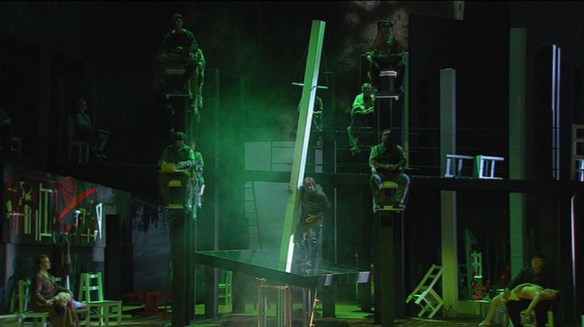
The chorus, orchestra and conductor (Franz Welser-Möst) get absolutely top marks. Welser-Möst directs a consistently incisive, even thrilling, reading of the score and his forces respond magnificently. The chorus is arguably even better than the Met’s and their English diction is almost impeccable.

Video direction is by Felix Breisach and it’s very good indeed. he’s reasonably judicious with his close ups and doesn’t muck about with silly angles. Generally i felt the camera was going pretty much where I would if I were watching in the theatre. In an attempt to do his camerawork justice the screencaps in this post are full sized. Click to get the large version.
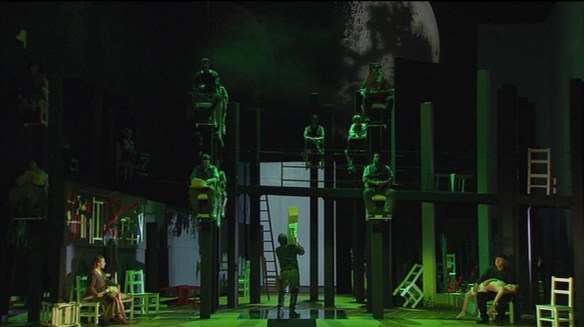
The 16:9 anamorphic picture is first class. The sound options are LPCM stereo, Dolby 5.1 and DTS 5.1. The last is clear, detailed and focussed with excellent dynamic range. It’s markedly better than the options. There are English, German, French, Spanish and Italian subtitles. Extras are restricted to some EMI promos which do include some interesting Maria Callas material. Documentation is limited to a short generic essay about the history of Peter Grimes. It’s a shame really. With two DVD9 discs to play with there’s definitely room for a conductor and/or director interview. A chapter listing would be nice too!

Quibbles about the packaging aside, this is a very fine DVD set. For those interested, David Pountney has a rather interesting blog.

The other Khovanshchina

There are only two video recordings of Mussorgsky’s Khovanshchina currently available. The 1989 Vienna recording, which I wrote about yesterday, and a 2007 production from Barcelona’s Gran Teatre del Liceu which I’ve also just had a chance to see.

The two productions make for interesting contrasts on many levels. In Barcelona, music director Michal Boder, while opting to use the Shostakovich orchestration as a basis modifies it in places with elements of the Rimsky-Korsakoff version. He also uses Voronhov’s lower key alternative to the Stravinsky in the final chorus and he makes some cuts; most notably the Susannah scene in Act 3. He also gets quite a different sound from the orchestra. Where Abbado in Vienna is very refined, one might almost say Viennese, Boder is brasher. In places the music almost sounds like Shostakovich with the characteristic braying brass. Admittedly some of this may be due to the quality of the recorded sound. The Vienna recording is rather soft focussed Dolby 2.0 while Barcelona gets very crisp and detailed DTS 5.1 (There’s LPCM stereo too but I didn’t check it out).

Continue reading

Battle of the basses

Mussorgsky’s Khovanshchina may be the most depressing opera ever written. It’s a catalogue of executions, murders, betrayals and mass executions that are no doubt designed to show the extreme purity of the Russian soul. I’m glad I’m not Russian. It’s also a rather beautiful score, though how much that’s due to Mussorgsky who didn’t complete and didn’t orchestrate it is, I suppose, anyone’s guess. In the version I watched; a 1989 performance from the Wiener Staatsoper, the ending is by Stravinsky and the orchestration by Shostakovich. Continue reading

The house that Elsa built

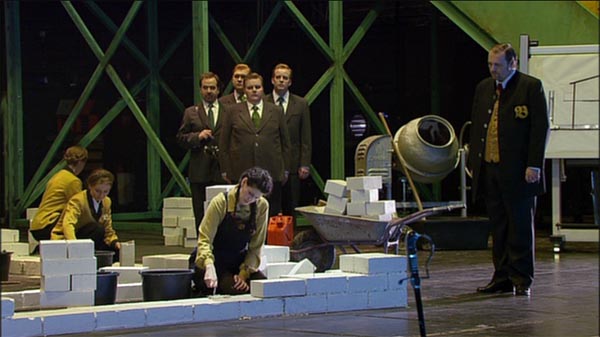
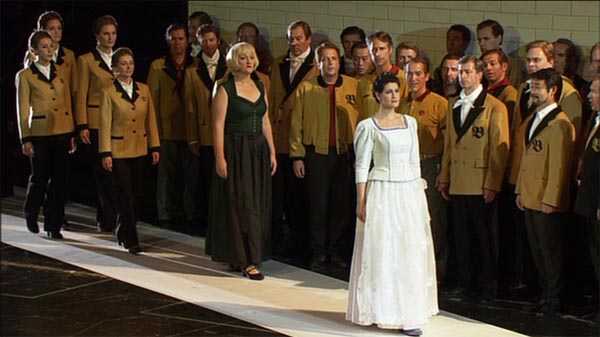
I guess Richard Jones’ 2009 Munich production of Lohengrin isn’t to everyone’s taste but I found it quite compelling. He’s set it in the 1930s and Elsa is building a house; a symbol for rebuilding the state and society of Brabant torn apart by the loss of her brother and general internal disorder. In the prologue we see her designing the house on a drawing board and then it gets built by stages culminating in a topping out ceremony as Elsa marries Lohengrin. At key points of the action the symbolism is manifest. Telramund kicks over half finished walls in the scene where he accuses Elsa and Lohengrin, having defeated Telramund in the duel, joins Elsa for a spot of bricklaying. After Elsa breaks her oath to Lohengrin he burns the house down so the final scene is played out on a more or less empty stage. There’s some really skilled stage handing going on to support all that! For contrast, and to facilitate the practicalities of the concept, some of the scenes are played out in front of a plain flat decorated solely with some coats of arms and a door. The alternation of very stark and very busy is intriguing. Inevitably there are times when the concept is stretching possible interpretations of the libretto right to the limit and the duel between Lohengrin and Telramund is a bit lame but mostly for me it worked.

Within the overall concept Jones has obviously given a lot of thought to the relationships between the characters. The Personenregie seems almost obsessively detailed and he seems to have taken his cast along with him because the acting is first class. Every look and gesture, especially from Wolfgang Koch as Telramund and Anja Harteros as Elsa, carry a depth of meaning. It’s very impressive.

The singing performances are very strong across the board. Again, for me, Koch and Harteros are the standouts. Harteros is really lovely to listen to even when she’s cranking out the decibels and Koch was never less than musical even in his angry outbursts where the temptation to shout or bark must be strong . Michaela Schuster as Ortrud and Jonas Kaufmann in the title role are pretty much as good. Schuster gets a bit strident but that’s not inappropriate to the role and Kaufmann has moments when he is just gorgeous to listen to. His hushed and unearthly “In fernem Land” was gripping. Christof Fischesser was a solid Heinrich and Evgeny Nikitin (a superb Dutchman in Toronto a few months later) made more of the Heerrufer than some might. All of this is very well supported by the orchestra under Kent Nagano.

The production for DVD is pretty good. Karina Fibich directs for video. She gives us a pretty good idea of the overall set and blocking and rations her closeups. It’s hard to argue with going to close up when there are just one or two singers in front of a flat. She gets a bit overambitious in the more crowded scenes and experiments with camera angles that are quite confusing. Sometimes the shot even seems to be behind the action. Overall though it’s a decent presentation and it’s backed up by a sharp 16:9 anamorphic picture and solid DTS 5.1 sound (LPCM stereo as an alternative). There are English, French, Spanish and Chinese subtitles. There are no extras but the trilingual booklet (English, French, German) includes a synopsis and a short essay about the production.

The ur Grimes

In 1969 the BBC’s new Director of Music and recording producer of genius, John Culshaw, contrived to align the heavens to permit the recording and broadcast for television of Britten’s Peter Grimes with Peter Pears in the title role and Britten conducting. What’s more it was recorded on a stage set (at The Maltings) with the orchestra in the same room as the singers who sang ‘live’. So, unusually for the time there was neither a double studio set up nor a studio audio recording that was lip synched to the stage performance. There’s a great little essay in the DVD booklet that explains how this all came to pass.

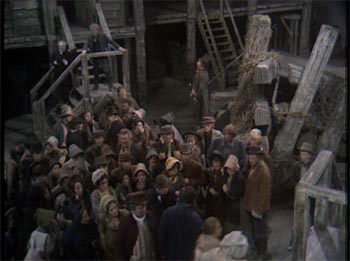
All that said, it’s a 1969 TV broadcast and I expected it to be of largely historic interest. I didn’t expect to get completely sucked in which is what happened. The design and production is very literal. The Boar is a pub. Grimes’ hut is a hut and so on. The people of the Borough are dressed in a range of working class clothes of sometime in the 19th century. They don’t look like a flock of crows on a telephone wire. Oddly, this makes their conformity all the more telling. The direction is a collaboration between Joan Cross who, we are told, directed the singers and Brian Large (who must have been about twelve at the time) who directed the cameras. As you would expect for a 1969 TV production there are lots of close ups which is fine as there was no “house view” here. The orchestral interludes are played out to either abstract patterns (which sometimes look a bit like those gel slides popular in discos of the period) and continuity shots. We don’t see the orchestra or, worse, a heavily perspiring conductor. It’s all straightforward but effective. There are some interesting interpretative nuances. For example in the storm scene in the pub I’ve never seen Grimes’ otherness so well brought out. Also, it’s absolutely starkly clear that Ellen and Balstrode have given up on Peter during Act 2 Scene 1 but he persists most compellingly in his hope until the ‘prentice falls at the end of the act. Pears’ reading of the part at this point is so hopeful that I had to go back and check that the bit where he accuses the boy of betraying him hadn’t been cut.

The performances are mostly strong. Pears’ Grimes is what it is. It’s beautifully sung and the lyrical passages like “Now the Great Bear and Pleiades” are gorgeous. It’s not totally convincing though. When he punches Ellen it comes out of nowhere. This dreamy, haunted Grimes just doesn’t have the violent side that the Borough and, ultimately Ellen, see. Heather Harper’s Ellen is gorgeous. She sounds younger and sweeter than in the later Vickers recording. Bryan Drake’s Balstrode is well sung but he’s more of the Borough and less the more broadly travelled and worldly wise character than others make of him. Both Gregory Dempsey as Bob Boles and Elizabeth Bainbridge as Auntie are more delineated than is often the case and Ann Robson gives a decidedly sinister Mrs. Sedley. Other supporting roles are perfectly adequate. Britten conducts the LSO and gives, especially, in the interludes, an even more taut and compelling reading than on the audio recording with the ROH Orchestra ten years earlier. This, for sure, is definitive.

Technically this disc is amazingly good. The 4:3 picture is a bit soft grained but amazing for 1969 TV. The sound is “enhanced Dolby mono” and while, obviously, it doesn’t produce any width or depth it’s clear and bright. (There’s also LPCM mono but its not nearly as good). There are English, French, German and Spanish subtitles.

All in all this is so much more than “just” a historical document. In every way it’s a performance worth watching.

L’Amour des Trois Oranges – Amsterdam 2005

Prokofiev’s The Love for Three Oranges is a really peculiar work. It’s like an adult fairy tale crossed with a Dario Fo farce. A hypochondriac prince can only be cured by laughter. Conventional attempts fail but he is highly amused by the evil sorceress Fata Morgana. She’s offended and curses him to seek out the three oranges which are guarded by a giant ladle wielding cook. She is overcome by a magic ribbon only for the prince and his sidekick Truffaldino to get stuck in the desert with the oranges, by now grown huge, but without water. Trouffaldino taps two of the oranges for a drink and out pop two princesses who promptly die of thirst. The third princess is rescued from the same fate by the intervention of the chorus and the Ten Eccentrics who have been commenting on the action throughout. While the prince is off getting help, the princess is turned into a giant rat and Fata Morgana’s sidekick substituted for her. But back at the palace the good magician turns the rat back into the princess, the baddies are unmasked and the goodies live happily ever after. And all this takes less than two hours. There are Russian and French versions of the libretto. This production uses the French.

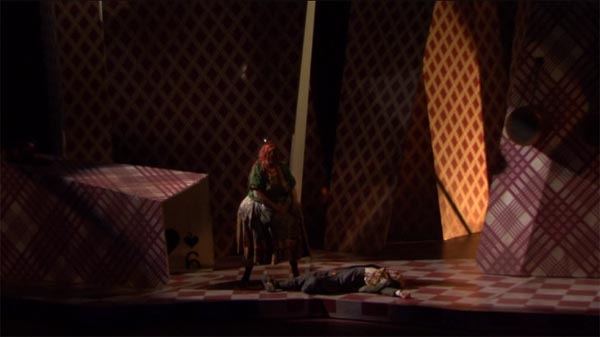
Laurent Pelly’s 2005 production for De Nederlandse Opera with sets by Chantal Thomas is a wonderful piece of direction supported by really slick stagecraft. The basic theme is of playing cards as we are in the realm of the King of Clubs. There are playing card moving flats creating the necessary farce like entries and exits, playing card dancers in the attempts to amuse the prince, a high level game of cards between the magician Tchelio and Fata Morgana. Giant card houses collapse to signify chaos at the end of act two and so on. It all moves at a breakneck pace with set changes on the fly and is very engaging.

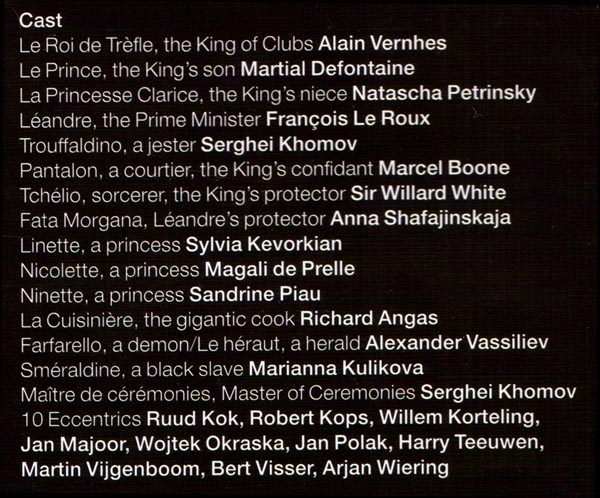
Pelly is backed up by a strong cast of singing actors. The vocal lines are mostly not very interesting but the acting demands on the principals are up there for an opera production. This cast pulls it off really well. The full cast is listed below and it’s a bit invidious to single out individual efforts as this is very much an ensemble performance. That said, I would single out for special praise the acting of Serghei Khomov as Trouffaldino and Anna Shafajinskaya as Fata Morgana. Singing honours go to the prince and princess; Martial Defontaine and Sandrine Piau, who get one of the few lyrical bits to sing in Act 3.

Most of the musical interest in this piece is in the orchestra. Here we have the Rotterdam Philharmonic with Stéphane Denève. It’s a brisk and lively idiomatic reading. At times the orchestra tends to overwhelm the singers but I think that’s the score rather than the conducting. I’m mildly amused that one theme, a march, recurs throughout the piece and it appears to be what John Williams borrowed for the March of the Imperial Stormtroopers!

Direction for TV and video is by Misjel Vermeiren and it’s very good indeed. There’s a lot going on on stage, on the approaches to the stage and even in the pit. Vermeiren doesn’t miss anything and gives us a very good idea of the stagecraft and what the audience in the theatre saw. First rate! There’s a cast gallery, a useful synopsis some interviews as bonus material. On DVD the sound options are DTS 5.1 and LPCM stereo. The surround track is clear with decent spatial awareness. The picture is 16:9 anamorphic and really pretty good helped by the fact that, although quite short, the work is spread over two discs. There are English, French, German, Spanish, Italian and Dutch subtitles. This performance is also available on Blu-ray disc and based on previous Opus Arte DVD/Blu-ray productions I’d go that way if I was buying.

All in all this is a very satisfying and entertaining package.

A feast for the eyes

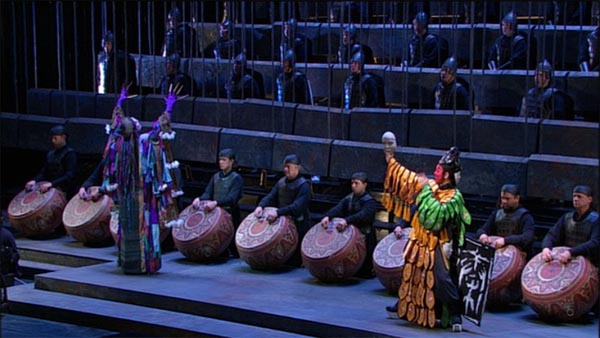
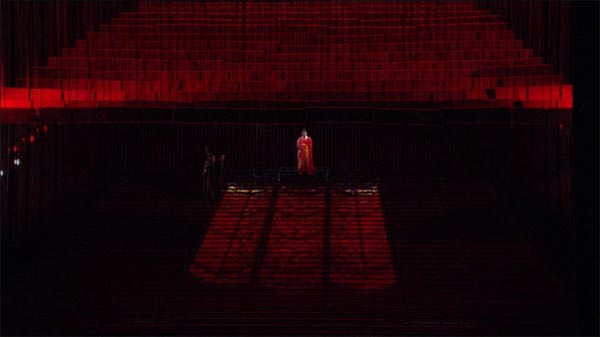
The design and production team that created the production of Tan Dun’s The First Emperor at the Metropolitan Opera in 2006, broadcast in HD in January 2007 and subsequently released on DVD, deserve the highest praise. Set designer Fan Yue, costume designer Emi Wada, lighting designer Duane Schuler, choreographer Dou Dou Huang and director Zhang Yimou (of Raise the Red Lantern fame) create some absolutely stunning images making full use of the great breadth and depth of the Met stage. Unfortunately the libretto and the music aren’t nearly as good and despite extremely committed performances from soloists, chorus and orchestra the work never quite gels.

So what is The First Emperor? It’s a two act opera based on the life of the emperor Qin unifier of China, builder of the Great Wall and ultimately buried with the famous terra cotta soldiers. In Tam Dun’s version of the story he, besides conquering China, is looking for the ultimate anthem to celebrate his life which will be produced by his childhood companion Gao Jianli. There’s a love triangle involving Gianli, the princess Yueyang and the general Wang. In true operatic style they all end up dead and Gianli’s revenge is that Qin’s anthem turns out to be the lament of the slaves building the Great Wall. It includes the line “When will our suffering end?” which was about what I was thinking by that point.

The problems, as so often with modern opera, start with the libretto. There is no poetry, literal or figurative, in it. It’s banal in the same way that most of the libretto of Doctor Atomic is banal. Mostly the vocal line is set in a dull declamatory style though the princess gets some passages with some coloratura interest and the chorus gets some Peking Opera like writing. What goes on behind, and almost independently, of the vocal line is all over the map. Sometimes it’s derived from the Peking Opera and sometimes from Chinese folk music; the mix at times sounding like the soundtrack for a Chinese propaganda film. At times it recalls the dissonances of modern European art music and at others it sounds like watered down Andrew Lloyd Webber. Write at the beginning the emperor asks “Is this music?”. I’m not sure he gets an answer. It’s got some good things going for it. There is some really good writing for percussion and the opening sequence using a Peking Opera trained singer, Wu Hsing-Kuo, as the master of ceremonies is weirdly affecting (this is the bit that got played over and over as the test track for subsequent Met HD broadcasts). All in all it doesn’t really cohere.

The performance is pretty good though. The stand outs are Wu Hsing-Kuo and Elizabeth Futral as the princess. Placido Domingo is, of course, solid as the emperor but really he doesn’t have much to work with. Good solid work too from Paul Groves as Jianli and Michelle deYoung as the shaman. The Orchestra and Chorus do wonderfully well coping with some highly unusual demands. For example, there is a passage where the orchestra downs instruments and engages in a sort of pitched shouting. There’s a whole core of Chinese percussionists too. The composer conducts with great fire.

Direction for video by Brian Large isn’t bad. It’s heavy on the close ups but there are enough setting shots to give us context. The picture is very good by DVD standards as one might expect but one really wonders(1) why this didn’t get a Blu-ray release for if any of the Met HD productions would have benefited from the extra video quality it’s this one. Sound is solid DTS 5.1 with LPCM stereo as an alternative. There are English, French, Italian, German and Spanish sub-titles. The documentation (English only) includes an essay on Tan Dun’s musical style and a synopsis. There is further English, French and German documentation included in PDF format. There is also a 20 minute rehearsal bonus track and a short interview with Domingo.

fn1. One doesn’t really wonder. For whatever reason it’s an EMI release and they don’t do Blu-ray.

Baldrick, you’ld laugh at a Shakespeare comedy

Peter Hall’s 1981 Glyndebourne production of Britten’s A Midsummer Night’s Dream was quite celebrated in its day. How does it wear, thirty years later? The bottom line is it looks and sounds a bit tired.

The production was innovative in its day. The scenery in the forest is inhabited by supers who make it, in a sense, “enchanted” and the lighting is interesting (at least so far as one can tell on the DVD). The problem is it never manages to generate any sense of menace from the world of the Fairies without which, to me at least, Dream (Britten’s version or Shakespeare’s) is insipid. Part of this lies in the old fashioned counter tenor sound of James Bowman and part in the very childlike fairies. As a result the first act starts very slowly and the Hermia (Cynthia Buchan) and Lysander (Ryland Davies) scene fails to spark. The “I swear to thee” duet is really slow and a bit lack lustre. Things do liven up a bit with the entry of Demetrius (Dale Duesing) and Helena (Felicity Lott). All in all Act One is a bit of a snooze.

Act Two is better and the cat fight between Hermia and Helena is funny but there is still little element of menace. Oberon can’t even make “This is thy negligence” threatening and even the scenes with Bottom having an ass’ head don’t really have any bite. The Act Three lovers’ quartet is lively but Act Three really turns on whether the Rude Mechanicals are actually funny. That takes close to a miracle from both director and singers and a miracle just doesn’t happen here. Both Bottom (Curt Applegren) and Flute (Patrick Power) have their moments but it never gels. Throughout it’s fairly static with only Damien Nash’s “cheeky chappy” Puck creating much movement. So, lack of both menace and humour rather undermines some interesting design elements.

Musically this is pretty mixed too. Especially in the first act the orchestral playing seems oddly unfocussed. It’s partly a matter of tempi. Bernard Haitink is eight minutes slower overall compared to the composer’s studio recording for Decca. He also fails to get the rhythmic attack and dynamic range out of the LPO that Britten gets from the LSO. (Part of the problem here may be the soft recorded sound versus John Culshaw’s excellent Decca recording). The overall effect is a bit insipid. The singing is OK but really only Duesing and Lott stand out vocally. Ileana Cotrubas as Tytania is oddly anonymous.

Dave Heather directed for TV and video and it’s a typical early 1980s directed for TV effort. I don’t think the whole stage (and this is the old, small Glyndebourne stage) is visible even once. The picture is 1981 quality too. It’s soft by DVD standards. There is flickering on the subtitles. Don’t watch from too close on a modern TV. The Dolby 2.0 sound is barely average. There’s no real depth and at times the orchestra seems to be muffled. It’s not remotely as good as the sound on the 1966 studio recording. There are English, French and Spanish subtitles, no extras and minimal documentation.

I haven’t seen the only other Dream currently available but it’s a recent Robert Carsen production from Barcelona with Harry Bicket in the pit and David Daniels as Oberon plus video direction is by the excellent Francois Roussillon. I’d certainly advise taking a look at that before buying this one.