A blast from the past

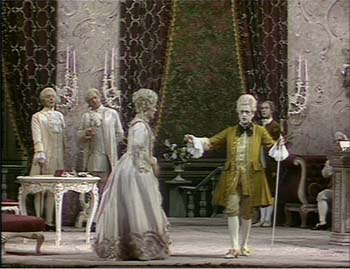
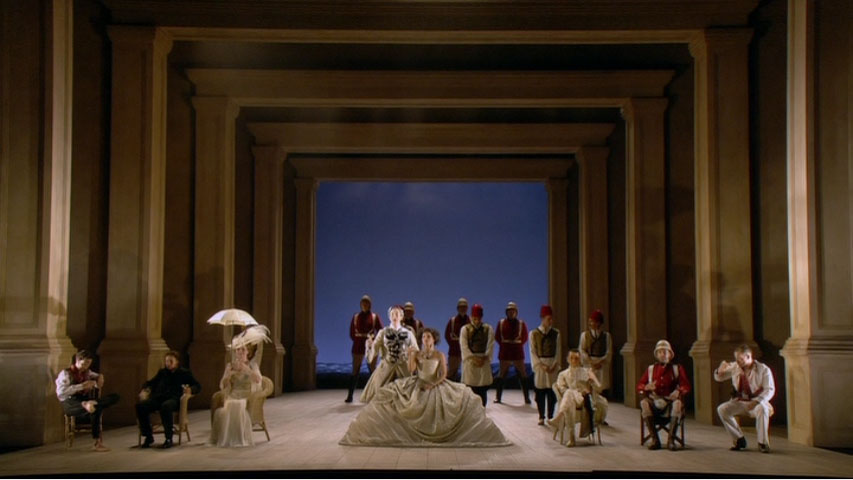
The 1983 Royal Opera house production of Puccini’s Manon Lescaut is probably a pretty good representation of what that annoying person at your local opera company’s season launch means when they ask why they can’t have productions the way they used to be.  Except it’s a rather exceptionally good example of what s/he means. Continue reading

Happy ever after?

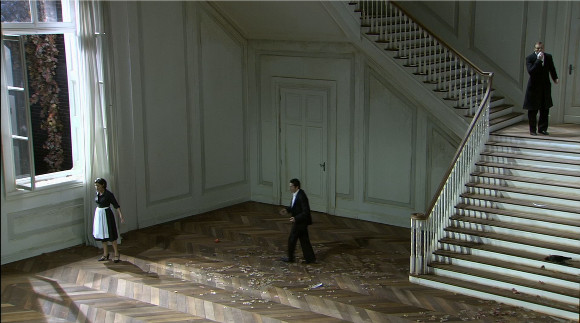
I’ve watched the Blu-ray version of the 2006 Salzburg production of Le Nozze di Figaro a few times now but sitting through it with notepad at the ready made me realise how much I hadn’t seen on the previous viewings.  My notes are copious.  I usually take a couple of pages or so.  This time I covered four pages and it could easily have been more.  You have been warned.

1.stairs Continue reading

Orgasm and murder

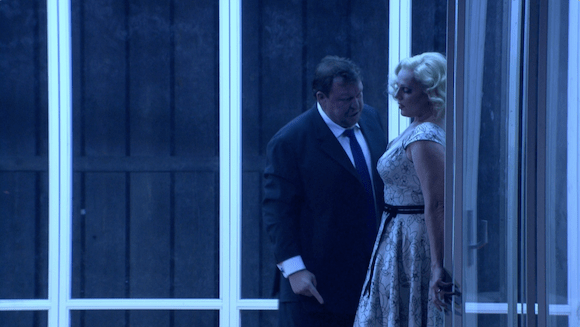
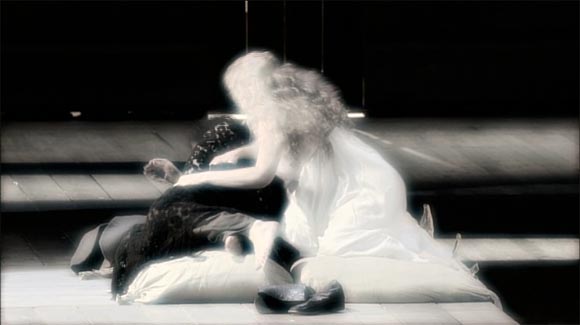
Martin Kušej’s 2006 production of Shostakovich’s Lady Macbeth of the Mtsensk District for De Nederlandse Opera is occasionally puzzling but mostly brilliant.  The performance, with a strong cast centering on Eva-Maria Westbroek’s Katerina, inspired conducting from Mariss Jansons and consistent excellence from the Royal Concertgebouw Orchestra in the pit and the Chorus of De Nederlandse Opera on stage is unbeatable.  Combine that with decent video direction and superb audio-visual quality and the Opus Arte Blu-ray package becomes very attractive indeed.

1.boriskaterina

Continue reading

Pelléas et Mélisande in the Valleys

The Gramophone Classical Music Guide 2010 describes the DVD of the 1992 Welsh National Opera performance of Debussy’s Pelléas et Mélisande thusly:

This is, in every respect, a model of what a DVD ought to be, a perfect realisation in picture and sound of Debussy’s sole and inspired opera.

Followed by a good deal more in the same vein.  This, regrettably, tells us more about the Gramophone Guide than about this DVD(1).  Actually it’s not bad at all by 1992 standards but “a perfect realisation” it isn’t.
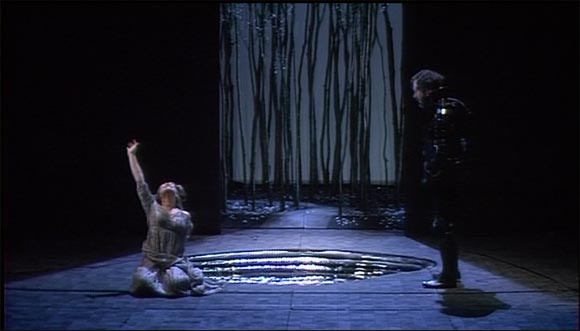
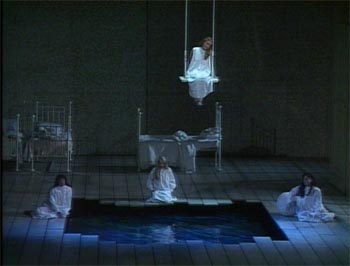
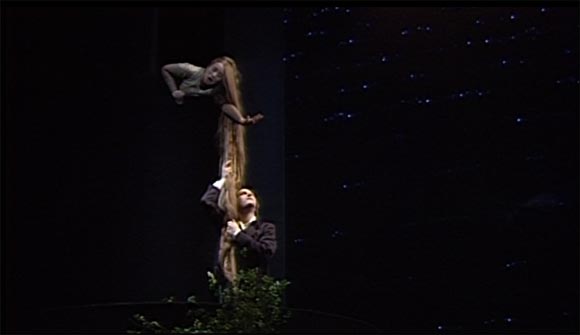
Peter Stein’s production is semi-abstract and monotone.  The tone is “dark”.  There’s some interesting lighting but visually it’s pretty nondescript.  The director’s focus is clearly on the actors and their interactions and in a work like Pelléas et Mélisande that makes sense.  There is some very good acting, especially from Alison Hagley as Mélisande.  The tower scene is brought off rather well with perhaps the most extravagant hair extension in the history of opera.  This also features in a disturbingly violent Act 4 Scene 2.  Act 4 also sees a brief appearance by a live sheep, no doubt in deference to local sensibilities.  I’m not entirely convinced that Stein gets enough complexity from his cast to really raise the psychology beyond the cardboard cut out level.  Donald Maxwell’s rather crude and coarse Golaud doesn’t really make a case for his descent into jealousy, madness and murderous rage based on not much at all really.  He’s not helped by the rather colourless Pelléas of Neill Archer.  On the other hand Alson Hagley conveys the fragility and mystery of her character exceptionally well.  (I also wondered whether a visual reference to Gerald of Wales’ Melusine was being made in the tower scene but maybe that’s over-theorising).  She’s very much in the same frantic and febrile mould here as Natalie Dessay on the Theater an der Wien recording.  Kenneth Cox gives a strongly characterised Arkel with particularly good chemistry with Hagley.  Stein uses a boy treble, Samuel Burkey, in the role of Yniold.  It works dramatically but I don’t much care for it musically.
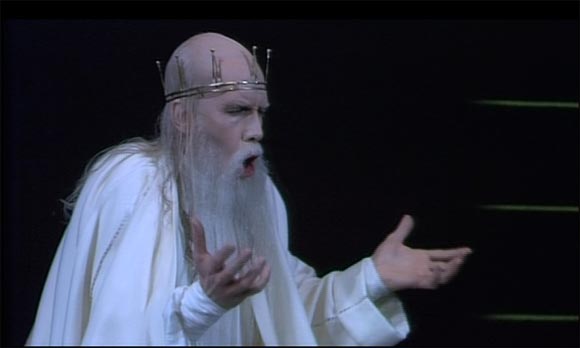
In general the singing is very good.  All the principals have adequate French at least, though they can’t quite match Vienna’s line up of Francophone star talent.  Pierre Boulez conducts.  He gets a very detailed, transparent reading from the WNO orchestra while occasionally pushing out a genuinely Wagnerian dramatic climax.  No complaints here.
Stein also directed for TV/DVD.  It’s pretty conventional 1992 TV direction.  There are lots of close ups but generally there’s no sense that one is missing anything.  Although recorded live, there is no applause and no sign of an audience.  During the orchestral interludes we get film of the orchestral score which is an interesting treatment but tends even more to make this like a film rather than a theatre performance.
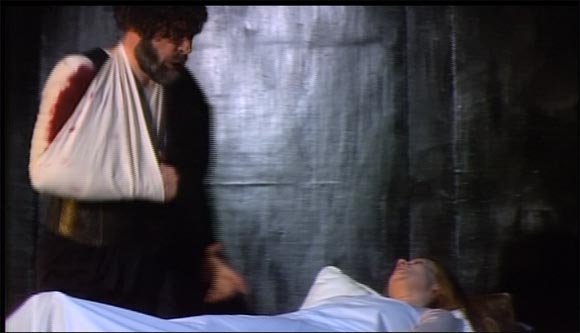
The picture is average DVD 16:9 and the sound options are PCM stereo, Dolby 5.1 and DTS 5.1.  The surround tracks were created from an original stereo source using DG’s AMSI II technology.  The DTS track is very decent but not quite up to best modern standards.  Extras include a trailer, a picture gallery and some DG promo material.  Subtitles are French, English, German, Spanish and Chinese.  There’s a trilingual booklet with track listings, synopsis and a short, not very useful essay.

This is a good (though far from perfect!) effort.  It’s definitely worth a look though I personally prefer the more recent Vienna recording.

fn1. I’ve long been skeptical about reviewers who claim that the best recording of a well known work is one made by Fritz Busch in his garden shed in 1935.

 

Rusalka in the nursery

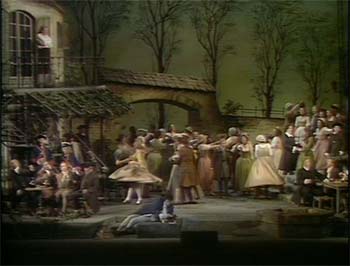
David Pountney’s 1986 ENO production of Dvorak’s Rusalka is set in an Edwardian nursery. The action is all a dream or a figment of Rusalka’s imagination in which her grandfather, in a wheelchair, becomes the Water Gnome, her sisters water sprites, her governess the witch Jezibaba and so on. In Act 1 it works reasonably well. Clearly we are looking at a metaphor of Rusalka escaping the nursery for adult life with all the risks and discoveries that involves. It starts to get pretty strained in Act 2. There’s some not very subtle loss of virginity imagery but that’s about it. By Act 3 Pountney seems to have run out of ideas and the final denouement is played out pretty straightforwardly. Certainly there’s nothing in the ending to bring closure to the concept which seems like a cop out.

The performances, in English this being ENO, are mostly OK but not stellar. Elaine Hannan has a clear bright voice which suits the idea of Rusalka as a young girl but she doesn’t have the range of colour or dynamic range of, say, Renee Fleming. John Treleaven is rather good, if a bit stiff, as the Prince. You can definitely hear heldentenorish qualities in the voice. It’s a shame that, with his ‘tache and sideburns, he looks like a 1970s lounge lizard. Ann Howard is vocally competent as the governess/witch/Jezibaba but while she’s be fairly scary in a schoolroom she isn’t really the stuff of nightmares the part needs. Rodney Macann is a straightforwardly effective grandfather/Water Gnome but he doesn’t really dominate. The other parts are all quite well sung tough far from thrilling.Mark Elder conducts a rather routine sounding reading from the ENO Orchestra and Chorus. To be fair, part of the problem may be the sound, see below.

The video direction by Derek Bailey needs to be taken on its own terms for a record of what’s happening on stage it isn’t. There are lots of superpositions and some weird camera angles. It does reinforce the “dream” aspects of the production so I think it can be considered a valid approach.


Technically this is not a great disk. The 4:3 picture is 1986 TV to DVD quality. I suppose that, in a way, reinforces the dream quality too. The sound is very average Dolby 2.0. At times it’s worse than that. At the end of Act 1 it sounds like Treleaven is singing from the bottom of a well and nowhere does it do the orchestra any favours. There are no subtitles and the less than vivid sound makes it even harder than it otherwise might be to figure out the words. Documentation is limited to a track listing.

Given that Robert Carsen’s fascinating Paris production; strongly cast and well recorded, is also available on DVD it’s a bit hard to see why anyone would bother with this one.

Dialogues of the Arkelites

Debussy’s Pelléas et Mélisande is not an opera I’m especially familiar with. It’s a strange piece based on a libretto by Maeterlinck. For much of the time it’s wordy without much action. There is a lot of philosophising. When the action does break out; Golaud’s mad jealousy in Act 3, the killing in Act 4, it gets musically and dramatically quite violent. The music is tonal and mostly quite dreamy. It’s almost mood music. All of this reminds me quite strongly of Poulenc’s Dialogues des Carmélites hence the title of this post. Also it’s French. Actually it’s very French.

Laurent Pelly’s 2009 production for Theater an der Wien is also very French; French director, French conductor, almost entirely French cast. In an opera where the words and the relationship between the music and the words matter a lot that’s a distinct advantage. The sets are semi-abstract and placed on a rotating turntable so that scenes can follow on with a minimum of interruption. The forest, the tower, the cave are all suggested rather than made entirely explicit. Even Mélisande’s extra long hair is not depicted explicitly. This fits the indirect nature of both the libretto and the music rather well. The costumes suggest somewhere around 1900 and the colour palette doesn’t stray far from “forest floor”. Lighting is quite dark but evocative. The sense of a gloomy castle in a gloomy (Breton?) forest is quite strong.

With the exception of a few outbursts from Mélisande’s husband, Golaud, and one fairly lyrical love scene between Mélisande and Pélleas the singers have few opportunities for vocal pyrotechnics. They do need to sing stylishly and articulate well though and this cast excels in that department. Natalie Dessay as Mélisande does the fragile Natalie thing which works really well in this role. Perhaps she could create more mystery around her character but her interpretation seems quite valid. Stephane Degout as Pélleas is a good physical actor and is lyrical where he needs to be. I’m not sure that there is much depth to be got out of the character anyway. Perhaps the most interesting role is the insanely jealous Golaud, sung here by the admirable Laurent Naouri. He has a fairly major emotional arc to go through and is strong in the scene of crazy jealousy where he gets his young son, Yniold (well sung and acted by Beate Ritter), to spy on the lovers. It’s a fine all around performance. The part of the old king, Arkel, is sung by Philip Ens. He conveys wisdom, sympathy and a kind of philosophical detachment in an extremely dignified but weary way. It’s a fine job of portraying a very old man without the voice sounding past it. Good supporting performances too from Marie-Nicole Lemieux as Geneviève and Tim Mirfin as the doctor.

Bertrand de Billy is in the pit with the ORF Radio-Symphonieorchester Wien. He seems to be thoroughly at home with the score and gets some lovely, transparent, sound out of the orchestra. The chorus, the Arnold Schoenberg Chor, does what little it has to do perfectly adequately.

The video direction, by Landsmann and Landsmann, is pretty sympathetic. A lot of the time not much is happening and they close in on the singer(s) which is fair enough. When there is a stage to be shown they show it. It’s nowhere annoyingly gimmicky. The picture is top DVD quality 16:9 and the DTS 5.0 sound is mellow rather than punchy which seems appropriate. AV quality is pretty much as good as it gets without going to Blu-ray. There are English, French, German, Spanish and Italian subtitles. Despite being split over two disks there are no extras. The documentation too is limited to credits (there’s not even a track listing). It;s quite a major omission for a work like this. An interview or an article about the director’s reading of the piece and his approach would be very useful.

There’s some stiff competition for this release, notably from Zurich and WNO, so I’ll certainly be trying to get my hands on some alternative versions in an attempt to deepen my understanding of the work as much as anything.

And then there were nun

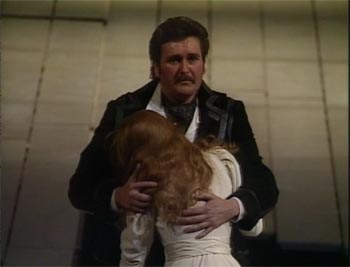
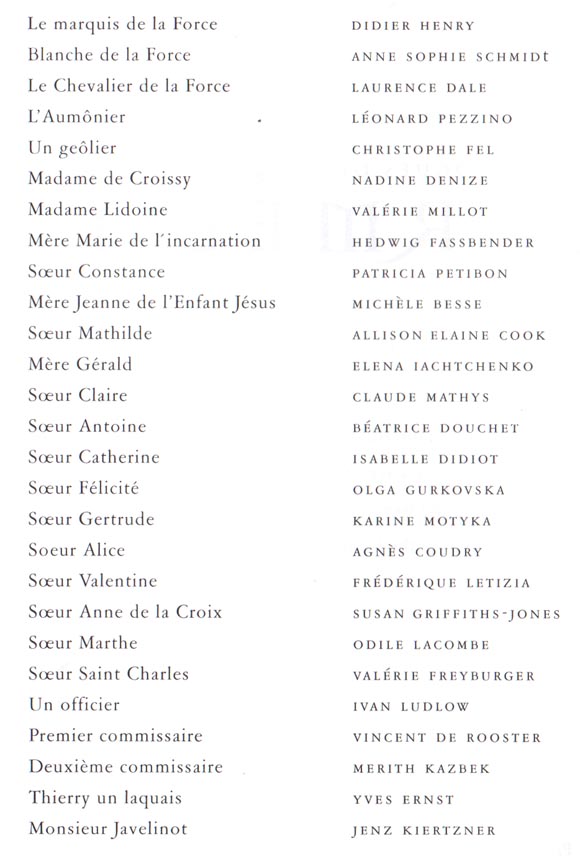
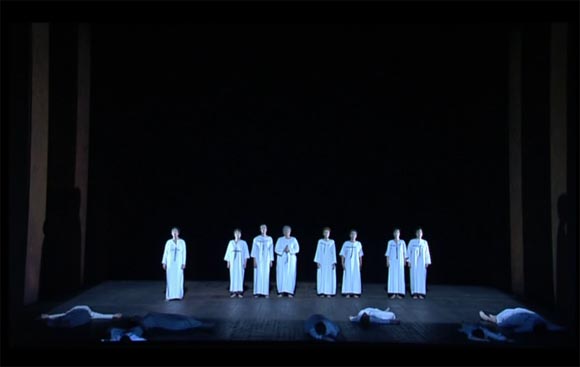
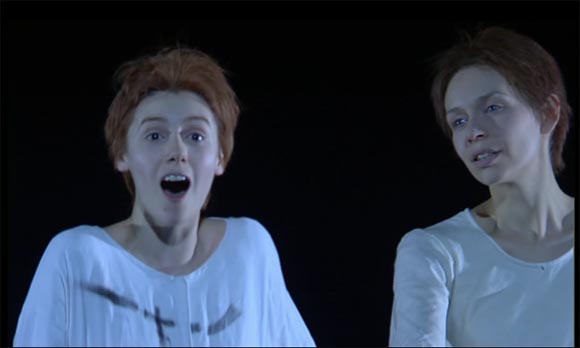
Nest season the Canadian Opera Company is presenting a production of Poulenc’s Dialogues des Carmélites. It’s not a work I’ve had any exposure to and it sounded enough like Catholic snuff porn for me not to have bothered before. However, in the interests of furthering my education I got my paws on the library copy of DVD of a 1999 production from Opéra National du Rhin. I actually ended up quite liking the piece though the libretto might well have been written by Gide in one of his darker moments. The score is so tonal that it could almost have been written a hundred years earlier but it’s pleasant enough in a movie soundtrack sort of way. The production in question, by Marthe Keller, is very restrained. Much of the time it’s quite dark with very little happening. The drama is all in the words and expressions of the singers which must have made it quite hard to appreciate from the cheap seats. It’s also very traditional and period in costume and set design while remaining essentially simple. Given that most of the “action” is a series of dialogues that could have been lifted from a theology text this isn’t a bad set of choices. The final scene is almost impossible to stage literally as it involves the mass guillotining of the nuns. Here it’s handled effectively enough by having the nuns step forward in turn and collapse on stage to the successive sounds of the guillotine falling. The final reconnection of Blanche and Constance is really quite affecting. The cast is huge (full list below) There are a few key roles that have to convince for the piece to work. Foremost among these is Blanche de la Force aka Soeur Blanche de l’Agonie du Christ, here played by Anne Sophie Schmidt. She’s a character of deep religious devotion but also getting on for batshit insane. It’s not an easy role to play. Schmidt is really convincing in what could be a bit of a cardboard cutout role if not handled carefully. She also sings very well though occasionally sounds a bit strained in the upper register. The other young nun is Soeur Constance, a very optimistic young lady, played utterly charmingly by Patricia Petitbon. There are also lots of older nuns. I had to keep looking up who was who because it’s a bit like trying to pick out a suspect in a penguin identity parade. The important one’s are the old prioress (Nadine Denize), who dies in the first act, Blanche’s mentor, Mère Marie (Hedwig Fassbender), and the replacement prioress, also Mère Marie (Valérie Millot). All three ladies play their parts convincingly and sing appropriately for the character. Among the men, the stand out for me was the Aumônier of Léonard Pezzino who has a lovely voice. Really though, Blanche aside, this is an ensemble piece with no real opportunities for vocal fireworks. Here the ensemble worked well and was well supported by Orchestre Philharmonique de Strasbourg under Jan Latham-Koenig. I’m not sure how I feel about Don Kent’s video direction. He starts off with artsy stuff in the title sequence and it’s not entirely clear where the credits end and the piece begins. There is something to be said for showing the conductor going to the pit and starting the show. He stays very close in on the singers most of the time which normally drives me nuts but here seems unavoidable and, to be fair, when there is a stage tableau to be seen we see it. There are also grainy black and white images used during some of the orchestral interludes. It’s not entirely clear whether they are projections in the house or inserts in the video. I think the latter but I can’t be sure. It’s perhaps best to enjoy this as a video and not worry too much about how well it reflects what is going on on stage. Technically this isn’t a bad DVD. The 16:9 picture is quite decent and the LPCM Stereo sound is OK though not in the class of the best recent releases. The only subtitle options are English and Chinese. There is a trilingual (English, French, German) booklet with track listing, synopsis and a brief historical essay. The only real competition for this work on DVD is a much starrier La Scala cast in the Robert Carsen production that will be seen in Toronto so this Strasbourg version is probably worth a look for anyone with a serious interest in the work. There’s also an old (1984) Opera Australia version sung in English still in the catalogue.

I came, I saw, I picnicked

The DVD of the 2005 Glyndebourne Festival production of Handel’s Giulio Cesare in Egitto is one of the most satisfying that I have ever got my hands on. David McVicar’s production is a delight. The cast is consistently excellent with stand out performances from Sarah Connolly as Caesar and Danni de Niese as Cleopatra. William Christie gets wonderful playing from the Orchestra of the Age of Enlightenment. The production for DVD/Blu-ray is exceptional in every way. There’s even over an hour of worthwhile extras giving a total of over five hours of material.

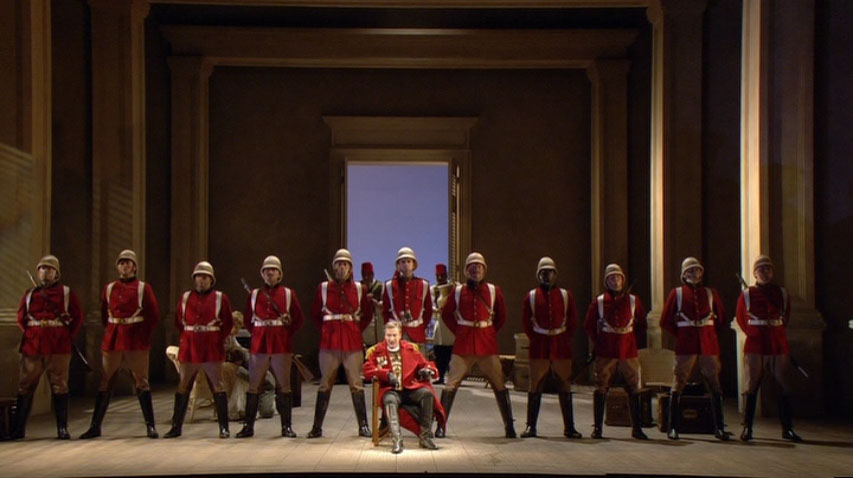
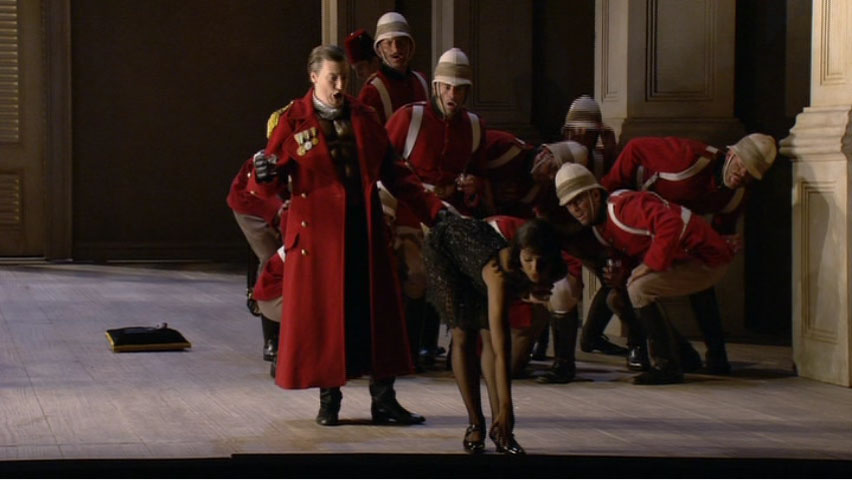
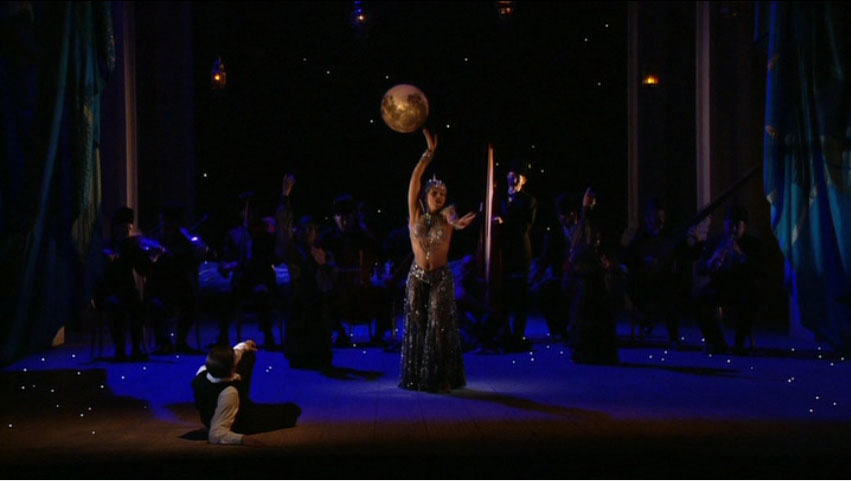
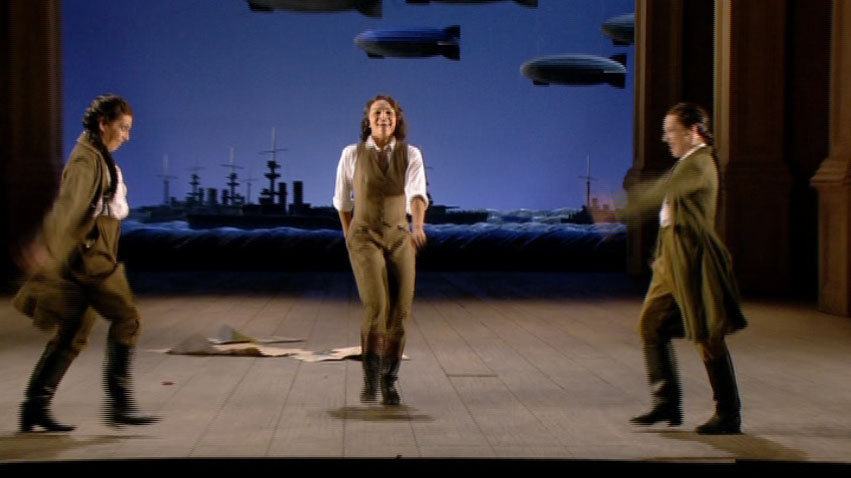
Let’s start with the production. McVicar and his design team have placed the action firmly in Egypt but moved the time period to the late 19th century with the Romans being portrayed in the manner of the British who effectively ruled Egypt at the time. There are a number of elements taken from Bollywood musicals which seems to have led some reviewers to dismiss it as not being “serious” enough to be a proper Handel production. I think this is misguided. The Bollywood elements are well integrated dramatically and musically and serve a dramatic purpose. They point up the cultural rift between the Romans and the Egyptians without getting into a crude and heavy critique of colonialism. There are a few places where Andrew George’s choreography is a bit over the top but mostly it works and, if nothing else, it’s tremendous fun. McVicar has obviously worked really hard on the and all the main characters and their interactions are clearly defined. The gulf between Romans and Egyptians emerges through these relationships though perhaps the rather overwrought Sesto of Angelika Kirchschlager somewhat undermines the chilly memsahib Cornelia of Patricia Bardon. Throughout there are neat little touches like Cleopatra ditching her cigarette in the urn containing Pompey’s ashes or the Roman/British warships sailing into Alexandria harbour with airship cover during Da tempeste il legno infranto. At the very end, Achilla and Tolomeo, blood soaked, (both are dead at this point) reappear and flank the line of seated dignitaries sipping champagne. It’s weird but works. Notably the production team got one of the biggest ovations of the night when they appeared for a curtain call.

The individual performances range from very good indeed to spectacular. Musically the star is Sarah Connolly. She’s utterly brilliant with completely secure coloratura and ornaments that are far more than just decorative.  Right from Empio, dirò, tu sei where she manages to spit out her disgust while maintaining 100% musicality, to the very end she’s note perfect. Her acting is also really good. She covers a wide range of emotions and her physical acting is genuinely masculine. She really does not look or move like a woman in drag. Then there’s Danielle de Niese! Musically there may be subtler or more refined exponents of the art of Handelian singing but I doubt whether there are any who could handle the role Danni is handed here. (Jane Archibald maybe, just maybe). She sings very well in fact. Some of her big numbers are very well done indeed and Piangerò la sorte mia is very fine and she’s very clever vocally in Da tempeste il legno infranto here she works some ornamentation in to accompany miming firing a sub-machine gun. But singing is only a fraction of the work she gets through. She has a lot of physical acting and several major dance numbers. She’s a very good dancer and, of course, she really looks the part. It’s really quite a performance!

Patricia Bardon acts well in a chilly way and sings beautifully. Priva son d’ogni confortois a real tear jerker. Kirchschlager sings very well but is a bit overwrought in the acting department and doesn’t really come across as a young man set on revenge. Rachid Ben Abdeslam is wonderful as Nireno. He gets the basically scaredy cat (and somewhat effeminate) functionary spot on. Chris Maltman is an appropriately brutal and coarse Achilla without letting the coarseness affect his singing. Alexander Ashworth in a kilt, is a solid, if unexciting, Curio but that’s the role. Christophe Dumaux is brilliant as Tolomeo. He looks like Captain Darling from Blackadder Goes Forth and is similarly petty and petulant. He’s also a vicious, spoiled bully and narcissist. Dumaux brings out all these aspects while singing at the highest level. It’s almost up there with de Niese and Connolly. The musical direction and orchestral playing is of the highest order.

Glyndebourne has been really well treated on video in recent years and this Opus Arte release is no exception.  The production for DVD is both excellent and opulent. The DVD version is spread across three disks (the Blu-ray gets two which is remarkable!). The video direction, by Robin Lough, is sympathetic and unobtrusive. The production was filmed in 1080i (which is what one gets on the Blu-ray) and the DVD rendering of the picture is about as good as DVD gets. The audio choices on DVD are LPCM stereo and DTS 5.0 with the latter being superior. In fact it’s superb; maybe the best sound I’ve come across on DVD. The fidelity with which the brass and woodwinds are captured is exceptional. The Sinfonia just before the final scene is thrilling to listen to. I’d really like to hear what the PCM 5.0 track on the Blu-ray sounds like. There are English, French, German, Italian and Spanish subtitles. Besides a synopsis and cast gallery there are two documentaries incluced. There’s a “making of” called, appropriately “Entertainment is not a dirty word” and a feature on “Danielle de Niese and the Glyndebourne experience”. It’s rather touching as Danni gushes over what an amazing place Glyndebourne is and interviews Gus Christie about what it’s like to live there. I’d like to see the follow up with Mrs Gus Christie, chatelaine!

This really should be watched by anyone who thinks baroque opera is difficult and boring and needs to be dumbed down for the average audience. But I don’t suppose he’s listening.

Barbarella, Prinzessin von Judea

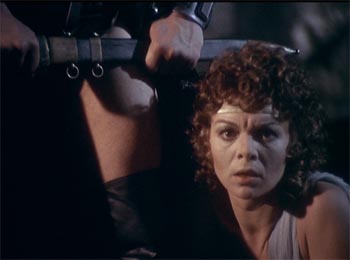
Götz Friedrich’s 1974 film of Strauss’ Salome is a bit of an oddity. It’s a studio film rather than a video recording of a live performance. This allows the casting of singers who might not be able to manage the role in the opera house. In this case, crucially, the light lyric soprano Teresa Stratas sings the title role which she most certainly never did on stage. Continue reading

Lady Macbeth in Florence

Shostakovich’s The Lady Macbeth of the Mtsensk District is becoming quite a staple of the opera repertoire. Even so, I’m still a bit surprised to see a production from the Teatro del Maggio Musicale di Fiorentino making it onto DVD and Blu-ray. It’s a 2008 recording with James Conlon conducting and Lev Dodin directing a mostly Russian cast though with Jeanne-Michèle Charbonnet in the title role.

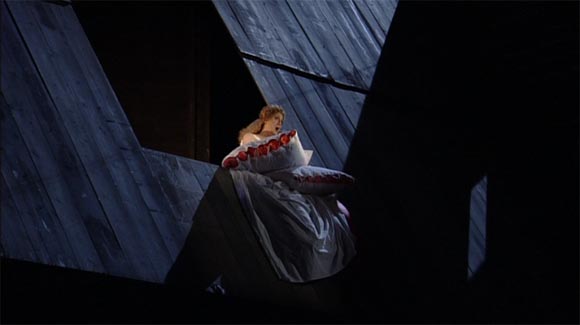
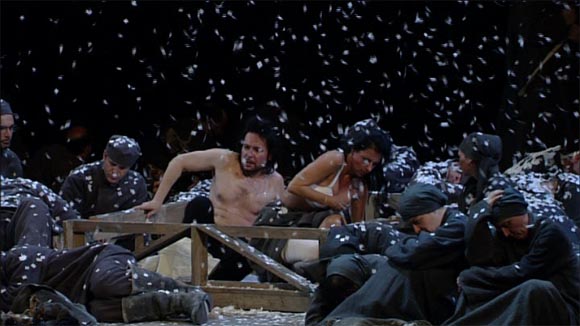
The production is fairly conventional. A wooden set serves variously as the interior of the Izmailov’s warehouse, the police station, some external scenes and, with minor changes, the convict’s camp. There are various galleries and a sort of eyrie that serves as Katerina’s bedroom. The production is not particularly exciting. The seduction/rape in Act 1 is depicted by Katerina’s bedroom light swaying increasingly wildly while a minor character clowns across the stage. It really stays in much the same key until Act 4 where everything goes blue and white and “snow” pours down continuously onto the stage. Sergei and Sonyetka get it on under a big white sheet while the rest of the convicts look on. The push/jump into the river happens so suddenly and unobtrusively that if one didn’t know the plot one might miss it.

Maybe it’s the essential dullness of the production that causes video director Andrea Bevilacqua to take the approach he does, which is highly interventionist. Sometimes we get to see the action more or less as the theatre audience does but often we get extreme closeups or weird angles; backstage, side stage, from the pit, the works. He also indulges in some video trickery. At least I think that’s what’s happening in the scene with Boris’ ghost which is very white and somewhat out of focus. I don’t think the effect could be produced with stage lighting. In Act 4 Bevilacqua also pulls out the fades, dissolves and superpositioned shots. As a video in its own right it is quite interesting. As a record of a stage production it largely fails so whether one likes it or not becomes largely a question of point of view on what a video recording of a live opera performance should be. The disk includes an introductory credits sequence which involves what appear to be black and white portraits of the cast put through Photoshop’s oil painting filter. It really is a taste of things to come.

Musically this is a mixed bag. James Conlon takes an unusually lyrical view of the score and at times his Florentine orchestra sounds almost more like Verdi than Shostakovich. I was sufficiently surprised by his reading of the first act, especially the scene at the end between Sergei and Katarina that I put on the Amsterdam production (Mariss Jansons conducting the Concertgebouw) for a comparison. It’s night and day. Conlon shapes long legato phrases and the percussion is quite restrained. Jansons is strident and staccato with incisive percussion and blaring brass. Jansons sounds much more like the music I fell in love with as a teenager! Conlon is not quite as extreme in the remaining acts but it’s still very restrained Shostakovich. The singing is generally pretty good. The stand out is Vladimir Vaneev as the brutally lecherous father in law. Sergei Kunaev is an adequate Sergei but he’s not terribly charismatic and the chemistry between him and Charbonnet never really gets going. She’s OK too but her vibrato increases with volume and is really quite obtrusive when she’s singing loud.
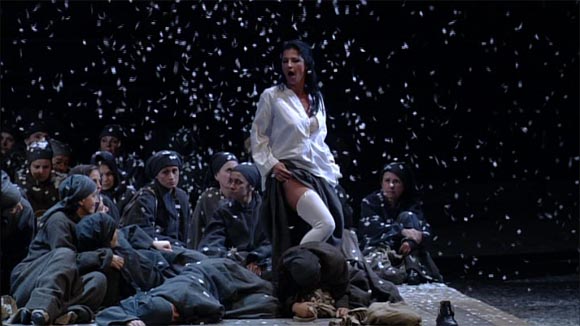
Technically the DVD production is pretty good. It was filmed in 1080i and is generously spread across two DVD9 disks. The picture is comparable with DVD releases from the MetHD series. Sound options are LPCM stereo, Dolby 5.1 and DTS 5.1. As to be expected the DTS track is the best bet. It’s clear, spacious and detailed. The dynamic range seems a bit limited but I think that’s probably the orchestra and the house acoustics rather than a fault in the recording. There are Russian, English, Italian, German, French and Spanish subtitles. There are no extras but the booklet includes casting, a full track listing, a historical essay and a plot synopsis.

People who find the dramatic liberties that Martin Kusej takes with his Amsterdam production really irritating may prefer this. Most people, I suspect, will prefer that version. So I guess I’d better do a full review sometime.