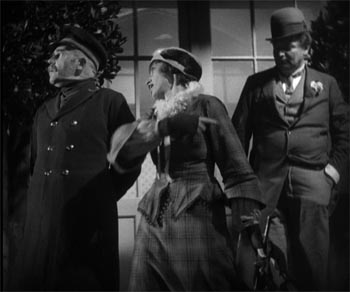
I don’t really know whether the collaborations between Brecht and Weill deserve to be called operas but some of them at least are sung by opera singers and produced in opera houses so I think they are legitimately within the ambit of this blog. Arguably the best known of them all is Die Dreigroschenoper which premiered in Berlin in 1931. I’ve seen it a couple of times in English translation and, like most people I guess, I’m familiar with the music (in both English and German) through recordings by people like Lotte Lenya, Ute Lemper and Robyn Archer. With that background I was very interested to take a look at the 1931 film of the work directed by GW Pabst. Continue reading
Category Archives: DVD review
de Bello Gallico
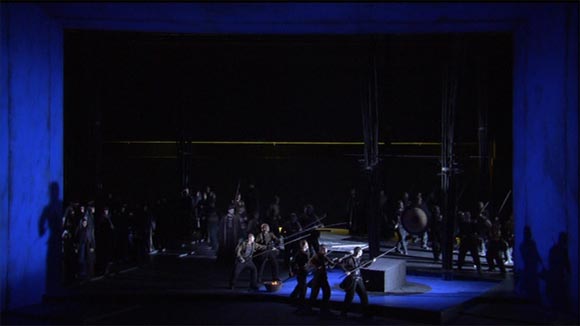
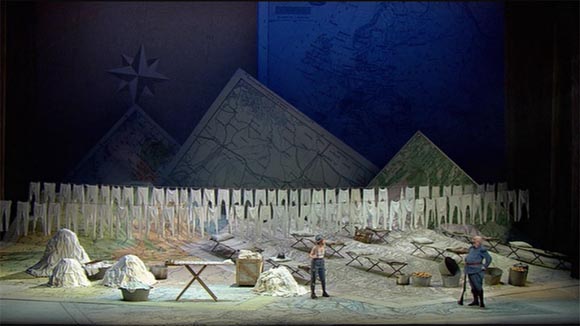
Bellini’s Norma is a tale of illicit love between two Gaulish priestesses (can women be called druids?) and a Roman tribune. In this 2006 production for the Bayerische Staatsoper director Jürgen Rose has set the piece in the present day in a vaguely Middle Eastern setting. Within that framework the story is told quite straightforwardly and there’s no attempt to project some kind of agenda. The designs are very striking. Blue figures a lot. Norma’s home is an underground bunker. When the Gauls arm for war they put on ski masks and supplement their spears with assault rifles. It all looks really good. The acting is also excellent and we get some real intensity in the Norma/Pollione/Adalgisa love triangle and in the tension between Norma and her father Oroveso. It works as drama.
Don Giovanni – choices and futures
This is a continuation of a discussion of how Martin Kušej treats sex in his Salzburg Don Giovanni. The first installment, dealing with Act 1, is here.
At the conclusion of Act 1 the cycle of, at least apparently, consensual kinky sex has been broken by the first clearly non-consensual action; Zerlina has been hunted down by Don Giovanni and forcibly borne off by the sisters of Persephone. Where is this going? Continue reading
Don Giovanni – delusion and collusion
This is a follow up to yesterday’s review of Martin Kušej’s Salzburg production of Don Giovanni. What I want to explore here is how Kušej treats issues of collusion, consent and delusion as it applies to sexual relations.
There are some real problems in updating Don Giovanni. After all, central to the plot is the death in a fight/duel of a man fighting to defend his daughter’s “honour”. Since the notion that female “honour” is a simple matter of pre-marital chastity and post-marital fidelity makes no sense in the setting Kušej has chosen something else has to be seen to be happening. Continue reading
Don Giovanni in the 21st century
After a week of nostalgia wallowing in ancient “productions” from the met and the COC it’s back to Regietheater with a vengeance for the 100th DVD review on this blog. The subject is Martin Kušej’s Salzburg production of Don Giovanni which premiered in 2002 but was recorded in 2006 as part of the M22 project.
For a start there’s nothing giocoso about this dramma. It’s a very bleak and complex production with lots of ideas; some of which work and some of which are more problematic, and it’s provoked more discussion at the Kitten Kondo than just about any other recording we’ve watched recently. Rather than write a 3000 word review I’m going to write a normal length review and follow it up with one or more posts on aspects of the production that seem particularly worth exploring. Continue reading
Joan Sutherland on form
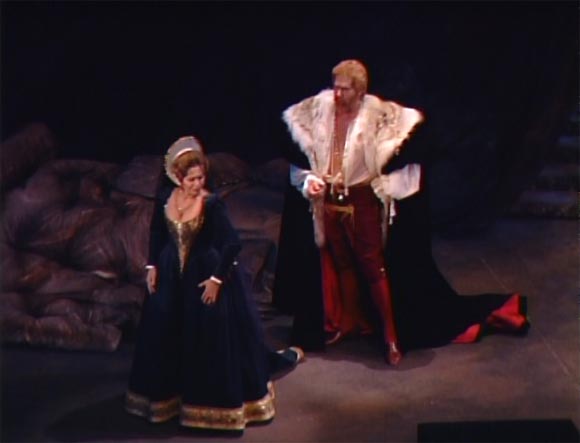
A while back I reviewed the train wreck that is the CBC recording of Joan Sutherland in Norma. Three years later the Canadian Opera Company and the CBC tried again with a recording of Donizetti’s Anna Bolena. As a recording and a production it has its limitations but it’s not a disaster and is enjoyable in many ways.
Kathleen Battle steals the show again
In this next episode of our wallow in Met nostalgia we are looking at the 1988 production of Richard Strauss’ Ariadne auf Naxos. It’s a starry affair with James Levine conducting, Jessye Norman in the title role, James King as Bacchus, Kathleen Battle as Zerbinetta and Tatiana Troyanos as the Komponist. There’s even a bit of luxury casting in the minor roles with Barbara Bonney and Dawn Upshaw among the nymphs. It’s also as old fashioned as one could possibly imagine, being a revival of a production that premiered in 1962. Continue reading
Hockney’s Flute
It seems to be “looking back at older Metropolitan Opera productions” week here in the blogosphere. Over at The Earworm there’s a series of posts on a 1980 production of Don Carlos. Our subject will be the 1991 Die Zauberflöte.
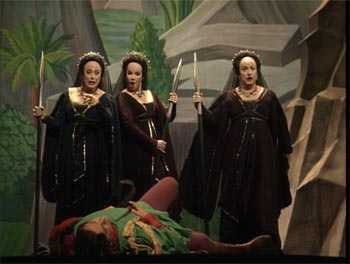
The production was designed by David Hockney and the look varies from the whimsical; the opening scene, to the grandiose; the final scene, with bits of Egyptiana in between. It’s very handsome. The direction is described as “original direction” by John Cox and “direction” by Guus Mostart. I’m not entirely sure what this means as there doesn’t really seem to be a production concept and the Personeregie is pretty basic. Basically it looks like acting is considered to be an optional extra. Some of the singers are good actors and some don’t even try. There’s no consistency. The impression is that the “production” is just a backdrop for the singers to do their thing. Continue reading
There’s the Moral to Draw
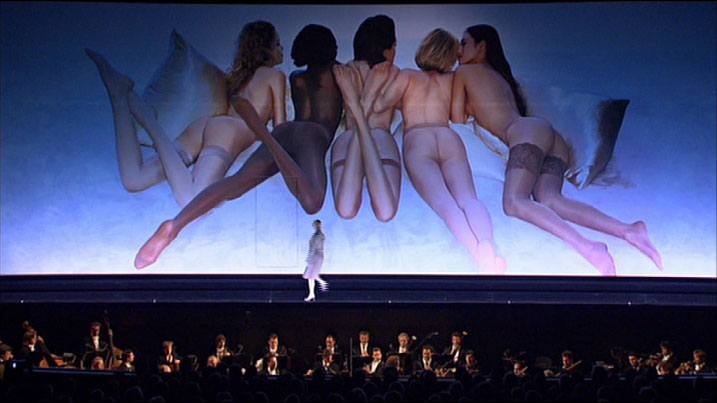
Robert Lepage’s 2007 Brussels production of The Rake’s Progress is fascinating on many levels. I think all good opera productions start with the music and this is no exception. Lepage sees a crucial relationship between Stravinsky at the time the work was written (1948) and film and television. It was an era when insubstantial visual imagery was being supported emotionally by pretty impressive music. Lepage works with that idea; setting the work in the 40s and incorporating film and film making imagery extensively. I think this decision also frees up the music. By taking the piece out of the 18th century it becomes possible to take the 18th century out of the piece. For instance, there are elements in the libretto that mimic 18th century street ballads but Stravinsky absolutely avoids writing the kind of phrasing one might expect and quite deliberately breaks up the line. That phrasing is respected here whereas I have often heard a false legato imposed on some of those phrases. In a way, the production is helping the viewer to hear the music differently which is perhaps the highest compliment one can pay an opera production. There are other intriguing relationships between Lepage’s vision and Stravinsky’s. Lepage sees Stravinsky as playing with time in a cinematic way i.e. rendering it non-linear. Lepage seeks to mirror this in the spatial dimension by using some odd perspectives and some cinema devices; notably Anne driving her car in front of a moving backdrop just like a studio movie of the period. There’s a lot going on and it would be tedious to describe it in detail.
La Fille de Laurent Pelly
Laurent Pelly’s 2007 production of Donizetti’s La Fille du Régiment was a coproduction of the Royal Opera House, The Metropolitan Opera and the Wiener Staatsoper which one make expect to produce a stodgy snoozefest. It’s not. It’s a fast paced, energetic and funny production. There’s nothing especially cleverly conceptual about it but its well designed, well directed and well played. If one were to be hyper critical it would be that the humour in Act 2 is rather laid on with a trowel but it’s not too seriously overdone. The setting is updated from the wars of the first Napoleon to something vaguely WW1 like. In some ways this doesn’t make a whole lot of sense but it does provide a visual “Frenchness” that’s probably easier for modern audiences and, anyway, the libretto as originally written is about as historically accurate as the average piece of bel canto fluff. Best not get into serious military history buff territory and get on and enjoy the show.