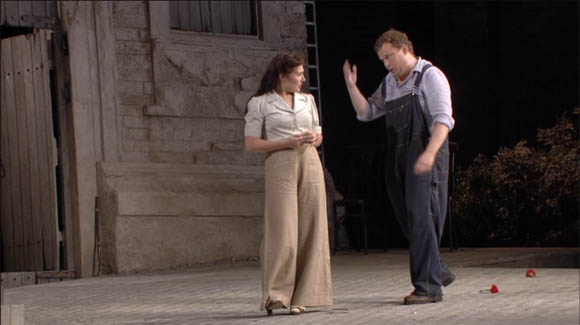
Thomas Allen and Eva Jenis in The Cunning Little Vixen

Once in a while a video recording comes my way that’s just pure delight.  The 1995 recording of Janáček’s The Cunning Little Vixen from the Théâtre du Châtelet is one.  The creative team of director Nicholas Hytner (director), Bob Crowley (designer), Jean-Claude Gallotta (choreagrapy) and Jean Kalman (lighting) created a spectacle that is as much ballet as opera with vivid costumes and simple sets  It’s a rather splendid and touching adult fairy tale. Continue reading

Chacun à son goût

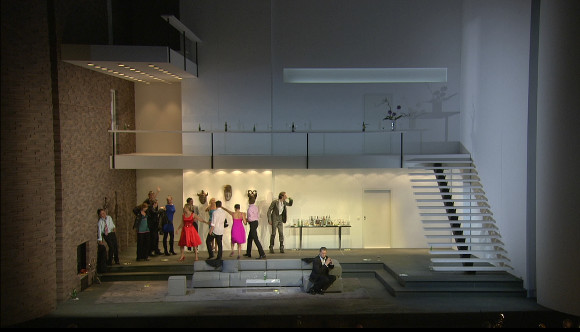
There’s lots to like in the 2003 Glyndebourne recording of Die Fledermaus.  Let’s start with Stephen Lawless’ production.  It’s attractively designed, quite slick and has a few good new gags without going overboard.  The sets are designed with striking diagonals and staircases and gantries.  Rotation is used both as a device to change the setting and as an element in the scene composition.  The overall effect is that the scene changes from drawing room to a sort of “gilded cage” for Orlofsky’s party – which opens out to create space for the action – to a prison with minimum disruption to us or the action.  Spots are used to create stagey effects and at one point Jurowski in the pit ostentatiously upstages the actors on stage.  Lawless never lets us forget this is a “show”.  Continue reading

We’ve already got one you see

Last night I tried to watch Parsifal – The Search for the Grail.  Ostensibly it’s a documentary about the origins of Wagner’s opera and to give it opera cred they roped in one Placido Domingo as narrator.  Valery Gergiev is also involved.  What a load of tosh!  It’s basically a rather weak history of the Grail as portrayed in popular culture complete with Monty Python, Indiana Jones, real Nazis as well as fake ones, pitiful reconstructions of crusader battles and on and on.  Mind numbing cliché follows mind numbing cliché.  Nul points!  What was Domingo thinking of associating himself with this dreck?

Idomeneo at the Met

The 1982 Metropolitan Opera recording of Mozart’s Idomeneo will likely please those who like their Mozart on the well done side.  The story telling is straightforward (though there are some design quirks), the orchestra is big, the tempi are not too sprightly and the vocal talent is starry if not especially Mozartian.  To reinforce this James Levine has made a number of cuts and interpolations from different early performances to structure things a bit more like a grand opera and less like a tragédie lyrique. Continue reading

La Belle Helène in Paris

When I reviewed the 1997 Zurich production of La Belle Helène about a week ago the commentariat was strong in the belief that I should take a look at the 2000 Paris-Châtelet production.  So I did and they were right.  It’s excellent.  It also reinforced my belief that operetta; English, French or German, works best when it’s taken seriously by which I mean using the best available singer/actors, a good director and a top notch orchestra, chorus and conductor.  All of these are in place in this Paris production. Continue reading

Birgit Nilsson’s Elektra

I grew up with the Solti Ring and Nilsson’s Immolation Scene still makes the hair on my neck bristle.  The 1980 video recording of her performance in the title role of Strauss’ Elektra at the Metropolitan Opera really doesn’t have the same effect.  The voice is accurate enough, there’s still a lot of power and the vocal acting is good but somehow the voice seems to have hollowed out and to lack resonance.  Admittedly she’s not helped by the recording which seems to favour the orchestra over the voices fairly consistently.  The other sopranos suffer from the acoustic/recording too but come off better and if Leonie Rysanek really had a high fever it’s not obvious.  Mignon Dunn’s Clytemnestra is also well sung.  The orchestra plays wonderfully for James Levine and gets much better treatment from the sound engineers. Continue reading

Rod Gilfry is Saint Francis

Messiaen’s Saint François d’Assise is an astonishing piece of music theatre and Pierre Audi’s Amsterdam staging of it is equally extraordinary.  There is very little “plot”.  The work consists of eight loosely linked tableaux taken from 16th century accounts of St. Francis’ life and ministry.  There is theology and leprosy and ornithology and it goes on for four and a quarter hours.  It ought not to work but it does.  Continue reading

La cosa vostra?

If you are a fan of bel canto comedies you will probably enjoy the 2009 Glyndeboure production of Donizetti’s L’Elisir d’Amore quite a lot.

Director Annabel Arden sets this bucolic comedy in the Italian countryside of the 1950s (though some of the iconography is more appropriate to the Mussolini period).  It has some of the look, but little of the edge of Italian neo-realist cinema.  It does though take the work fairly seriously with a Dulcamara who is isn’t the obvious quack we usually see but just hints at having real powers.  Dulcemara also acquires a rather bizarre mute assistant.  Beyond that it’s all carefully staged with the chorus action well directed and performed. Continue reading

Existence is futile

I think my good luck run with Offenbach just ran out.  I really didn’t enjoy the 1991 Opéra National de Lyon production of La Vie Parisienne.  The productions of La Belle Helène and Orphée aux Enfers which I reviewed last week were very much performances by operatic forces letting their hair down; comparable, perhaps, to ENO doing Gilbert and Sullivan. The Lyon La Vie Parisienne seems to come out of an entirely different performing tradition. Continue reading

A fun La Belle Helène from Zurich

Having had a lot of fun with the Lyon recording of Orphée aux Enfers I decided to try and track down some more Offenbach operetta and managed to find a Zurich recording of La Belle Helène conducted, perhaps surprisingly, by Nikolaus Harnoncourt.

It’s not perhaps as wildly funny as the Orphée nor perhaps does it have as many memorable tunes but it’s good fun in an undemanding (at least for the audience) sort of way.  The Zurich production, by Helmut Lohner, is painted in pretty broad brush strokes.  The costumes a re very colourful, a bit silly and most have writing on them, much of it, oddly, in English.  The thunder machine is positively Heath Robinsonish.  There’s lots of stage action and fairly silly dancing around.  It’s all very fast paced and doesn’t take itself too seriously despite the sleeve notes leading one to expect more in the way of social satire.  Harnoncourt is obviously having a whale of a time and occasionally gets caught up in the stage action rather as he does in the Salzburg King ArthurContinue reading