Historically informed performance à l’outrance

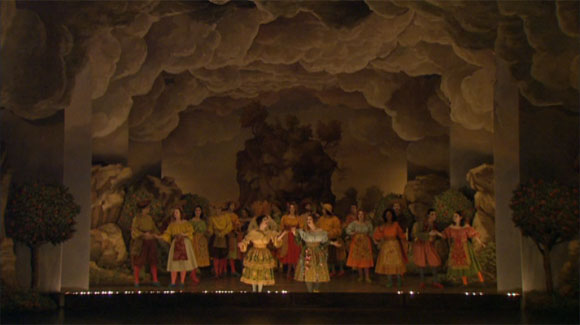
The works of the French baroque are a rather specialized taste.  Some people love them, some not so much.  There are also strong views on performance style.  Some people favour an essentially modern treatment as in Robert Carsen’s Paris Garnier production of Rameau’s Les Boréades.  Others are fans of the fantasy baroque approach taken by the likes of Opera Atelier.  I’ve seen good examples of both approaches.  What I haven’t seen before is a rigorous attempt to recreate a 17th century staging complete with period appropriate scenery and stage effects.  In 2008 such an attempt was made at the Théâtre de l’Opéra Comique in Paris.  The work involved was the first true opera in French; Lully’s Cadmus et Hermione.  The results are very interesting.

Continue reading

Tcherniakov’s Gambler

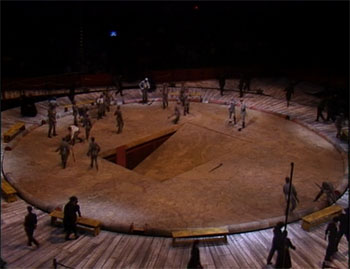
So I finally found a way of getting the Kultur release of the 2008 Staatsoper unter den Linden production of Prokofiev’s The Gambler to work, with subtitles and all, though I had to go to my back up DVD player.  As you will read below this is a very interesting and worthwhile DVD but whatever you do, don’t buy the Kultur release which is technically wonky and features sub-standard Dolby 2.0 sound.  For heaven’s sake who is doing Dolby 2.0 on an opera DVD in 2008!  The same recording is available on regionless DVD and Blu-ray from C-Major and in that release it features PCM 5.1 and LPCM stereo choices.  There may even be some useful documentation which, as ever with Kultur, is minimal.  There are also more subtitle choices on the C-Major version.

Continue reading

Maria’s Carmen

In 1989 entrepreneur Harvey Goldsmith followed up his Aida of the previous year with a spectacular production of Bizet’s Carmen in the amphitheatre at Earl’s Court.  This is a sports stadium like venue that seats 19,000 and a cast of 400 or so singers, dancers and supers was employed.  The production was revived in 1999 when It was broadcast by Tyne-Tees Television and has been available on DVD ever since.  Continue reading

Ice and Steel

Vladimir Deshenov’s 1929 opera Ice and Steel, based (loosely) on the Kronstadt sailors’ revolt of 1921 isn’t very good but it is of some interest as one of the very first Soviet era works for the operatic stage.  The libretto, by Boris Lavrenjov, is so crude it might be project work for GCSE Stalinist Propaganda.  In the first act black marketeers and sundry other anti-socials are rebuked by sound workers and the political police.  Next we move to grumbling factory workers who are, again, rebuked by the politically sound ones  news of the Kronstadt rising reaches Petrograd and a rather dodgy looking commissar recruits the loyal workers to help put down the rising.  The one character with any real individuality, Musja, a female organizer in a metal works, volunteers to infiltrate the mutineers.  Meanwhile a really motley band of counter-revolutionary elements; SRs, a Mensheik, foreign agents, Tsarist officers, a çi devant aristo vamp and anarchist sailors, argue among themselves in the fortress.  Musja is unmasked and tortured as a spy but as the Soviet infantry launch their famous attack across the ice she manages to blow up the key defensive position and herself.  Cue heroic revolutionary tableau vivant and curtain.

Continue reading

Assassinio nella Cattedrale

I’ve often wondered what happened to Italian opera after Puccini because nothing much has ever come my way.  That is until today when I got my hands on a DVD of Pizzetti’s 1958 piece, Assassinio nella Cattedrale which is closely based on the Eliot play.  Murder in the Cathedral is, when one thinks about it and how Eliot uses the chorus, a really good basis for an opera libretto.  The libretto sticks pretty close to the play and Pizzetti provides a tense, dramatic score which brings out the underlying fear and tension in the Eliot.  Just occasionally, and very effectively, he becomes more openly lyrical, as in Becket’s acceptance of his impending martyrdom, but mostly it’s pretty high energy.  That said, Pizzetti seems to be quite a conservative composer and the music is essentially tonal and easy to grasp.  One curiosity I noted is that in the lead up to Becket’s death he interweaves the men’s chorus singing the Dies Irae with the forebodings of the women’s chorus and the setting of the Dies Irae he uses is the same as in Bergman’s Seventh Seal which came out the year before.

Continue reading

Tancredi in Schwetzingen

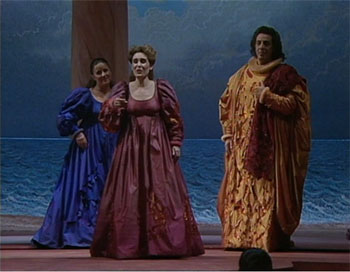
Rossini’s Tancredi isn’t performed particularly often but it was Stendhal’s favourite opera and it’s not hard to see why both these things are true.  It’s got some really lovely music but the plot is pretty thin and it’s hard to cast.  It needs a very versatile low mezzo/contralto for the title role and a crackerjack soprano and tenor too.  I watched it in a well cast 1992 production from the Schwetzingen festival and enjoyed it despite some frustrations with the staging and the implausibly drawn out plot of the second act.  Continue reading

Turandot in the Forbidden City

Being an opera lover would probably be easier if I liked Puccini more, given how much air, DVD and stage time his works get, but I really struggle with him.  I think it’s that concepts like “subtlety”, “elegance”, “verisimilitude” and “cultural sensitivity” completely passed him by.  In an Italian setting his bombast and melodrama are somewhat made up for by the catchy tunes but move him to China or Japan or the United States and my ability to override my reality chip fails me.  Which is a long winded way of saying Turandot is not my favourite opera.

Continue reading

Patchy Zauberflöte from Ludwigsburg

The Gramophone Guide describes the 1992 Ludwigsburg Festival production of Die Zauberflöte as a “life-enhancing experience” so I thought I’d take a look.  I think the folks at The Gramphone Guide are rather over-egging it but it is a pretty decent production.  It’s very much geared to Ludwigsburg’s small stage and limited scenery handling capacity but it makes good use of the space and clever lighting, including a willingness to black out the stage, and some deft stage craft make up for the limitations. Continue reading

22 minutes of Monteverdi

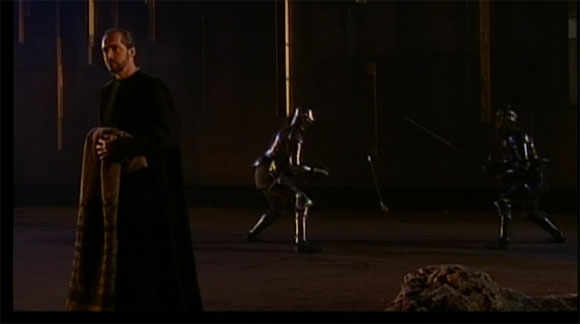
Monteverdi’s Il combattimento di Tancredi e Clorinda must be, at twenty two minutes, one of the shortest operas around.  In typical Monterverdi style though it crams a lot of music and emotion into a very short space.  Based on a story by Torquato Tasso, it concerns a Christian knight, Tancredi, and a Moorish princess, Clorinda.  Somehow they have managed to fall in love but are still fighting on opposite sides  They meet on the battlefield but as each has their visor down they don’t recognize each other.  They fight a long and bloody single combat in which Tancredi mortally wounds Clorinda.  When their helmets are removed they recognize each other and Clorinda asks Tancredi to baptize her so they can be united in heaven.  It’s pretty dodgy theology but great theatre.

Continue reading

Netrebko and Villazon in Manon

Massenet’s Manon is a glitzy 19th century set piece. It’s very French and very much a star vehicle.  In this 2007 production from the Staatsoper Unter den Linden, director Vincent Paterson’s decides to to stage it in the 1950s and make Manon somewhat cinema obsessed, in a narcissistic way, which works rather well.  It’s a self consciously glitzy affair with a bright gold curtain and technicians with Klieg lights following Manon much of the time.  Even the “squalid” bits are treated with glamour.  The only jarring element, deliberately I guess, is the use of giant reproductions of 19th century paintings as backdrops; notably Liberty Leading the People in Act 3.

Continue reading