Frock Opera

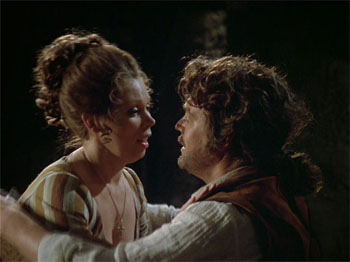
Giordano’s Fedora is a sort of apotheosis of the 19th century Italian opera.  It’s a melodramatic love story in an aristocratic Russian setting.  There is murder and suicide and plots and a dead mother and brother.  The music is dramatic, even bombastic, when the mood suits but finds time to give showpiece arias for the principals.  There is not a single idea in libretto or score that could give anyone an uncomfortable thought.  The Metropolitan Opera’s 1996 production by Beppe di Tomasi builds on this by playing it dead straight and setting it in a series of suitably opulent settings complete with extravagant frocks.  The cherry on the already rather rich cake is casting Placido Domingo as Loris Ipanoff and Mirella Freni as Fedora Romazoff.  I imagine it’s many people’s idea of the perfect night at the opera   In it’s way it’s the polar opposite of, say, Bieito’s WozzeckContinue reading

A rather straightforward Cenerentola

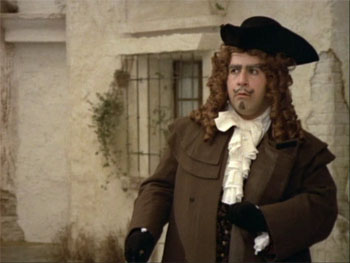
Rossini’s La Cenerentola takes almost three hours to tell a very straightforward version of the Cinderella story.  Generally directors, despairing of the this, either camp it up (for example the Els Comediants production seen, inter alia, in Houston and Toronto in recent years) or they try to find a few more layers of meaning as in Ponnelle’s film version.  Michael Hampe does neither in his 1988 Salzburg production, preferring to tell the story as a straightforward morality tale.  I guess if one really loves the music and it’s really well sung this could work but, ultimately, I found it rather dull.  Continue reading

Pulp Figaro

Today’s Ponelle production is the 1976 Le Nozze di Figaro.  It has the starriest cast of any of the Ponelle films I’ve seen to date; Herrman Prey in the title role, Mirella Freni as Susanna, Kiri Te Kanawa as the countess and Dietrich Fischer-Dieskau as the count.  It even, rather bizarrely, has Maria Ewing as Cherubino.  To round things out Karl Böhm conducts with the Wiener Philharmoniker and Staatsopernchor.  As we shall see, musically it lives up to the casting.   Continue reading

Superbly sung Butterfly with Mirella Freni and Placido Domingo

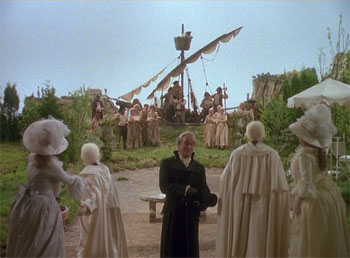
Continuing the Jean-Pierre Ponnelle marathon we come to his 1974 film of Puccini’s Madama Butterfly with Mirella Freni in the title role and a young Placido Domingo as Pinkerton.  Musically this is the most satisfying of the Ponelle productions I’ve yet come across.  Freni is superb.  Radiant is not too strong a term,  Domingo sings pretty much as well (we’ll come to points of dramatic interpretation later) and the supporting cast is flawless.  There’s some serious luxury casting here with Christa Ludwig as a superb Suzuki.  Robert Kerns is an excellent Sharpless and Michel Sénéchal equally good as Goro.  Herbert von Karajan conducts.  He tends to go for sheer beauty of sound rather than maximum drama but what beauty of sound!  The soloists are wonderfully backed up by the Wirner Philharmoniker and the Staatsopernchor.  Continue reading

In which I fail to ‘get’ dubbed opera films

I’ve reviewed a fair few films of operas on this blog. They have all been of a kind where a director rehearses a cast they record the opera in the studio and then film a lip synched version either on set or on location. There are also films where the opera is recorded in the studio thenan entirely different cast mimes the opera on location. Petyer Weigl’s 1988 film of Tchaikovsky’s Eugene Onegin comes into this category.  It started life as a perfectly normal studio recording and then Weigl filmed it on location, presumably in Russia, and in the process cut nearly a quarter of the music.  The approach doean’t work for me.  However good the film actors are, they look like film actors miming someone else and in so doing much of the interpersonal drama is lost.  The result is that it’s like listening to the CDs with eye candy.  Continue reading

Alfano’s Cyrano with Domingo and Radvanovsky

It’s hard to think of a play that would make a better basis for an opera libretto than Edmond Rostand’s Cyrano de Bergerac.  Henri Cain’s adaptation is rather good; somewhat simplifying and tightening up the plot in a similar manner to that later taken by Britten and Pears with A Midsummer Night’s Dream. It’s a shame Franco Alfano’s music doesn’t really rise to the same heights.  It has its moments, especially later in the opera, but much of the time it’s dull and impressionistic; more like a film soundtrack than an opera score.  I guess the lesson is that one just can’t do verismo while trying to avoid vulgarity and excessive melodrama.  It also has to be said that much of the time the music seems to be fighting the natural rhythm of the words rather than supporting it.  What the music does have is Alfano’s trademark torturing of his singers, especially the principal four roles of Cyrano, Roxane, Christian and De Guiche.

Continue reading

Cartoonish barbiere

So following on from Jean-Pierre Ponelle’s last film we now turn to one of his earliest, a 1972 version of Rossini’s Il barbieri di Siviglia.  It’s based on his production for La Scala but is, as usual with Ponelle, studio recorded and shot in the studio with lip synching.  It’s not an especially interesting production but it does have a starry cast including Hermann Prey in the title role.  Continue reading

Artificial and cruel Così

In 1988 Jean-Pierre Ponnelle made the last of his lip synched opera films; Mozart’s Così fan tutte.  It carries Ponnelle’s trademark “artificialityeven further than in other of his films that I have seen.  The sets, the costumes, the acting and the camera work never let us forget that this is a work of the, in the director’s words, “greatest artificiality”.  It also becomes increasingly clear as the piece progresses that Ponnelle has a very clear idea of what “the opera is about”.  Continue reading

Monteverdi’s L’Orfeo at the Liceu

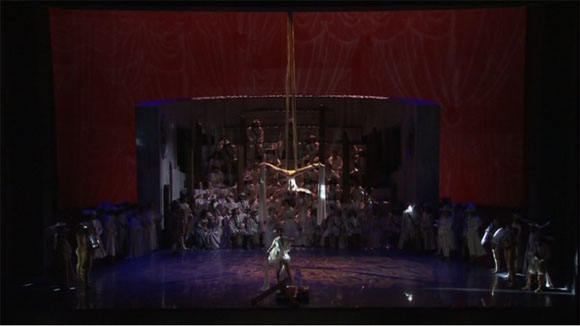
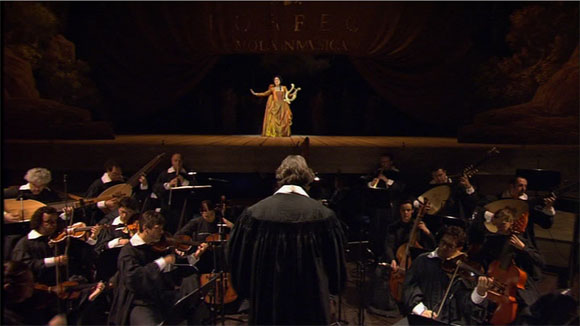
Director Gilbert Deflo was inspired by the Hall of Mirrors in the ducal palace in Mantua, scene of the first performance of Monteverdi’s L’Orfeo, to try and create something similar for the much larger Gran Teatre del Liceu in Barcelona.  The result is an almost extreme HIP approach.  Sets, costumes, acting and singing style are all what we have come to expect from HIP performances of baroque works.  In this case even the conductor and orchestra wear period dress which is quite effective as conductor Jordi Savali looks remarkably like Monteverdi.  For reasons I don’t understand though the lighting plot is one that could never have been realised with baroque forces.  To further advance the “hall of mirrors” idea Deflo makes quite a lot of use of mirrors on stage reflecting the house back on itself which doesn’t really come off on video but I imagine, based on my experience with the COC’s staging of Semele, that it could work well if one was in the right part of the theatre.  There’s also a fair amount of characters entering via the auditorium including a dramatic entrance for Savali as the brass and percussion play the opening toccata from stage boxes.

Continue reading

Ponelle’s Cenerentola

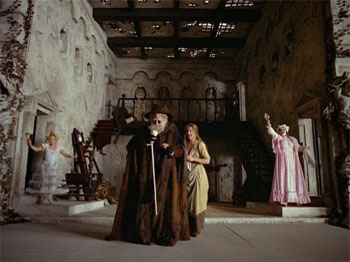
There’s been a fair amount of discussion of Jean-Pierre Ponnelle’s film version of Mozart’s La Clemenza di Tito over at The Earworm so I thought it would be a good time to dig out his La Scala production of Rossini’s La Cenerentola.  They have a lot in common; an obsession with statuary and heavy focus on verticality that makes the picture often seem taller than it is wide are just two.  The Rossini, despite being filmed at La Scala is very filmic.  It’s much more like a movie than a video recording of a staged performance.  Continue reading