Calixto Bieito has a reputation as one of opera’s “bad boys” but there is nothing particularly shocking about his production of Carmen filmed at Barcelona’s Liceu in 2011. The action is updated to maybe the 1970s (there’s a phone box and a camera that uses film) and there are lots of cars on stage. For Bieito, this is a story of people living on the margins where sex is a commodity that women use as a trade currency and where violence, especially toward women, is endemic. It’s enough to disturb, as this piece did its original audience, without being gratuitous.
Category Archives: DVD review
Et in Bohemia ego
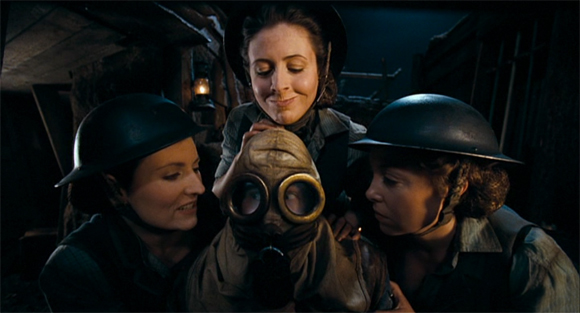
It’s a curious fact that two of the three most popular operas; Verdi’s La Traviata and Puccini’s La Bohème, are about women dying from tuberculosis. It’s also curious that they are almost always presented as frothy escapist fantasies in which Death makes his appearance only in the tear jerking finale. It’s very curious because Death stalks the libretto of both operas, albeit usually well hidden behind brocade, champagne and Christmas decorations. In 2005, at Salzburg, Willy Decker broke with convention and made Death an explicit actor in La Traviata creating the famous red dress production that has even been seen at that bastion of conservatism the Metropolitan Opera. In 2012 Stefan Herheim did something similar for La Bohème in Oslo.
Branagh’s Flute
It’s beginning to look like Keneth Branagh’s 2006 film of The Magic Flute will never be shown in Canadian cinemas and so, when I saw it on amazon.ca for $7.24 I couldn’t resist. Perhaps I should have.
Another Ulisse
William Christie and Les Arts Florissants recorded Monteverdi’s Il ritorno d’Ulisse in patria in Aix-en-Provence, five years before their Madrid recording. The Aix production was directed by Adrian Noble and featured real life couple Kreśimir Śpicer and Marijana Mijanović as Ulisse and Penelope.
Not especially magical flute
William Kentridge’s La Scala production of Die Zauberflöte is mainly notable for its use of black and white projections. The intention, apparently, is to tell the story as seen by, or even as seen inside, a Victorian camera. In places this works rather well but at times it’s quite hard to figure out what is actually going on. Whether it was that hard to read in the theatre I can’t say. Video recording projections is really hard and i have a lot of sympathy with Patrizia Carmine who video-directed here. The film of a play of a film thing is really difficult to capture remotely faithfully.
Ercole amante
Cavalli’s Ercole amante was written for the wedding of Louis XIV to Marie-Thérèse, a Habsburg princess. The marriage itself being the seal on the French victory over Spain in the war that had lasted until 1659. It’s an odd work considering. It’s not nearly as weird as, say, Il Giasone or La Didone but it’s hardly what one would expect for the nuptials of Le Roi Soleil. It’s clear from both the Prologue and the ending that Ercole is Louis but he’s also a most unlikeable character. In this version of the Hercules story he’s in love with his son’s (Hyllo) girlfriend (Iole) and will stop at nothing to bed her including casting off his wife (Deianira), imprisoning his son and bumping off Iole’s father. In the end he’s attacked by the spirits of various people he has wronged before succumbing to the trick with the centaur’s poisoned shirt. He’s made immortal and paired off with Hebe in the heavens but it’s hardly a tale of kingly virtue or marital fidelity. For good measure, along the way a good chunk of the Graeco-Roman pantheon make an appearance.
Grimes on Blu-ray
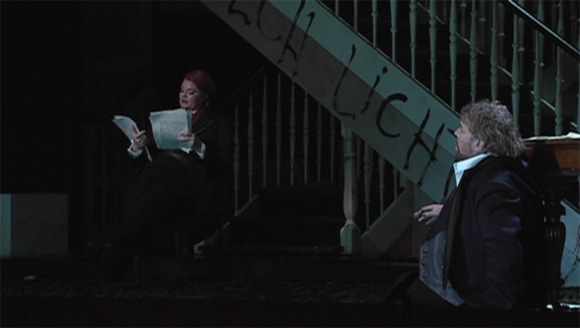
There is, finally, a recording of Britten’s Peter Grimes on Blu-ray. It’s a Richard Jones production with a largely British cast, recorded at La Scala in 2012. The sound and picture quality are first rate. Unfortunately the production and performances aren’t so much.
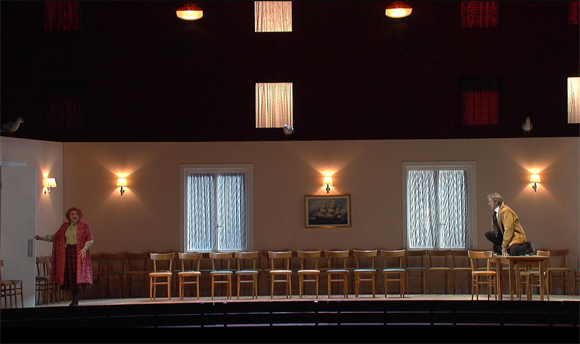
Richard Jones has chosen to set the piece in the 1980s and to portray the inhabitants of the Borough as a sort of inbred hive mind fuelled by prejudice, alcohol and drugs. Actually it’s not a bad concept but it comes off as exaggerated with cast and chorus repeatedly making more or less coordinated middle aged disco moves. He also portrays the nieces as the sort of permanently stoned bubble heads one wants to avoid on the last train home. There are some neat touches. The Moot Hall, The Boar and Grimes’ hut are all formed by box like spaces that are tilted and rotated to good effect. The lighting is effective too. Unusually for a modern production Jones doesn’t provide any staging for the interludes, leaving the theatre dark with the curtain down. Overall, it’s a production I’d want to take a second look at but I suspect it’s just painted too broadly to be really effective.
Elegant and Powerful Ulisse
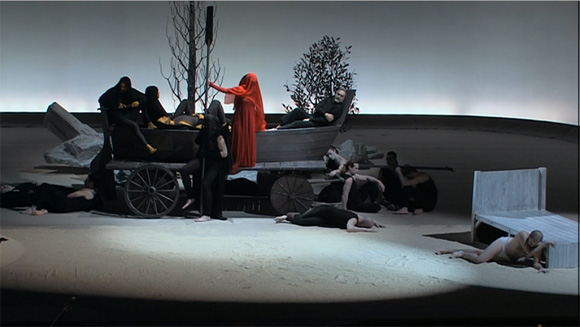
Monteverdi’s Il ritorno d’Ulisse in patria hasn’t proved as popular as his other late work L’incoronazione di Poppea but, given as compelling a performance as it got at the Teatro Real, it’s a bit hard to see why that is. On this 2007 recording we have an elegant and interesting production by Pier Luigi Pizzi, an excellent cast headed by Kobie van Rensburg and Christine Rice and the incomparable William Christie and his Les Arts Florissants. It’s a compelling package.
From the House of the Dead
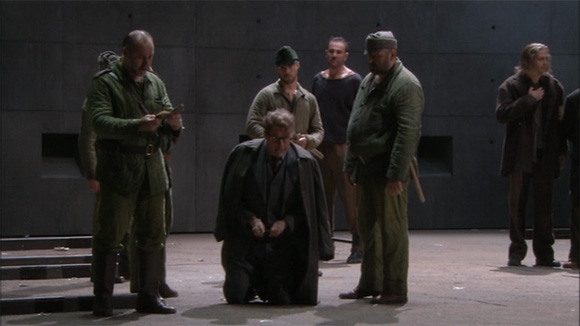
Janáček’s last opera, From the House of the Dead, is a curious piece. It sets certain episodes from Dostoevsky’s account of his life in prison into a collage of stories that doesn’t have a straightforward narrative arc at all. It’s quite brutal, as one might expect, and very male dominated. Few characters stand out as individuals and so the piece becomes very much an exercise in ensemble musical theatre. The music is unusual too. In Pierre Boulez’ words it is “primitive”. Certain phrases are repeated over and over with minimal development to create a sort of “expressionist minimalism”. It’s extremely interesting to listen to and a great sonic match for the brutal and repetitive nature of prison camp life.
Perplexing Tannhäuser
In Kasper Holten’s production, recorded at Royal Danish Opera in 2009, Tannhäuser is a poet torn between family and the conventional world of the Landgraf’s court and his creative processes symbolized by Venus and Venusberg. There are numerous visual clues that perhaps we are even supposed to identify Tannhäuser with Wagner himself. Far from being a young man, this Tannhäuser is middle aged, married to Eizabeth and has a son. He has withdrawn into a psychological world of his own and Venus, his muse, and Venusberg are in his imagination. Only after death is he recognized as a genius. Of the rest, how much is supposed to be external and how much internal to Tannhäuser’s imagination is a bit hard to grasp. If nothing else it goes some way to making the sixty year old Stig Andersen as Tannhäuser and the equally mature Susanne Resmark as Venus almost believable. The 1900ish setting works quite well for the sexually repressed court of the Landgraf von Thüringen though a chorus of pilgrims returning from Rome in full evening dress is a bit of a jar. The concept is quite interesting but really probably stretches further than the libretto can accommodate. This Venus isn’t remotely credible as a goddess of love and the matronly Elisabeth singing about being a pure, young maiden is just odd.