Deborah Warner’s entry point to Purcell’s Dido and Aeneas is the, almost certainly apocryphal, story about it premiering in a girls’ boarding school. At various points in the action we get a chorus of schoolgirls in modernish uniforms commenting silently on the action. They are on stage during the overture, are seen in dance class during some of the dance music and queue up for the Sailor’s autograph. It’s quite touching and adds to the pathos of the basic, simple, tragic story. Warner also adds a prologue (the original is lost). In Warner’s version Fiona Shaw declaims, and acts out, poems by Ovid/Ted Hughes, TS Eliot and WB Yeats. These additions aside the piece is presented fairly straightforwardly in a sort of “stage 18th century” aesthetic. The witch scenes are quite well handled with Hilary Summers as a quite statuesque sorceress backed up by fairly diminutive (and, for witches, quite cute) Céline Ricci and Ana Quintans. Their first appearance is quite restrained but they go to town quite effectively in their second appearance.
Category Archives: DVD review
David McVicar’s Die Meistersinger
David McVicar chooses to set his production of Die Meistersinger, staged at Glyndebourne in 2011, in the 1820s or thereabouts. It’s an interesting choice as it puts German nationalism in a specifically cultural rather than political context and also rather clearly makes the point that “foreign rule” = “French rule”. That said, he really doesn’t develop any implications from that and what we get is a production typical of recent McVicar efforts. There’s spectacle aplenty and very good character development but he doesn’t seem to have any Big Ideas; for which, no doubt, many people will be grateful. The only place he seems to go a bit overboard is in laying on some fairly heavy German style humour. People who think that slapping waitresses on the bottom is the height of comedic sophistication will probably appreciate it.
Flute of death and life
It’s hard to fault any aspect of the new recording of Mozart’s Die Zauberflöte recorded earlier this year at the Baden-Baden festival. The soloists are consistently good, and in some cases very good indeed, Simon Rattle is in the pit with the Berlin Philharmonic and Robert Carsen’s production is beautiful to look at and thought provoking without being pointlessly provocative. Add to that first rate video direction and superb Blu-ray sound and picture quality and one has a disk that looks competitive even in the very crowded market for Zauberflöte recordings.
Beyond pale
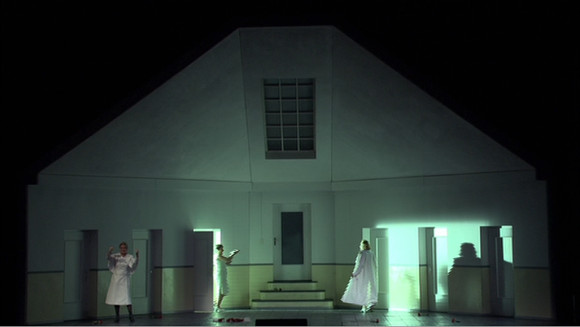
Paul Dukas’ Ariane et Barbe-bleue is a setting of a libretto by the symbolist poet and playwright Maeterlinck. It’s roughly contemporary with both Debussy’s Pelléas et Mélisande and Strauss’ Salome. It shows. It really is a product of a particular fin de siècle world view. Like Debussy’s piece, Ariane is loosely based on a folk tale. In this case it’s the gory story of Duke Bluebeard and his six wives but here it’s curiously etiolated. It’s as if Maeterlinck is reacting to the ultra-realism of, say, Zola, by retreating into a strange inner world. It’s not even the troubled inner world of Freud or Jung either. It’s colourless (and we’ll come back to that). All this is reinforced by Maeterlinck’s style of telling rather than showing. Much of what “action” there is takes place off stage and is narrated by the on stage characters. Both words and music are used to fill in the gaps.
Woe unto him who conceals deserts
Wolfgang Rihm’s Dionysos is described by him as “eine Opernphantasie”. It certainly isn’t an opera in the conventional sense lacking, as it does, anything resembling a plot. It’s a staged setting of poems by Nietzsche written just before his final descent into madness (if one considers that’s not where he was from the start!). Rihm conceives this as four scenes each dealing with a different “element” in Nietzscean terms. The four are Water, a scene set on a lake; Air, a mountain scene; Intimate Space, a scene in a brothel; and Public Space, set in a town square. So, episodic and linked only by a certain kind of mood and the characters. The weight of the piece is carried by “N”, a baritone role. he interacts variously with a amle guest who doubles as Apollo and a high soprano who doubles as Ariadne. In addition there is a trio of ladies; high soprano, mezzo, contralto, who play various roles from pseudo Rhinemaidens to tarts.
Petitbon’s Lulu
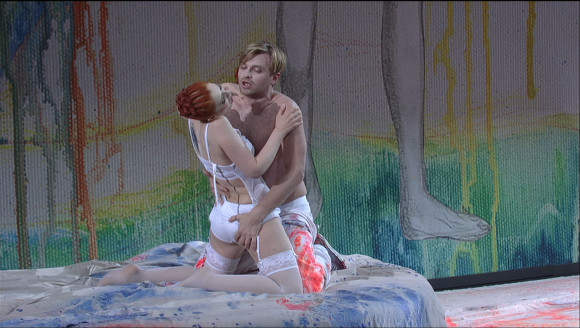
Vera Nemirova’s production of Berg’s Lulu was recorded in the Haus für Mozart at Salzburg in 2010. It’s presented in the now conventional three act version completed by Friedrich Cerha. The sets are painterly, including in Act 1 a giant painting of the title character. Lighting is used to create a very distinct palette for each scene and the detailed direction of the actors is careful and effective. I didn’t see any big ideas but then on this video recording, if there had been any, they would likely have been lost in the incessant close ups and strange camera angles. One “trick” perhaps is that much of the action in Act 3 Scene 1 takes place in the auditorium with a fair bit of confusion as the actors hand out fake cash to the punters. This is, of course, the scene where the glitterati go broke so perhaps some irony is intended.
Die Soldaten
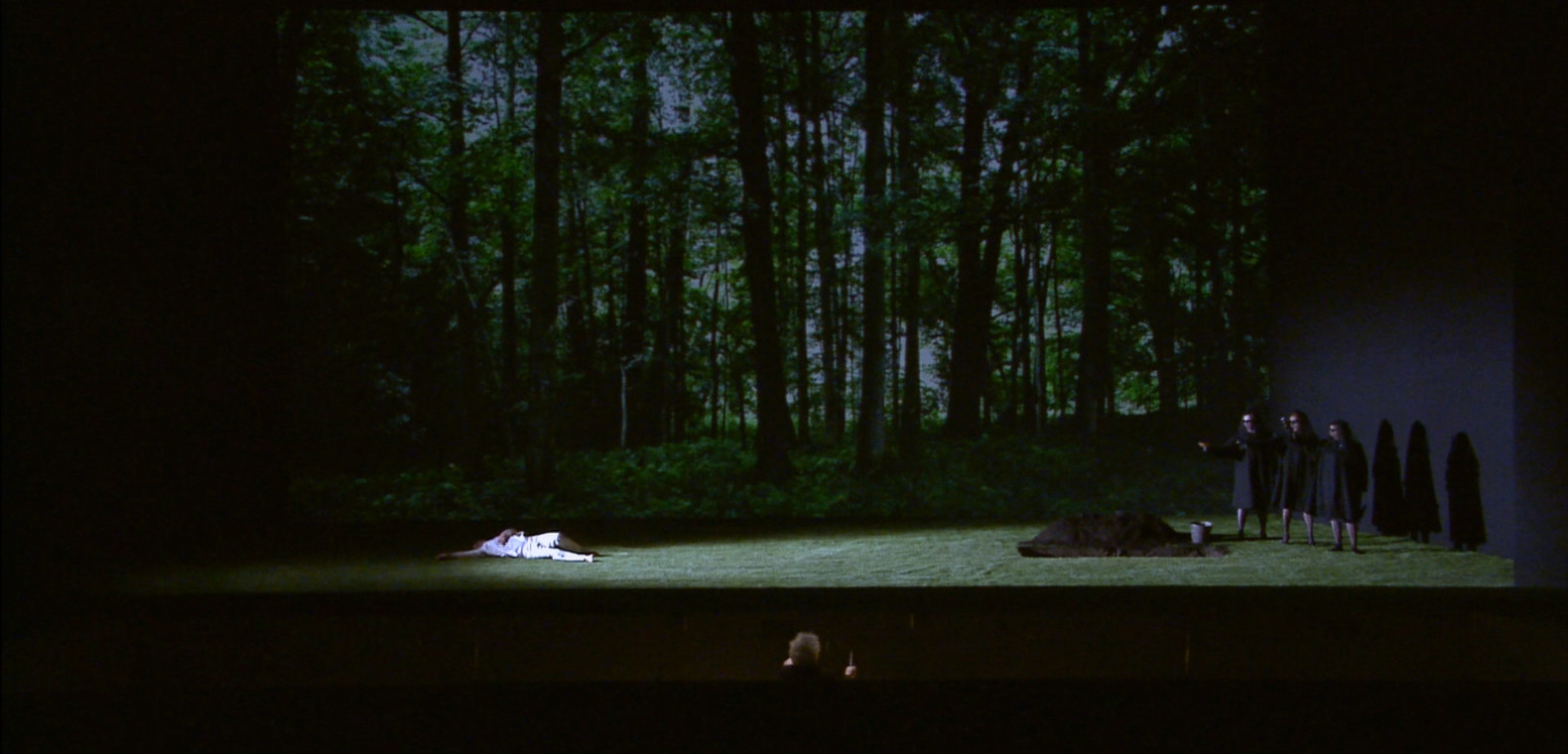
Berndt Alois Zimmermann’s Die Soldaten was something of a sleeper hit at the 2012 Salzburg festival and is now available on DVD and Blu-ray. It’s a peculiar work. It’s very episodic and requires massive forces. There are 16 singing and 10 non-singing roles, a 100 piece orchestra, a jazz band and more. At Salzburg the scale was magnified by staging it in the Felsenreitschule, using the full 40m width and enormous height of the stage. I’ve included some full stage shots in the screen caps to give an idea of how huge this all is. They can be expanded to full size Blu-ray caps (roughly three times the size of the image in the review).
Orlando Paladino
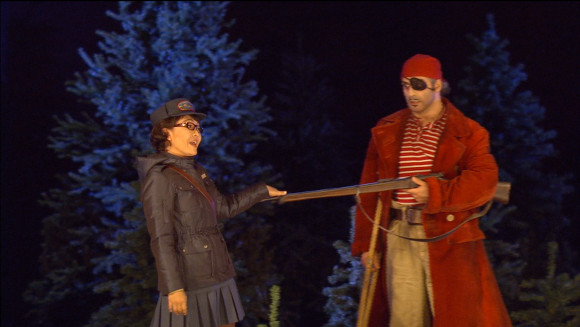
Haydn’s Orlando Paladino is a “heroic comedy” based, of course, on Ariosto. In this version Angelica, queen of Cathay, and her lover Medoro have fled to a remote castle to get away from Orlando who is in love, of course, with Angelica. There’s a shepherd and shepherdess, a sorceress, a squire and Rodomonte, the king of Barbary thrown into the mix and various misadventures ensue until the sorceress, Alcina, dips Orlando into the waters of Lethe causing him to forget being in love with Angelica and it all ends happily. There are also a bunch of non-singing characters who, I think represent the “dangerous” people of this remote country. For reasons I haven’t quite fathomed they include a bishop and a bearded air hostess.
Cunning Little Vixen short on magic
The 2009 Florence recording of Janáček’s The Cunning Little Vixen is bright, colourful, straightforward and fun but it doesn’t quite have the magic of the older Théâtre du Châtelet version. Laurent Pelly’s production is quite straightforward with attractive sets and costumes and interesting choreography from Lionel Hoche.
In fair Verona, where we lay our scene
Where better to record a production of Gounod’s Roméo et Juliette than in the spectacular Arena at Verona? The productio, dircted by Francesco Micheli with sets by Eduardo Sanchi and costumes by Silvia Aymonino, is as spectacular as the setting and also quite weird in a space opera sort of way, The characters wear huge collars and are colour coded; Yellow for the Montagues, red for Paris and his entourage and blue for the Capulets. Only the non-feuding characters escape this schema notably, of course, the two lovers and Friar Lawrence. There are also lots of colourful cage like structures that character pop in and out of or sing from and a huge chorus and crowd of supers flow all over the vast space. It’s amazing to look at and actually suits a straightforward telling of the story quite well.